


















At sunset, the western edge of Madrid was the wrong color. Instead of the city’s familiar golden light, a gray-pink haze hung above an artificial lake — the residue of wildfires moving through parched forests only a short drive from the capital.
The acrid smell reached deep into the park. People stopped exercising because their throats burned. Older residents wore surgical masks outdoors. Even after the smoke began to thin, the taste of ash lingered in the air. For a city accustomed to treating climate disasters as news from elsewhere, danger had become physical.
Madrid has spent recent years in a state of expansion. Investment, tourism, wealthy foreign residents, new restaurants and cultural projects have reinforced the image of a European capital rising quickly in wealth and influence. The fires punctured that protective bubble, showing that economic success does not create a separate climate.
In Daycom’s assessment, the disaster’s significance lies not only in the forests and homes already lost. The flames brought to Spain’s political and financial center a reality that rural communities have faced for years: extreme heat, desiccated land and a fire season with no stable boundaries.
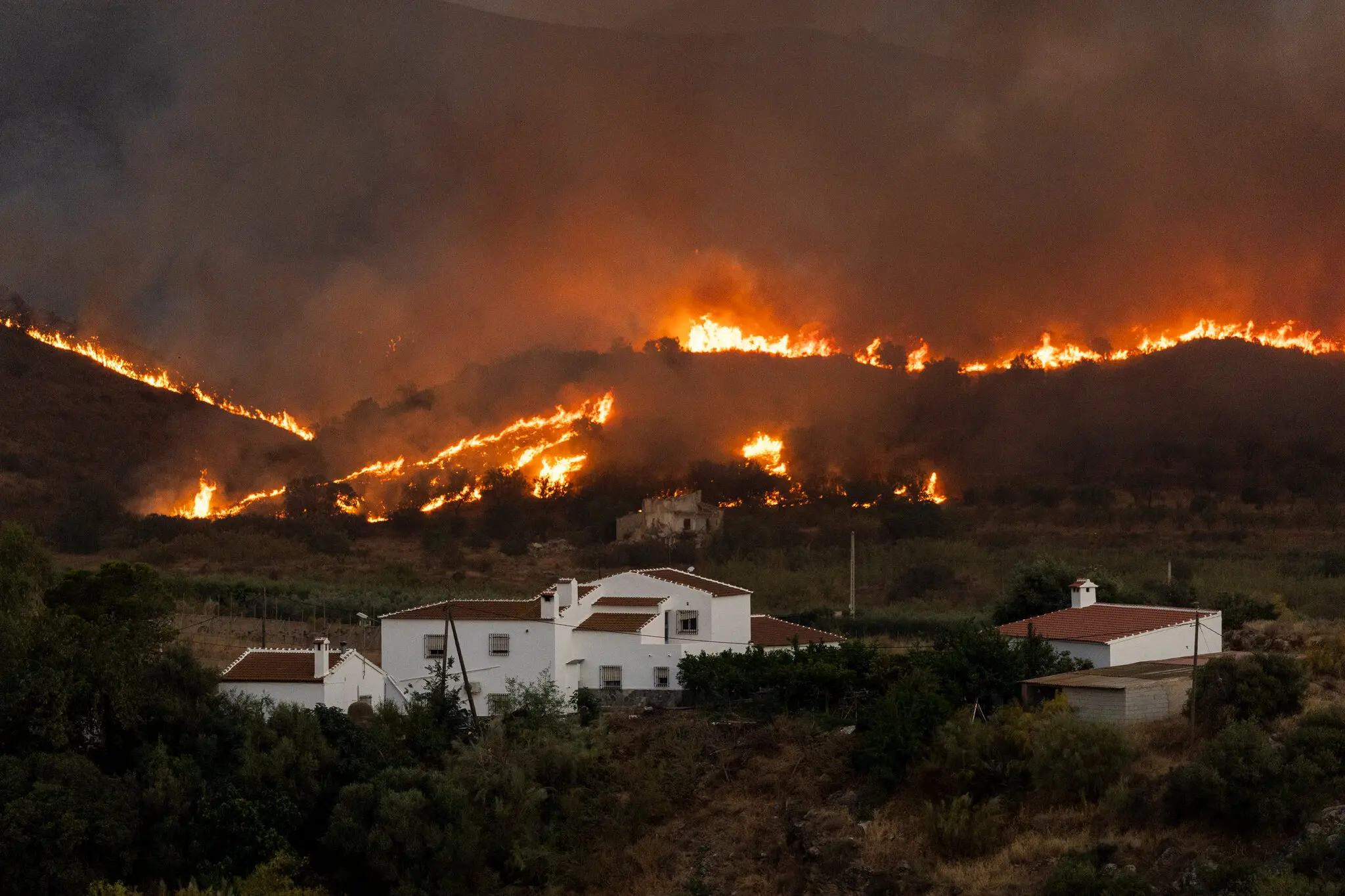
By Monday, the fires had reached new areas around Madrid and across other parts of Spain. Authorities ordered the evacuation of Valdemaqueda, a town of roughly 870 residents about 40 kilometers from the capital. Hundreds of people left homes, farms, animals and livelihoods without knowing what would remain when they returned.
Firefighters were operating within an exceptionally narrow window. Only two days remained before temperatures were expected to rise above 38 degrees Celsius. Under such conditions, every hour without strong winds or fresh ignition becomes a resource that cannot be stored or replaced by more aircraft and equipment.
Prime Minister Pedro Sánchez described the blazes as the largest in the country’s history and called for a national climate pact. His appeal went beyond emergency response. It was an attempt to move wildfire prevention outside the usual conflict between parties, regions and the central government.
That will not be easy. Climate policy in Spain has long been part of an ideological struggle. The fires intensify demands for faster action while also creating space for accusations over neglected forests, weak prevention and insufficient local preparation.
The emotional reaction of Madrid regional president Isabel Díaz Ayuso reflected the scale of the rupture. Politicians accustomed to discussing wildfire through budgets, agencies and jurisdiction were now watching flames burn almost within sight of the capital.
For Madrid’s residents, the anxiety appeared in simpler forms. Windows were kept shut to block the smoke. Clothes smelled of fire after brief walks. The horizon beyond the Royal Palace resembled a mountain range, though it was in fact a wall of smoke and ash.
Dogs evacuated from farms west of the city appeared in central Madrid. Their owners had left behind sheep, horses, beehives and agricultural land. While the capital preserved the outward rhythm of ordinary life, its nearest periphery had already entered emergency mode.
That contrast explains why the fires became a psychological turning point. Madrid itself was not burning, but its safety no longer felt unconditional. Flames do not need to reach the central squares to change a city’s sense of security. Smoke, evacuation orders and the knowledge that dry forest begins only a few dozen kilometers away are enough.
Spain has endured a summer of record-breaking heat that stripped moisture from soil and vegetation. In those conditions, a single spark finds an almost limitless supply of fuel. High temperatures accelerate evaporation, while nights increasingly fail to bring the cooling needed to slow a fire front.
Climate change, however, explains only part of the disaster. Another cause is the long decline of rural life, which once kept much of the landscape in a more manageable condition.
Fewer grazing animals mean more grass and brush left untouched. Reduced logging leaves dry branches and fallen trunks in forests. Rural depopulation means fewer people maintaining tracks, clearing land and spotting small fires before they spread.
As a result, landscapes that urban residents often regard as untouched and healthy can become continuous layers of combustible material. Forests grow denser, but not necessarily more resilient. Once a fire begins, it finds fuel almost everywhere.
This is where two policies meet: emissions reduction and land management. Moving away from fossil fuels may slow long-term warming, but it will not remove dry brush before next summer. Firebreaks, controlled burns, grazing and the revival of rural economies are needed immediately.
Wildfire prevention is therefore not only an environmental issue but a social one. A landscape cannot remain manageable without people who live and work on it. When rural regions continue to lose population, the state must replace daily maintenance with expensive emergency operations.
Even the best management will not eliminate the danger. Europe is warming faster than the global average, and the Iberian Peninsula is especially exposed to prolonged drought, repeated heat waves and water scarcity.
For Madrid, this requires a change in urban planning. Parks, transport systems, hospitals, power networks and housing must be designed not for exceptional heat, but for its regular return. Protecting the capital begins far beyond its administrative limits — in surrounding forests, villages and reservoirs.
The fires also deepen inequality. Wealthier residents can install air purifiers, leave the city temporarily or work from home. People employed outdoors, living in poorly insulated apartments or caring for elderly relatives have far fewer options.
Farmers and owners of small rural businesses risk losing more than a house. Burned pasture, dead livestock and destroyed hives are not restored by a single insurance payment. The economic effects can last for years after the final flames are extinguished.
Air quality creates another layer of danger. Wildfire smoke contains fine particles capable of penetrating deep into the lungs and bloodstream. Even dozens of kilometers from the fire, it threatens children, older people and residents with chronic illness.
This erases the familiar boundary between city and natural disaster. A forest fire is no longer a local event confined to the place where it burns. It affects schools, hospitals, transport, tourism and urban economies far beyond the line of flame.
For the government, the crisis is a test of whether it can act across several timescales at once. People must be evacuated today, vegetation managed before the next fire season and emissions reduced over decades. Failure at any level increases the cost of the other two.
Spain’s experience matters for the rest of Europe. Paris, Rome, Athens, Lisbon and other major cities are also surrounded by territories becoming hotter and drier. Capital-city status offers no protection from fire. It merely delays recognition of the risk.
Madrid has not become a city of mass evacuation. Its squares remain full of tourists, restaurants stay open and cultural life continues. Yet the smell of smoke has made the crisis visible in the place where it was easiest to ignore.
That is why “wake-up call” is more precise than natural disaster. The fires have not brought final catastrophe to the capital, but they have taken away the confidence that Madrid stands outside the danger zone.
The sun still rises and sets over Madrid. Its color now depends not only on the weather, but on what is burning beyond the horizon. And while the city hopes the flames do not come closer, the climate crisis has already crossed its boundaries — carried in by the smoke.