
















Keir Starmer remains prime minister of Britain, but the political space around him has narrowed sharply. After Labour’s disastrous performance in local and regional elections, the question is no longer simply whether the government can change course. It is whether the Labour Party itself still believes he can lead that change.
On Monday, Starmer tried to seize back control with a speech designed to calm the revolt inside his party. He acknowledged voters’ anger, accepted responsibility and tried to show that he understood the scale of the defeat. But the gesture failed to become a political turning point. By the end of the day, more than 70 Labour lawmakers were publicly calling for his resignation or a timetable for him to step down.
For British politics, this is a dangerous moment. A party that won a commanding parliamentary majority less than two years ago is now showing signs of internal fracture. Starmer came to office as the figure of stability after years of Conservative turmoil. He is now being forced to prove that he has not become the source of a new paralysis.
As Daycom has previously argued, Starmer’s crisis is dangerous precisely because it cannot be reduced to one scandal or one electoral defeat. It has built up through economic frustration, anxiety over migration, disappointment with the pace of change and a growing sense that the government speaks the language of responsibility without giving voters a tangible result.
The elections merely tore through the thin surface of party discipline. Labour lost more than a thousand council seats and suffered a painful defeat in Wales, where it had long been the dominant political force. Reform UK, led by Nigel Farage, turned public anger into a series of victories across a fragmented political field.
Starmer is trying to present himself not as the problem, but as the barrier against chaos. His argument is straightforward: replacing the prime minister now would drag the country back into the same cycle of instability that destroyed public trust in the Conservatives. But for part of Labour, this no longer sounds like a strategy. It sounds like a warning from a leader losing the ability to take the party into the next election.
Formally, the path to removing him has not yet opened. To trigger a full leadership contest against a sitting Labour leader, a challenger would need the backing of 20 percent of the party’s parliamentary group. In the current Parliament, that means 81 signatures. The central question is not whether there are enough unhappy MPs. It is whether they can unite behind a single alternative.
That is why Catherine West’s move mattered, even if it was not a final blow. She initially threatened an immediate challenge to Starmer’s leadership, then shifted toward demanding an orderly transition and a possible departure by September. That reduced the immediate threat, but it did not erase the essential fact: a section of the party is now openly discussing life after Starmer.
A dangerous vacuum is forming around the prime minister. Angela Rayner has not launched a challenge, but she has made clear that Labour’s agenda must change. Wes Streeting remains a potential contender, though he has not moved openly. Andy Burnham has popularity, but not a seat in Parliament, without which he cannot formally run for the Labour leadership.
That uncertainty works against Starmer. It allows him to remain in office, but it does not restore his authority. When a party does not yet know whom it wants next, it may temporarily remain with the incumbent. But that is not support. It is a postponed decision.
Starmer’s weakest point is not only his polling. It is the widening gap between his political biography and how he is now perceived. He rebuilt Labour after the 2019 defeat, moved the party back toward the center and led it into government. Yet the same qualities once seen as discipline and seriousness are increasingly read as coldness, caution and a lack of emotional connection with the country.
His speech tried to repair that. Starmer spoke about his family, work, low pay and the struggles of ordinary people. He tried to recover Labour’s moral vocabulary: the dignity of work, protection for the vulnerable, resistance to hate and division. But without a concrete political turn, even a more personal tone cannot change the balance of power.
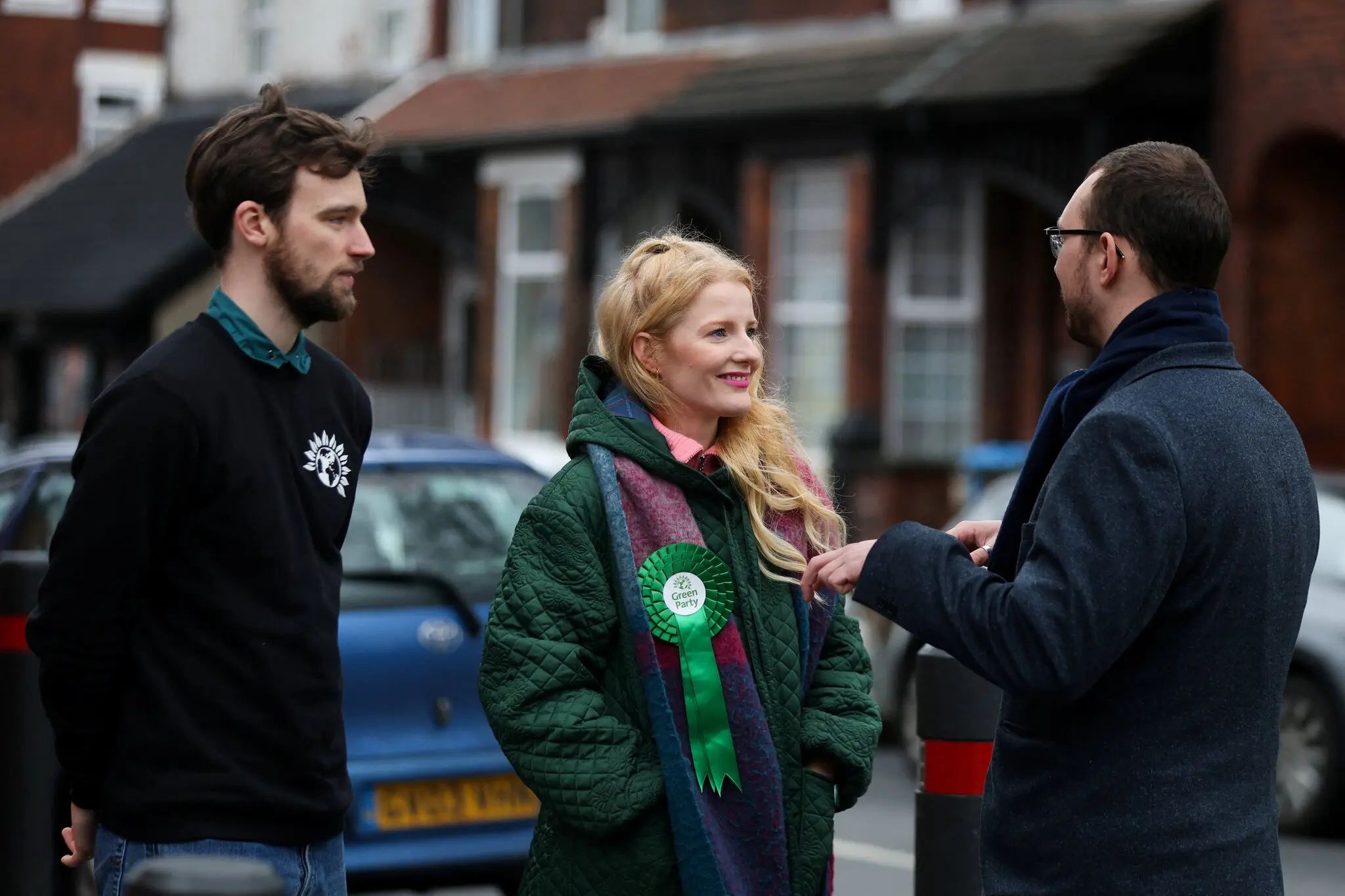
The pressure is coming from outside as well. Reform UK is attacking Labour among voters who feel the country has lost control over migration, prices and local services. The Greens are pressing from the other side, drawing support from younger, urban and progressive voters. Starmer is trapped between two different forms of protest: one right-wing and populist, the other left-wing and anti-establishment.
Financial markets are also beginning to price in political instability. The yield on 10-year British government bonds has risen toward 5 percent, as investors assess the risk of a leadership change and the possibility of a shift away from Chancellor Rachel Reeves’s strict fiscal line.
That turns the crisis from a party problem into a matter of state. Starmer cannot simply promise more spending, because the bond market is already reminding London of the limits of debt politics. But he also cannot remain only the guardian of fiscal rules if voters see those rules as the reason for prolonged strain in public services, wages and local infrastructure.
This is Labour’s trap. The party defeated the Conservatives by promising competence. But competence without visible improvement quickly becomes technocratic solitude. Voters do not punish a government only for bad numbers. They punish it for failing to explain why patience still has a purpose.
Starmer may yet survive as prime minister. He has a large parliamentary majority, his internal opponents lack a single candidate, and fear of a chaotic change of leadership is holding back some ministers. But survival in office is not the same as restored leadership. For that, he needs not a new tone, but a new political contract with both his party and the country.
The coming days will show whether Labour’s revolt becomes an organized attempt to replace him or remains a series of warning shots. But the central threshold has already been crossed: Starmer’s resignation is no longer a marginal subject. It has become a working scenario in British politics.
For the prime minister, that means the period of normal government is over. Every decision will now be read as evidence of strength or weakness, every speech as an attempt at rescue, every minister as a potential ally or successor. Starmer came to power promising to end chaos. His own party is now deciding whether he has become an obstacle to that very order.