
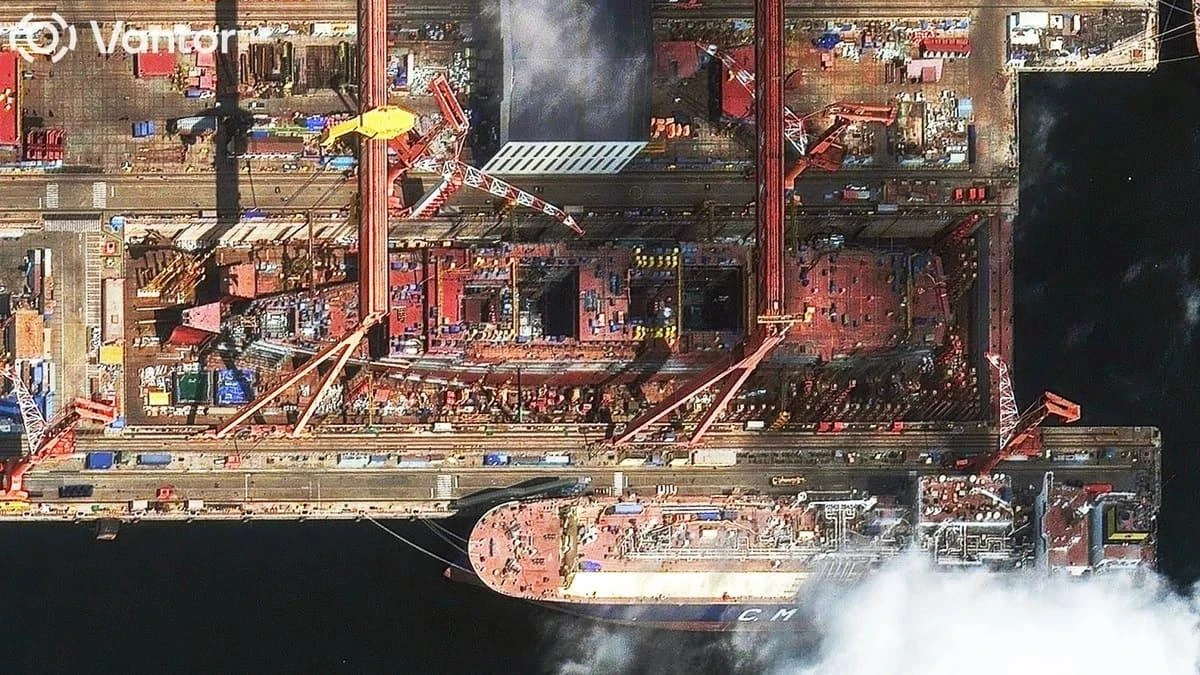

















Sometimes a geopolitical crisis condenses into a single hull, a few radio warnings and a brief piece of video from open water. That is what happened with the Touska, the Iranian-flagged container ship intercepted by U.S. forces in the Arabian Sea. At the level of headlines, it is another act of pressure. At the level of strategy, it is something far more consequential.
The significance of the episode lies not only in the ship itself, but in the way Washington chose to frame and execute the operation. The United States did not merely stop a vessel flying the Iranian flag. It folded the seizure into a larger logic of blockade, sanctions enforcement and the claim that any logistical asset linked to Iran’s financial or military networks can become a legitimate target of coercive action.
That matters because the Touska was not an unknown or newly identified vessel. It had already been placed under U.S. sanctions in 2020 over alleged ties to Iranian financial entities and weapons-related activity. In other words, Washington is not opening a fresh file. It is forcefully reactivating an older sanctions architecture and showing that it is prepared to enforce it physically, not just legally.
In Deykom’s assessment, that is what turns this incident from a tactical interception into a political demonstration. The Trump administration is signaling that sanctions no longer live only in Treasury designations, banking restrictions and insurance risk. They can now be materialized at sea, through direct naval action against a moving commercial asset.
The political effect is amplified by the style of the response. Donald Trump did not present the episode in bureaucratic language. He moved it immediately into the register of domination, stressing that the United States had full custody of the ship and was examining what was on board. That is classic coercive diplomacy in Trump’s preferred form: produce the image of total control first, and leave institutional justification to follow afterward.
The American account of the seizure reflects exactly that posture. A U.S. destroyer reportedly warned the vessel repeatedly to halt, then disabled it by firing into the engine room. That detail is crucial. Washington is showing that it is willing not merely to monitor or deter, but to physically immobilize a sanctioned vessel if it believes the ship forms part of Iran’s wider sanctions ecosystem.
For Tehran, the implications are different and far more humiliating. This is not simply the loss of control over one ship. It is a challenge to the principle that Iran can move goods under its own flag without foreign military interference. That is why the Iranian response has been so severe in language. Describing the seizure as armed piracy is not rhetorical excess. It is an attempt to recast the incident as an unlawful act of force rather than a legitimate act of interdiction.
Yet Iran’s response also reveals constraint. Officials have threatened retaliation, but they have also stressed concern for the crew and for the families connected to them. That suggests that while Tehran cannot afford to appear passive, it also cannot escalate instantly without risking a broader confrontation for which the costs may be far higher than the symbolic value of immediate revenge.
The China angle sharpens the episode further. The Touska’s route appears to have taken it from Chinese ports through Malaysia and toward Bandar Abbas, and the interception comes against a background of American suspicions that China may have transferred weapons to Iran during the war. Beijing denies that outright. But the overlap of route, timing and suspicion is enough to widen the meaning of the operation well beyond a bilateral U.S.-Iran clash.
This is where the incident becomes geoeconomic. If U.S. forces are prepared to stop a large container vessel and search thousands of containers, the message is not only about one possible shipment. It is aimed at the entire logistics chain around Iran. Any commercial route that Washington deems tied to sanctions evasion or military supply may now be exposed not only to financial penalties, but to direct military interruption.
For global shipping, that is a serious precedent. Even if the eventual findings aboard the Touska prove less explosive than the surrounding rhetoric suggests, the mechanism has already been established. A sanctioned or suspected vessel can be transformed, within hours, from a commercial carrier into a frontline object in a geopolitical confrontation. Trade routes begin to resemble contested military corridors.
There is also a problem of evidentiary asymmetry. The United States currently possesses operational control, but not yet a completed public case. The cargo’s origin has not been fully laid out, the contents have not been publicly documented, and the identities and status of the crew remain only partially visible. That gives Washington military leverage, but it does not yet guarantee political closure.
Iran, by contrast, has lost control of the ship but gained time for a political counterattack. If the inspection fails to produce a compelling public narrative, Tehran will argue that the seizure was an act of force in search of a justification. In that case, Washington risks turning a dramatic operation into a more ambiguous show of power—impressive in execution, but less stable in legitimacy.
If, on the other hand, suspicious cargo is found, the consequences could be even broader. Then the Touska will become a precedent for intensified maritime enforcement, deeper scrutiny of cargo routes into Iran, and a further militarization of commercial movement in and around the Gulf. One ship would have helped normalize an entirely new practice.
That is why the Touska matters. This is not just the story of a single vessel or even a single suspected shipment. It is a sign that sanctions are leaving the realm of paperwork and entering a far more physical, dangerous phase. The United States is demonstrating its willingness to convert economic pressure into naval action. Iran is responding through the language of violated sovereignty and threatened retaliation. And China, whether directly involved or not, is being pulled further into a zone of strategic suspicion. The Touska has already ceased to be merely a ship. It has become a marker of how quickly a trade route can turn into a front line.