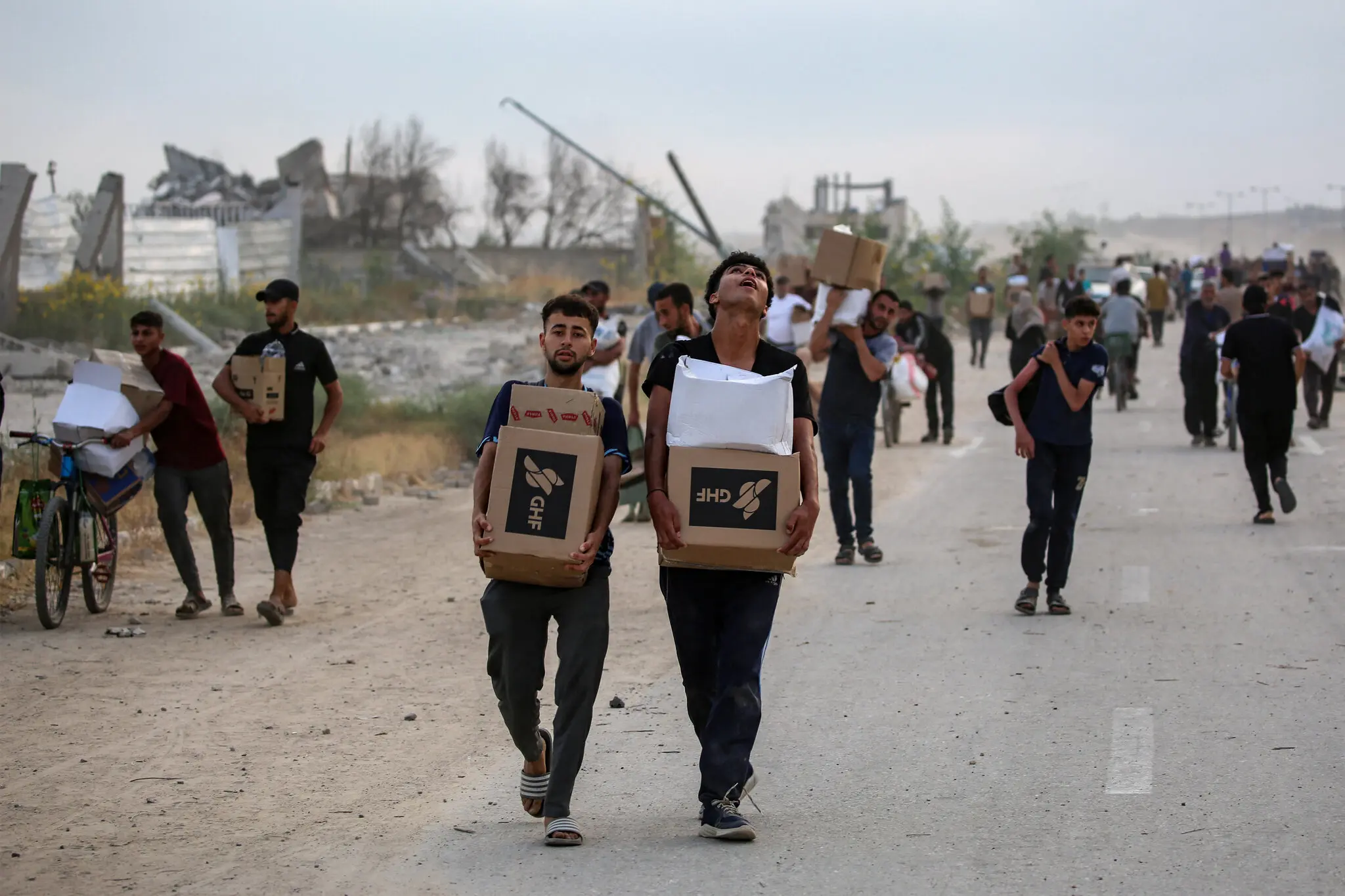


















In Gaza, even a food line is no longer simply a food line. It has become a place where hunger, weapons, political control, distrust of authority and the failure of postwar governance all meet. The incident at a World Food Program warehouse exposed what had long been growing beneath the surface of the cease-fire.
The United Nations said armed forces linked to Hamas’s de facto authority in Gaza forced their way into a food distribution center and warehouse where humanitarian aid was being stored. The agency then suspended work at the site. Formally, this was one raid. In reality, it revealed a crisis of trust in the entire aid delivery system.
A spokesman for the Hamas-run government did not deny that security forces entered the warehouse, but described it as a police operation against smuggling. That disagreement captures the essence of present-day Gaza. What humanitarian agencies see as pressure, intimidation and obstruction, the local authorities present as restoring order amid chaos.
According to Daycom’s assessment, the incident matters not only as a single confrontation between the United Nations and Hamas. It shows that after the cease-fire, Gaza has not acquired a neutral civilian administration capable of separating aid from political power. Where there is no trust in rules, every sack of flour becomes part of the struggle for control.
Humanitarian assistance in Gaza has long performed the function a state should perform. It feeds people, sustains minimal survival, compensates for a shattered economy and replaces a normal market. When that system stops even at one distribution point, the consequences are felt quickly not by officials, but by families dependent on the next food delivery.
The cease-fire between Israel and Hamas was supposed to free hostages, reduce violence and open a path toward reconstruction. Part of that goal was achieved: Israeli hostages returned, and Palestinian prisoners and detainees were released. But most of the agreement’s promises remain suspended. Gaza did not move from war to peace. It moved from mass war to unstable survival.
Israeli forces still control a large part of the enclave. Roughly two million Palestinians are compressed into a shrinking strip of territory along the coast. Cities, including Khan Younis, lie in ruins. Many people live in tents or partially destroyed buildings, where the restoration of normal life remains not a plan, but a distant hope.
In these conditions, food aid becomes political infrastructure. Whoever controls warehouses, lines, access, lists and security influences not only logistics, but daily life. That is why any intervention by armed men in a humanitarian center carries meaning far beyond one warehouse.
For international organizations, the case is especially sensitive. For years, they have largely criticized Israel for restrictions on humanitarian access, the blockade, cargo inspections and the destruction of civilian infrastructure. Open criticism of Hamas by aid groups has been rarer, because every such word could complicate work on the ground.
Now silence is harder to maintain. If armed forces belonging to the de facto authority can enter aid facilities, intimidate staff or force agencies to suspend operations, the humanitarian system loses its basic condition of existence: independence. Without it, aid stops being a shield for civilians and becomes a resource contested by armed structures.
Hamas, for its part, is trying to prove that it remains an authority, not only an armed movement. After the cease-fire, its checkpoints reappeared in Gaza as a show of force. Later, amid Israeli strikes, they became less visible, but the movement’s presence did not disappear. Its officials and security forces continue to operate in cities, hospitals and what remains of administrative infrastructure.
This creates a trap for civilians. On one side stand Israeli military power, strikes, blockade and territorial control. On the other stands Hamas rule, which suppresses opponents, punishes dissidents and seeks to restore control over the population after the cease-fire. Between these two forces, the space for ordinary civilian life has almost vanished.
Humanitarian aid was supposed to be the neutral zone. But neutrality requires protection, rules and minimal recognition from all sides. Gaza has none of these. Israel argues that Hamas cannot control the enclave’s future. Hamas refuses to disarm, citing Israeli strikes and blockade. Between those positions stand people who need food, water and medicine.
The humanitarian picture remains contested. Israeli agencies insist that supplies have improved since the cease-fire and that food prices have fallen. Aid groups and Gaza residents describe another reality: many basic goods remain difficult to obtain, and food often costs far more than before the war. Both realities can exist at once: partial improvement is not normal life.
The problem is not only how much cargo enters Gaza. The problem is whether it reaches people consistently, transparently and without armed interference. If aid enters the enclave but distribution depends on security conditions, political control and fear among workers, the system remains vulnerable. Any incident can break an entire supply chain.
Reconstruction under such conditions is nearly impossible. The World Bank and the European Union have assessed Gaza’s needs for rebuilding and economic revival at more than $70 billion. That sum requires not only money, but governance, trust, security guarantees, transparent contractors, corruption control and a political decision on who will rule.
Until such a decision exists, even major pledges do not change reality. The European Union has announced roughly $1 billion for infrastructure projects, but allocating and spending those funds will take months. For people standing in line for food today, that is not an answer for tomorrow.
The U.S. administration has assigned a special peace body to coordinate reconstruction, but it has so far failed to mobilize resources anywhere near the scale required. Donor fatigue is only part of the problem. Investing tens of billions in a territory where violence continues, no single authority exists and the question of Hamas remains unresolved is politically and financially difficult.
Israel and the United States insist Gaza cannot be rebuilt while Hamas keeps its weapons. For them, this is not symbolic: rebuilding cities while leaving an armed movement in power would lay the groundwork for the next war. But Hamas views disarmament as surrender to an enemy that still controls borders, airspace and much of the territory.
As a result, reconstruction is hostage to the security knot. Without Hamas disarmament, donors fear financing a new cycle of destruction. Without a political horizon for Palestinians, Hamas gains an argument for keeping its weapons. Without humanitarian stability, the population lacks the strength to wait for a grand diplomatic compromise.
The World Food Program incident shows how narrow the space for such a compromise has become. If Gaza’s de facto authority interferes with aid distribution, it undermines donor trust. If international agencies withdraw from individual centers, civilians suffer. If civilians suffer, anger grows — and that anger feeds new radicalization.
That is why Gaza’s humanitarian crisis cannot be separated from the question of power. Food, warehouses, hospitals, checkpoints and ruins are parts of a single political landscape. Whoever controls them today influences who will be able to speak for Gaza tomorrow.
For Hamas, control over order after the cease-fire is a way to prove the movement has not been destroyed. For Israel, every such display is evidence that the war has not achieved its strategic aim. For international organizations, this creates an almost impossible task: helping people without strengthening structures that much of the world sees as obstacles to peace.
The deepest tragedy is that Gaza’s population does not have the luxury of waiting for a clean political solution. People need food, water, medical care, shelter, fuel and security now. Yet each of these necessities passes through a system in which political power, military control and humanitarian logistics are almost inseparably entangled.
That is why a raid on one warehouse matters more than it may seem. It shows that after the cease-fire, Gaza has not become a postwar territory. It remains a place where war has changed form but has not given way to order. The ruins are already there, the hostages have been freed, part of the fighting has subsided — but the mechanism of normal life has not begun.
If humanitarian centers are not protected from armed interference, the food system will become even more fragile. If Israel does not ease the blockade and ensure stable access channels, shortages will persist. If Hamas does not give up armed control over civilian space, reconstruction will remain politically blocked.
Gaza today is not only a place of destruction. It is a test of whether the world can separate aid to people from rule by armed power. So far, the answer is negative. Every humanitarian incident is therefore not an exception, but a symptom. Every suspended food distribution reminds Gaza that a cease-fire without safe administration is not peace.
In this war, the dead, the released, the destroyed homes and the promised billions are often counted. But Gaza’s future may be decided in a far more prosaic place — beside a warehouse of flour, where armed men decide who has the right to manage aid. There lies the central failure of the current phase: the war appears to have paused, but the rule of force still stands between civilians and survival.