






















In the center of one of China’s richest industrial districts, there is a park that has become a quiet waiting room for people no longer needed by the new economy. Around them are trimmed trees, playgrounds, joggers in performance gear and bright apartment towers. In the shade are men waiting for casual work.
Kunshan, a city a short distance from Shanghai, was long a symbol of China’s manufacturing miracle. Electronics for global brands were assembled here, millions of migrant workers came here, and a factory shift, however exhausting, offered something predictable: wages, dormitories, routines and a place in the machine.
That order is now breaking. China is moving toward automation, artificial intelligence, robotic production lines, electric vehicles and advanced technology. But behind the polished face of industrial upgrading are the people whose hands made the country the world’s factory — and who are now slower, more expensive and less convenient than robots.
According to Daycom’s earlier analysis, Kunshan exposes the central social cost of China’s technological leap: the state can modernize factories quickly, but it moves far more slowly when it comes to retraining the workers who spent decades in low-skilled manufacturing.
Hu Xinbing, 31, once could count on longer contracts at plants assembling laptops, smartphones and components. In peak seasons, he earned about 6,000 yuan a month. It was not wealth, but it gave him a rhythm: dormitory, shift, paycheck, and a few thousand yuan saved each year.
Now he looks for daily gigs. Security work, temporary shifts, occasional calls. The pay is often between 60 and 120 yuan a day. When there is no work, there is the park: a bench, a jacket as a pillow, an early wake-up and another attempt at the labor market, where recruiters fill quotas before the day has fully begun.
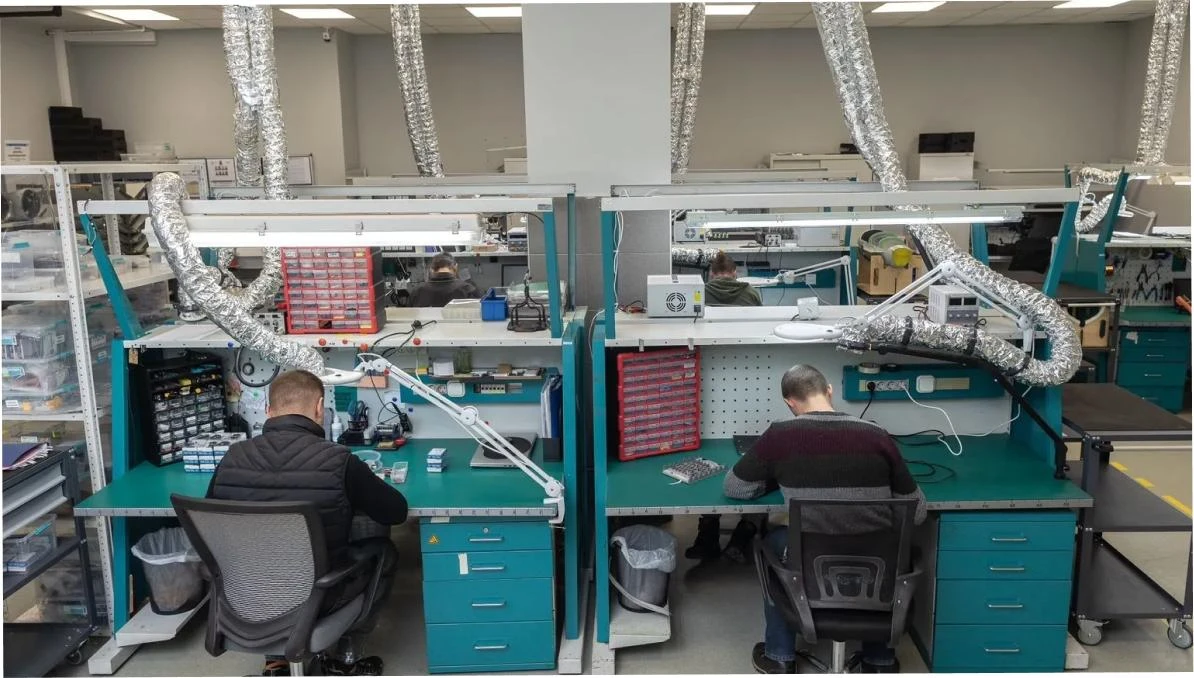
His remark that “robots now drive the screws” sounds almost like an epitaph for an era. Workshops that were once packed with people doing repetitive manual operations are now filled with mechanical arms, sensors and automated lines. Humans remain only to place batteries, wires or trays for the machines.
This is not merely a change of tools. It is a change in the hierarchy of the factory. The worker who was once the basic unit of production becomes a support part for the robot. His movements are measured by signals, his pace is set by machines, and delays trigger system alarms. Human fatigue no longer counts as an argument.
Chinese industry has strong reasons to move this way. Trade frictions, unstable demand, the relocation of some manufacturing abroad and the race for technological leadership are pushing companies to cut costs and raise productivity. A robot does not ask for overtime pay, fall ill, go home for holidays or demand social protection.
For the state, automation looks like a path to a new status. China wants to be not only the world’s workshop, but also a high-tech power in solar panels, electric vehicles, industrial robots, drones and artificial intelligence. In that vision, there is less room for cheap manual labor and more for engineers, technicians and operators of complex systems.
But that is exactly where the rupture begins. Millions of people who came from poorer provinces and started working after middle school cannot quickly become engineers of the new economy. Their experience is the assembly line, the night shift, circuit boards, casings, cables and small parts. Their education does not offer an easy entrance into the economy of algorithms.
China already has tens of millions of gig workers in manufacturing. In some large factories, temporary workers make up most of the labor force. This is convenient for employers: people can be hired for orders and dismissed without long obligations. For the workers themselves, it means life without guarantees, professional growth or stable income.
Gig work in this form is not freedom. Some younger workers may prefer it because they dislike rigid contracts and factory discipline. But for many older or less educated workers, it becomes a trap. A person sells not a profession, but his presence for a few hours at a time.
Kunshan is especially revealing because it is not a forgotten periphery. It is a wealthy industrial center that stood for decades at the heart of global supply chains. If workers there are sleeping in parks and waiting for day labor worth only a few dollars, the problem is not local. It is built into the very model of technological transition.
Automation does not necessarily destroy all jobs. It creates new ones, but not for the same people and not at the same speed. New positions require education, technical literacy, adaptability and access to training. Old jobs disappear faster than workers can change their qualifications.
That gap is becoming a social risk for China. The country is building the economy of the future, but a large part of its working class remains trapped in the past, without a clear bridge to the new system. Without real retraining programs, stronger labor protections and employment support, technological progress will produce not only profit, but also alienation.
The blow falls especially hard on migrant workers. They often lack full access to urban social services and depend on dormitories, recruiters and short contracts. When factories cut people, they are the first outside the gates. Their place in the city was tied to work; when the work disappears, so does their claim to belonging.
China’s paradox is that it can show the world robot baristas, delivery drones, dancing humanoids and factories of the future — while leaving people beside those factories unsure whether they will earn enough tomorrow to pay for a bed. Technological pride and human anxiety exist side by side, sometimes only one bus stop apart.
For Hu, robots are not enemies in any simple sense. He can admire Chinese technology, watch videos of robots online and remember drones delivering food during quarantine. But admiration does not cancel fear. Without education, energy or time to learn a new skill, progress looks less like an opportunity than a door closing.
This human detail makes Kunshan’s story more important than statistics. Automation is often described in the language of productivity, innovation and competitiveness. For a worker, it can mean the loss of conversations on the factory floor, a predictable wage, a feeling of usefulness and the minimum control over life.
China’s technological leap will not stop. Nor should it stop simply because old factory models no longer work. But a state that wants to call this leap modernization must answer a harder question: what happens to the people whom modernization leaves on benches outside the factories?
If the answer is only another wave of robots, China’s richest industrial cities will increasingly have two faces. One will be for investors, with clean parks, high towers and automated workshops. The other will be for those lying behind bushes after another failed search for work, waiting for morning to sell another day of their lives for less than the cost of a part in the machine that replaced them.