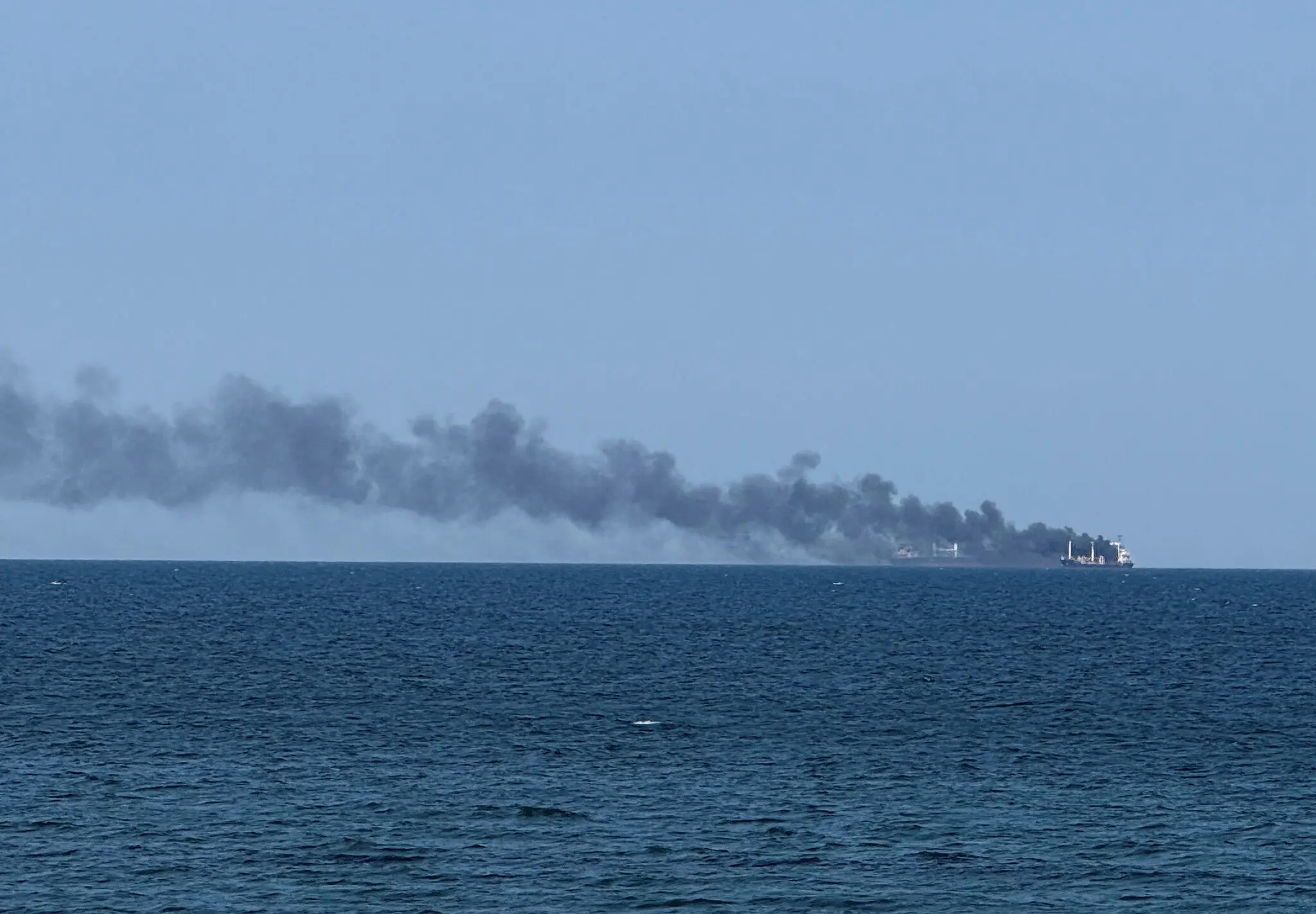




















The sinking of a wheat carrier in the Sea of Azov, with one person confirmed dead, two missing, and nine crew members reaching shore alive, might appear at first glance to be another isolated disaster on the margins of a larger war. In reality, it points to something broader. The Sea of Azov is no longer simply a commercial waterway. It has become a zone where trade, military risk, and infrastructural decay increasingly overlap.
By the available accounts, the vessel was a river-sea dry cargo ship of the old Volgo-Balt class, carrying wheat on a routine route toward Port Kavkaz. That detail matters. Ships of this type belong to an aging logistical architecture that was never designed to bear the cumulative pressure of prolonged war, disrupted maintenance cycles, higher insurance stress, and increasingly unpredictable operating conditions.
For now, the confirmed facts remain limited. An investigation is under way, and the precise cause of the sinking has not yet been established. But that uncertainty is itself revealing. In the Sea of Azov, it has become harder and harder to distinguish where ordinary maritime accident ends and the indirect impact of war begins. Navigation hazards, strained infrastructure, degraded operating conditions, and the broader militarization of the basin have fused into a single environment of risk.
In Deykom’s assessment, the most important meaning of this incident lies not in the drama of a shipwreck itself, but in what it says about the condition of the Sea of Azov as a system. This is increasingly a space of structural unreliability. Commercial voyages here no longer move according to the logic of normal trade. They move according to the logic of managed emergency, where every routine passage carries the possibility of sudden breakdown.
There is also a deeper infrastructural story behind the sinking. The Azov basin remains important for grain logistics, yet its geography has always imposed constraints: shallow waters, narrow routes, weather volatility, seasonal disruption, and sensitivity to water levels. Even in peacetime, these conditions demanded caution. In wartime, when pressure on export routes rises and redundancy shrinks, they become far more dangerous. A single accident in such an environment begins to look less like bad luck and more like a symptom.
The fleet working these lines only reinforces that impression. A significant share of shipping in this corridor still depends on older river-sea vessels whose technical margins are far thinner than modern operators would prefer. That does not prove that mechanical failure caused this particular sinking. But it does mean that every additional strain—storm, overload, human error, deferred repair, navigational stress—carries greater consequences than it otherwise would. War rarely creates fragility from nothing. More often, it exposes and accelerates weaknesses that were already there.
Just as troubling is the information fog that quickly formed around the incident. In Russian information channels, conflicting versions began circulating almost immediately, including speculation about alternative casualty numbers and even suggestions of hostile action. None of that has been conclusively established. The only defensible conclusion at this stage is narrower but still serious: a grain-carrying vessel sank, one crew member died, and two others remain unaccounted for. In a war zone, uncertainty is not incidental. It becomes part of the danger itself.
The economic meaning of the sinking should not be overlooked. The Sea of Azov has become more than a body of water between coasts. It functions as a logistical rear corridor where grain flows, port infrastructure, military restrictions, and insurance calculations all intersect. Every such incident damages more than a hull. It erodes confidence in the route, affects freight decisions, raises the perceived cost of transport, and chips away at the assumption that commercial movement through the basin remains broadly manageable.
That is what gives this event a significance beyond the immediate loss. One death and two missing seafarers is, first of all, a human tragedy. But it is also a stark snapshot of what the Sea of Azov has become in 2026: shallow, overburdened, militarized, and increasingly unpredictable. When grain moves through a space where old ships meet wartime conditions, even an ordinary cargo run starts to resemble a wager that the system can hold for one more day.
With each new incident, that wager looks less secure.