


















When the latest three-day pause in the war expired, the one thing it was meant to produce never arrived: silence. Ukrainian skies again filled with drones, missiles and guided bombs, while the front line showed little sign that the war had truly stopped even for a moment.
This was not merely another violation. It was a symptom. A cease-fire that once would have served as the entrance to a difficult peace process is increasingly becoming a political event in itself: announced, displayed, consumed by the news cycle and exhausted almost immediately.
In Russia’s war against Ukraine, that shift is especially dangerous. For Kyiv, a pause without monitoring, guarantees or a political framework does not create security. For Moscow, it can become a useful instrument: a way to perform readiness for peace without abandoning the logic of attack.
According to Daycom’s assessment, the central problem is not simply that cease-fires collapse. The deeper problem is that they are increasingly designed as short public gestures rather than as part of an architecture for ending war. These are different things, and confusing them carries a high price.
A traditional cease-fire was never just a pause in shooting. It required verification mechanisms, channels of communication, a political mandate, procedures for responding to violations and, above all, a clear idea of where the parties were supposed to move after the first silence.
That logic is now breaking down. The announcement of a pause becomes the result, not the beginning. It gives leaders a phrase for television, diplomats a few hours of cautious optimism and armies the freedom to continue operating wherever real supervision is absent.
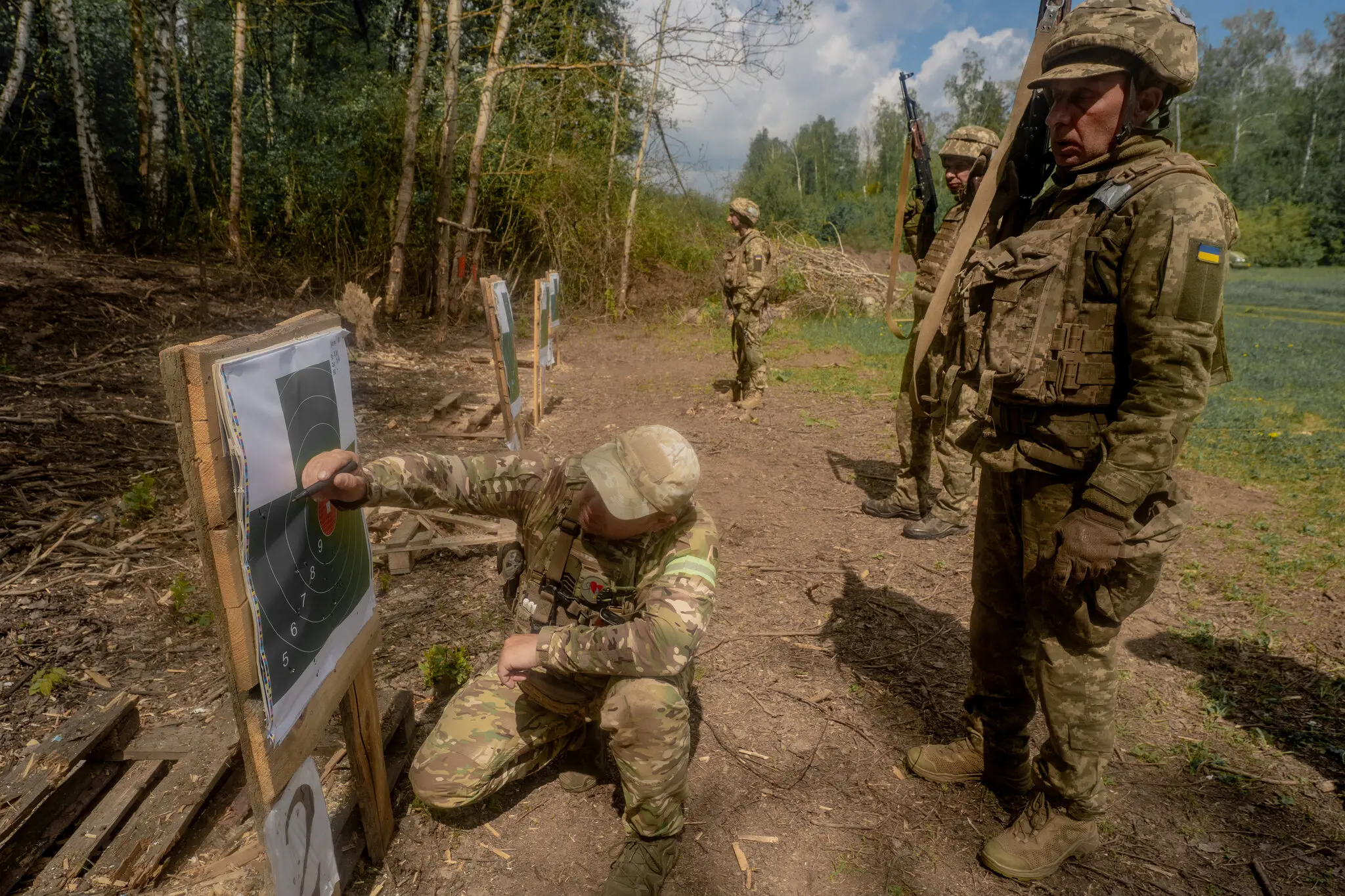 Новобранці 58-ї окремої механізованої бригади Збройних сил України відпрацьовують військові навички на полігоні поблизу лінії фронту в Харківській області у вівторок — Андрій Марієнко
The three-day cease-fire became precisely that kind of episode. It was presented as a possible beginning of the end of the war, but it ended in mutual accusations, renewed strikes and a return to the familiar rhythm of combat. Ukraine again faced large-scale attacks after the supposed pause.
For Ukraine, this history has a long memory. The Minsk agreements of 2014 and 2015 left a bitter lesson: a document may exist, capitals may speak the language of diplomacy, but Russia’s military machine can continue moving if there is no enforcement, monitoring or accountability.
Then came the humanitarian corridors of 2022, which often failed to become safe routes for civilians. There was also the Orthodox Christmas pause of 2023, which Kyiv saw as little more than an attempt to give Russian troops an operational breather. Each such episode reduced confidence in the instrument itself.
That is why Ukrainian skepticism is not diplomatic stubbornness. It is a memory of how the word “cease-fire” can cover regrouping, pressure and political entrapment. If a pause does not change the aggressor’s behavior, it merely shifts moral responsibility onto the victim.
Moscow understands this asymmetry well. When Ukraine refuses a dubious pause, it can be accused of obstructing peace. When it accepts one, Russia preserves room for maneuver and later blames Kyiv for violations. In such a structure, the cease-fire becomes not a bridge, but a stage set.
The defining feature of the current moment is that this model fits a new American diplomatic style. The quick gesture is often valued above slow work. Symbolic agreement takes precedence over the technical details without which silence on the front has no chance of surviving.
A peace process is difficult precisely because it is made of tedious and mostly invisible things: maps, lists, observers, procedures, lines of separation, complaint mechanisms, exchanges, guarantees and painful political formulas. Without them, a cease-fire remains only a statement.
For the Kremlin, that emptiness is useful. Russia may fail to achieve its maximal aims on the battlefield, but it can try to move the war into a diplomatic fog. Where there are no clear criteria, the stronger aggressor will always try to present a pause as a concession and pressure as negotiation.
For Kyiv, the trap is obvious. Rejecting an empty cease-fire can hand Ukraine’s opponents an argument about intransigence. Accepting it can legitimize a model in which the announcement of peace matters more than the safety of people, cities and the front.
The question, then, is not whether Ukraine needs pauses in attacks. It does. Any reduction in strikes on civilian infrastructure, airports, energy facilities or cities can save lives. But a pause must be concrete, measurable and mutual, not theatrical.
 У центрі Києва в понеділок — Роман Піліпей
This is where a new European role may emerge. If Washington increasingly operates through large political gestures, Europeans can take on the technical work: verification, monitoring, interim arrangements and narrow regimes of silence that can actually be checked. Ukrainian diplomacy is already speaking of the need for an additional European track.
But Europe will be useful only if it does not confuse caution with neutrality. This war does not involve two equivalent sides that somehow found themselves in conflict. There is a state that invaded and a state that is defending itself. Any cease-fire that ignores this foundation benefits the stronger violator.
The most dangerous illusion is to mistake silence for peace. Silence can be a pause before the next strike. It can be a way to relieve pressure on the aggressor. It can be a television image that lasts less time than an air-raid alert in a Ukrainian city.
A real cease-fire begins not with a loud announcement, but with accountability for the next shot. It must answer basic questions: who observes, who records violations, who imposes consequences, what happens after the first day and why the aggressor will not use the pause to prepare the next attack.
Until those answers exist, every short pause risks becoming part of the war rather than a path toward ending it. Ukraine understands this better than most because it pays for diplomatic illusions not with reputation, but with lives.
That is why the latest three-day cease-fire matters not as one more failed episode, but as evidence of a deeper degradation in international politics. Peace is increasingly being performed faster than it is being built. And a war deprived of a real pause continues doing what it has done all along: testing the price of empty words.