
















Dublin does not pretend to be a cheap city. Hotel prices rise quickly, queues form around the major sights, and it is easy to spend more than planned before the first evening is over. Yet the Irish capital has another economy — not only financial, but emotional.
The city runs on what the Irish call craic: conversation, music, humor, storytelling, chance encounters and the sense that a night can arrange itself without much planning. That is why a budget trip to Dublin does not have to feel like a compromise. It often makes the city sharper, more immediate and more human.
Three days in Dublin can unfold without expensive restaurants, private tours or an overloaded museum schedule. What matters most is a good pair of shoes, a transport card, a willingness to walk and the understanding that the best routes here often pass not through ticket desks, but across bridges, squares, pubs and the voices of street musicians.
According to Daycom’s earlier analysis, Dublin is unusually well suited to budget travel because its scale favors pedestrians. The city is compact enough to avoid wasting whole days in transit, yet layered enough for each neighborhood to offer a separate story — from Georgian Dublin to the Liberties, Temple Bar and Smithfield.
The first way to save is simple: walk whenever possible and use public transport only when it truly helps. Dublin’s buses and light rail connect the city efficiently, and a Leap Visitor Card gives unlimited rides for one, three or seven days. But the city’s real reward begins on the pavement.
On Grafton Street, between Trinity College and St. Stephen’s Green, busking has long been part of Dublin’s character. Future stars once played there for tips, and today the street still changes voices by the hour — local performers, traveling musicians and singers who have come from far away to test themselves on one of Europe’s best-known open-air stages.
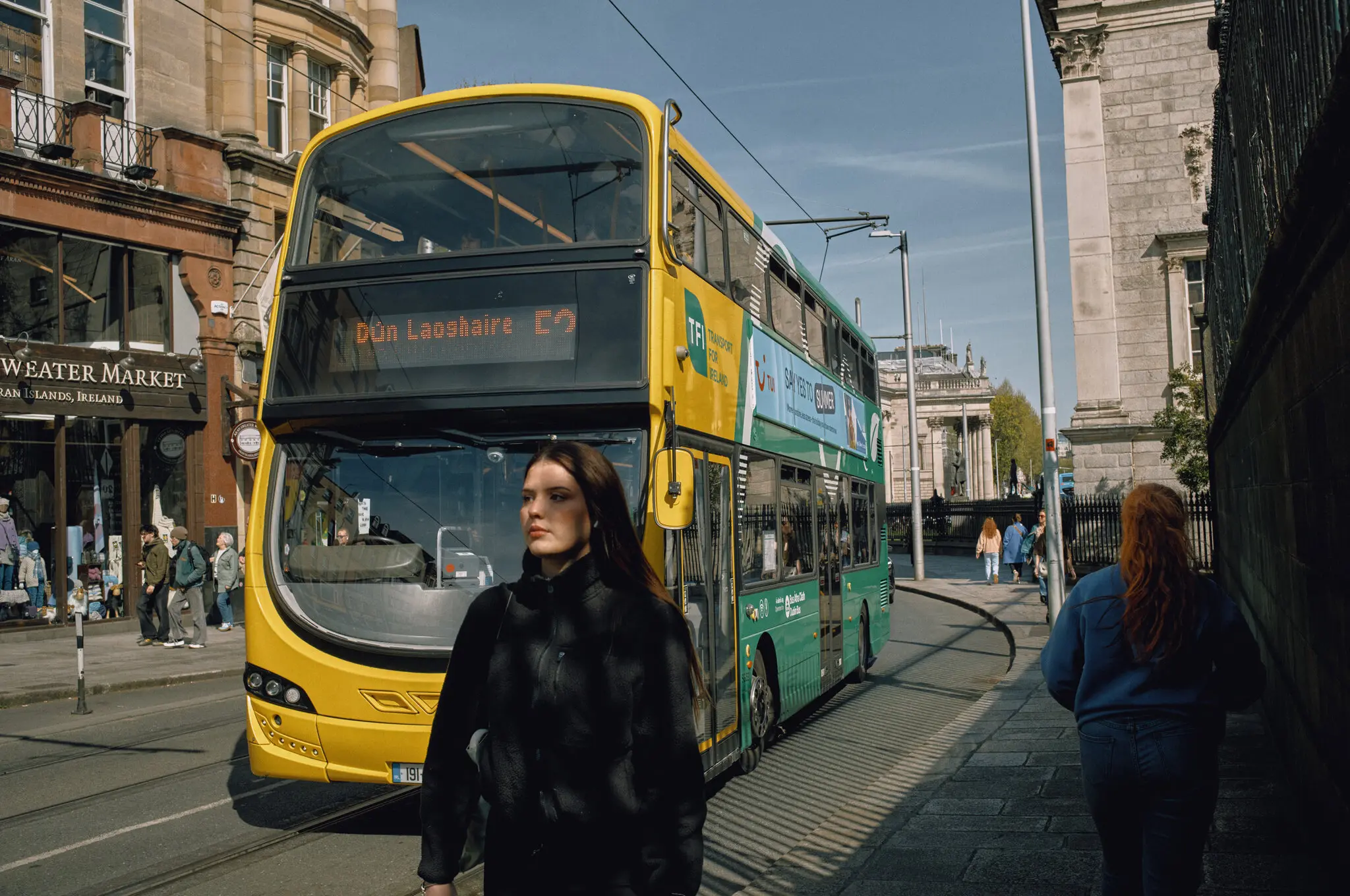 Бюджетні мандрівники можуть розраховувати на систему громадського транспорту, яка включає автобуси та легкорейкові трамваї — Майкл Вінс Кім
This is not a preserved tradition behind glass. It is a living scene. In a city where musical culture often matters more than architectural grandeur, a few songs on a crowded street can reveal more of Dublin than a formal tour. A budget route does not lose depth here; it gains spontaneity.
Sunday is the best day for a thrifty traveler. At Merrion Square, artists hang their work along the park railings, turning the street into an open-air gallery. Even without buying anything, it is easy to spend an hour among landscapes, portraits and city scenes that show Ireland not as a souvenir, but through local hands.
Nearby, the statue of Oscar Wilde is a reminder that Dublin remains a literary city not only because of plaques and famous names. Its writers have become part of the tourist mythology, but the city’s deeper tradition of language is still alive — in museum tours, pub talk and guides who tell history as if they are holding a room rather than delivering a lecture.
The free Sunday concerts linked to the Hugh Lane Gallery are another example of Dublin’s generosity. While the gallery is under renovation, performances take place at Abbey Presbyterian Church. Tickets must be reserved online in advance, but the experience is intimate, serious and never feels like a cut-rate substitute.
By afternoon, the music moves into the pubs. At the Brazen Head, often described as Ireland’s oldest pub, traditional sessions draw crowds, so arriving early matters. Musicians often sit around a table rather than on a stage, as if the evening has happened by accident. That is the strength of a Dublin pub: it does not always perform community; it creates it.
Across the street or in nearby neighborhoods, less tourist-heavy sessions offer reels, ballads and covers of Bob Dylan, Bruce Springsteen or the Cranberries. In Dublin, this mixture feels natural. Local tradition is not sealed in the past; it absorbs other songs and makes them part of the night.
Another way to save is to choose stories over expensive attractions. The Little Museum of Dublin is not free, but it explains something essential about the city: Dublin loves history best when it refuses to be dull. A tour there can feel like improvised theater, where 200,000 years of Irish history begins with a joke about cold and rain.
The city knows how to sell not only objects, but narration. Inside the museum, a room devoted to U2, an old telephone box, street photography and odd little collections might seem eccentric elsewhere. In Dublin, they work because the city itself is built from details and voices.
That becomes even clearer in the Liberties. Here, history does not have a polished surface. Around Guinness, new lofts and hotel developments, traces remain of working-class Dublin, old trades, decline and gentrification. A walk through the area shows the neighborhood not as scenery, but as a place where change has a cost.
Budget travel is also about eating well without treating every meal as an event. Dublin’s food scene is no longer limited to pub classics. Nearly one in five city residents is not Irish, and that diversity appears on the plate: Middle Eastern kebabs, Lebanese flatbreads, Chinese dumplings, local cafés, bakeries and casual places where lunch can be generous without becoming expensive.
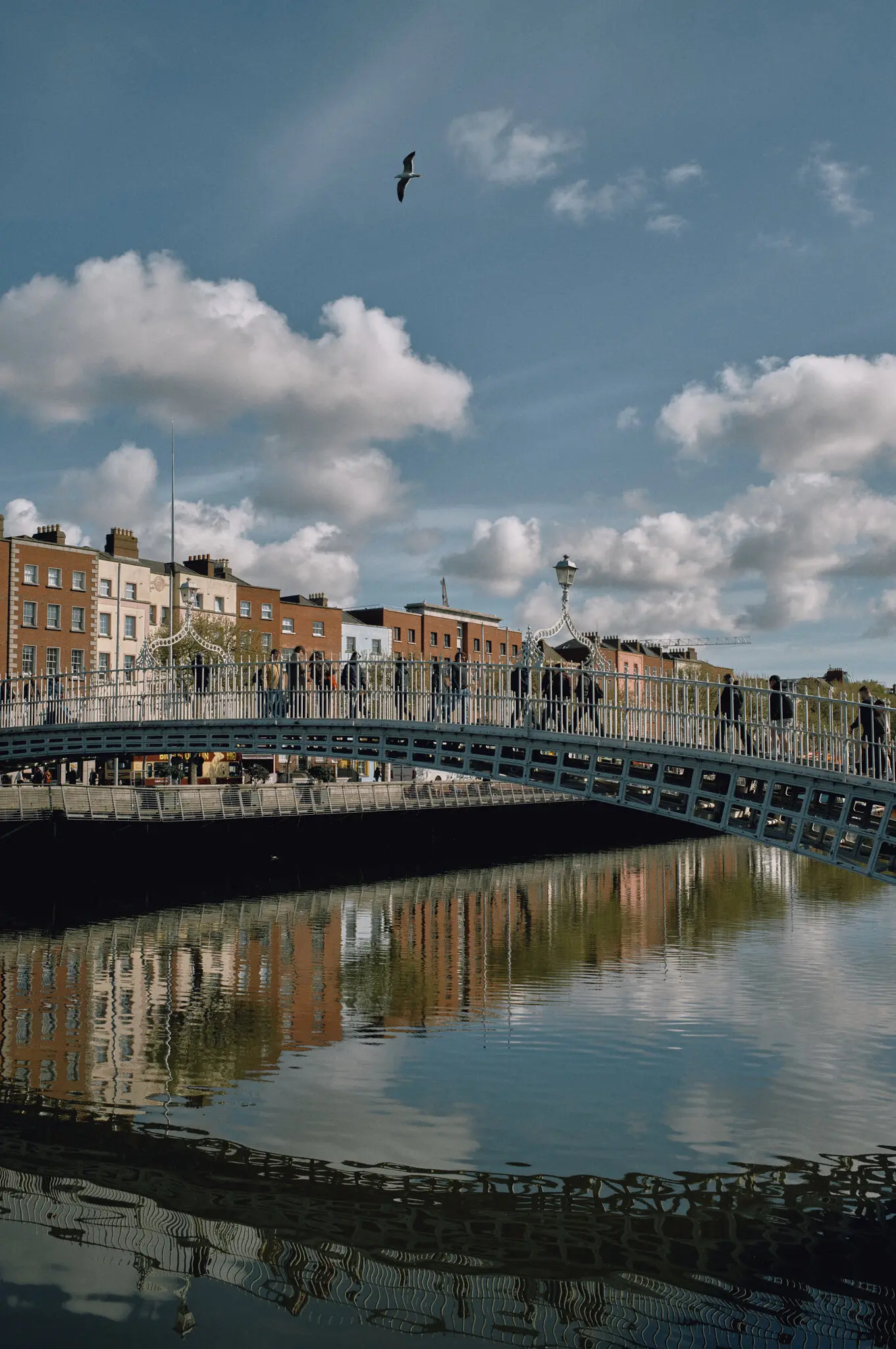 Пішоходи перетинають міст Ха'пенні через річку Ліффі — Майкл Вінс Кім
In Temple Bar, a filling Middle Eastern dinner can be found without restaurant ceremony. At Tang, a flatbread layered with hummus, lamb, beans, vegetables and salsa works as a fast, satisfying lunch. Near St. Stephen’s Green, Little Dumpling centers its menu on handmade dumplings with fillings such as wild mushroom and roast duck.
Bakeries are their own temptation, but a manageable one. Bread 41, near Trinity College, draws lines for cruffins, Danish pastries, salted caramel knots and savory tarts. The Fumbally in the Liberties blends bakery, grocer and neighborhood living room, offering the kind of breakfast that can replace a more expensive restaurant meal.
Accommodation remains the hardest part of a Dublin budget. Still, cheaper does not have to mean characterless. Zanzibar Locke near the Ha’penny Bridge offers an almost apartment-like feel, with a kitchenette, sofa and strong location by the River Liffey. Generator Dublin in Smithfield works as a hybrid of hostel and urban hotel, with both shared beds and private rooms.
Smithfield is especially useful for travelers who want to stay just outside the most touristed center while remaining close to it. From there, the river walk is easy, and the Cobblestone pub is nearby — one of those places where a music session can become the day’s main event without a ticket, a reservation or a script.
Dublin is not always cheap, but it is generous to the attentive. It rewards travelers who do not chase a checklist of mandatory sights, but let the city open slowly: across the Ha’penny Bridge, through Sunday music, past paintings on a park fence, in a guide’s sharp line or in a song rising from a packed pub.
That is the secret of a budget trip to the Irish capital. Dublin should not be reduced to a list of free things to do. Its real luxury is social energy, and that has almost no price. It sounds on the streets, laughs inside museums, spills through pubs and makes the city feel larger than any budget.