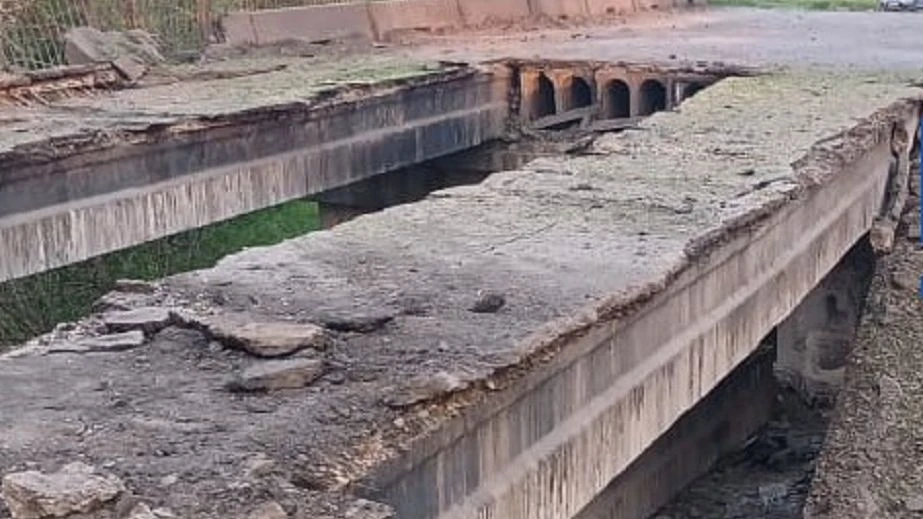



















Donald Trump’s threat to turn Tuesday into a day of strikes on Iranian power plants and bridges, unless Tehran loosens its blockade of the Strait of Hormuz, changes the structure of the crisis itself. This is no longer only about forcing Iran into a concession. It is about making civilian infrastructure an explicit instrument of wartime coercion.
That is why Europe’s response sounds sharper than a routine diplomatic warning. The line articulated in Brussels is not driven by passing irritation, but by a deeper principle: facilities on which civilian life depends cannot become an acceptable language of strategy, even when the target is a regime few in Europe are inclined to defend.
For the European Union, the issue is especially sensitive because it does not begin or end in the Middle East. Europe has spent years arguing that attacks on power grids, water systems and critical infrastructure are illegitimate methods of pressure against civilian societies. If it now falls silent when the same logic is directed at Iran, it risks weakening not only its legal position, but the moral architecture of its foreign policy.
In Daycom’s assessment, that is the real meaning of the current European warning. Brussels is not trying to shield Tehran. It is trying to defend a rule: one cannot condemn the destruction of energy systems in one war while treating the same method as acceptable in another. If that distinction collapses, the West loses its strongest claim — that it stands for order, not merely for force.
The problem is that Europe has almost no hard leverage with which to compel Washington to change course. That is why its answer takes the form it does: phone diplomacy, coordination with regional capitals, efforts to widen the space for talks, and a preference for multilateral pressure over military alignment. Even recent consultations around Hormuz were centered less on expanding the war than on preventing a new model of maritime coercion from becoming normalized.
The caution is easy to understand. For Europe, the Strait of Hormuz is not a distant regional flashpoint. It is one of the central arteries of the global energy system. A substantial share of seaborne oil and liquefied gas moves through that corridor. Once such a route becomes an object of military pressure, the consequences move quickly beyond the region and into prices, shipping, insurance, industrial costs and political stability across Europe itself.
Those consequences are no longer theoretical. The more traffic through the strait is disrupted, the more expensive not only fuel but predictability becomes. For European economies, that means renewed market anxiety, higher inflationary risk and the return of an energy insecurity the continent had hoped to leave behind after the most acute phases of Russia’s pressure campaign.
In that sense, the current crisis has become a double trap for the European Union. On one side, Europe cannot accept a world in which Iran is allowed to hold a global energy corridor in a state of political strangulation. On the other, it cannot accept that the answer to maritime blackmail should be the normalization of attacks on civilian energy infrastructure. That is why Brussels continues to speak the language of law even when that language sounds weaker than an American ultimatum. It is one of the last instruments through which Europe can still act as a political subject rather than a strategic spectator.
The legal dimension here is not ornamental. Once power plants, bridges and other elements of civilian infrastructure are openly discussed as legitimate targets, the boundary between military action and war against the conditions of ordinary life begins to erode. At that point, the issue is no longer simply one of means. It becomes a question of whether modern conflict retains any meaningful red lines at all.
For Trump, too, there is political risk in this course. The louder the threat, the greater the cost of stepping back from it without result. But if the threat is carried out, Washington will face more than another phase of escalation. It will collide directly with the same legal logic on which the West has built much of its criticism of other wars. The impact would not stop at Iran. It would hit the internal coherence of the Western camp itself.
That is why the core of Europe’s warning is larger than the attempt to stop one specific strike. What is at stake is whether the West still has a shared boundary between force and arbitrariness. When war begins to speak in the language of power stations, bridges and systems of survival, diplomacy is usually already late. But it is precisely at such moments that the existence of any real order is tested.