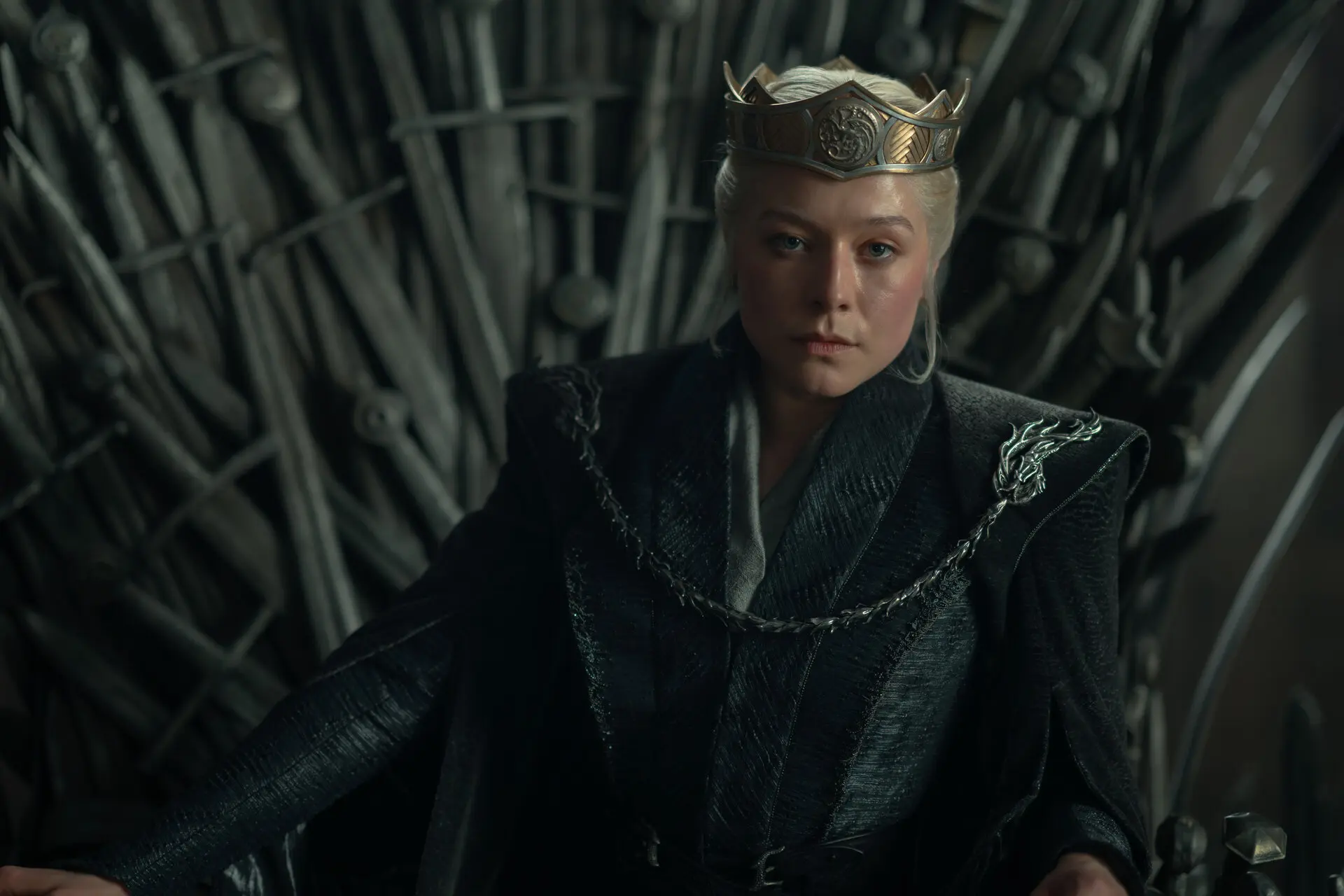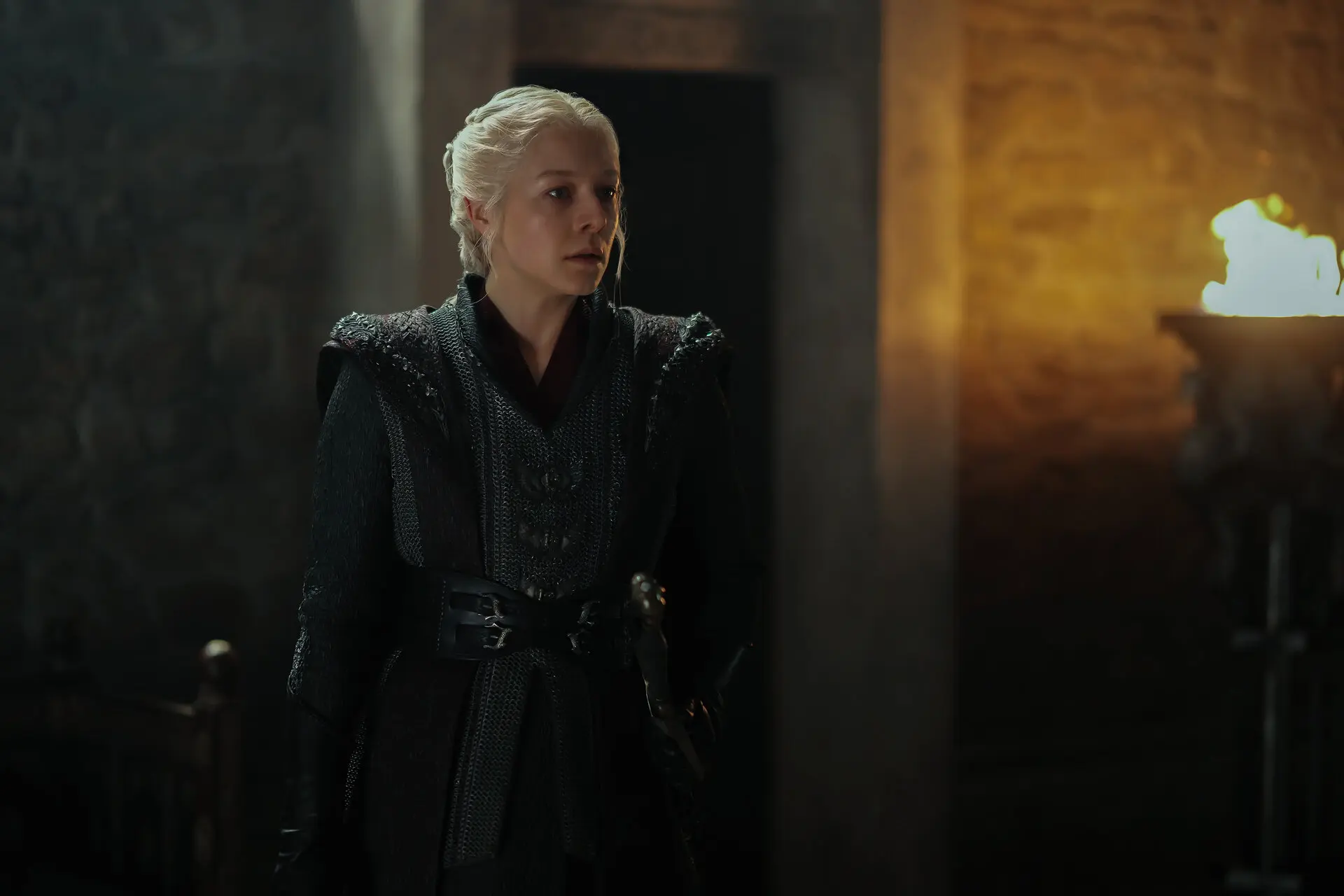



















In House of the Dragon, power rarely looks like victory. More often, it resembles a stone slowly pressing down on the neck of whoever has just climbed onto the throne. In the fourth episode of Season 3, Rhaenyra is no longer only fighting her enemies. She is beginning to fight the consequences of her own rule.
“Tumbleton” is not built around one grand battle. Its strength lies elsewhere: almost every scene shows how war corrodes alliances, families, oaths and the characters’ ideas of themselves. Dragons still burn people here, but the real fire comes from inside a system that is losing trust.
Rhaenyra enters the episode with formal authority, but not full control. She has the crown, the capital, the council, dragons and the stronger claim. Yet the more she tries to impose order on chaos, the more she looks like a ruler who has inherited not a state, but a machinery of grievances, debts and half-betrayals.
According to Daycom’s assessment, the episode matters because it moves the conflict into the realm of governance. Being the rightful heir is proving easier than being an effective queen. Rhaenyra is not losing to the enemy on the battlefield, but she is beginning to lose the warmth of her allies — and in a dynastic war, that can be more dangerous than an army.
The strongest thread begins far from the royal chamber, in the Vale, where Daemon finds Rhaena and the dragon Sheepstealer. For the viewer, this is not merely the revelation of a secret. It is a blow to the very nature of Daemon, a character who has long behaved as if every feeling can be replaced by action, threat or violence.
Sheepstealer was part of the tragedy that led to Jace’s death. Rhaenyra wants justice; she wants to confront and punish the guilty. But for Daemon, the truth is not political. It is paternal. The dragon’s rider is his daughter. To avenge Rhaenyra’s child, he would have to sacrifice his own.
That is where the episode unexpectedly strips Daemon of his armor. His brief “no” lands harder than a long speech. A man who has spent years looking at death with almost aesthetic indifference suddenly breaks before a consequence he cannot cut down with a sword. For the first time in a long while, Daemon looks not demonic, but helpless.
Rhaena gives him a demand that sounds like a sentence on their relationship: if he loves her, he must leave her in exile and not betray her to the queen. This is not reconciliation between father and daughter, but a bargain between people who have lived too long without trust. Daemon chooses a lie because the truth would destroy the last thing in him still capable of pain.
His return to King’s Landing is one of the episode’s darkest scenes. He throws the charred severed head of a shepherd onto the small council table and claims he has found and killed Sheepstealer’s rider. It is almost a parody of state justice: there is a head, there is proof, there is a convenient story — yet everyone can feel that truth lies somewhere offstage.
Rhaenyra responds not with relief, but with anger. She has been denied the chance to face the person she believes responsible for her son’s death. There is maternal grief in that anger, but also something more dangerous: the desire for power to serve not only law, but personal revenge. Here the queen begins to approach the line where justice becomes a ritual of rule.
Mysaria, as always, sees more in the scene than others do. She doubts whether the head belongs to the right man, and her distrust of Daemon has both personal and political roots. Mysaria looks at power from below, from the side of the common people, and therefore understands what others may not: the head of an unknown shepherd may be less proof than an offering meant to soothe the queen.
While Daemon lies, Rhaenyra tries to build a state. She fills seats on the council, allows Grand Maester Orwyle to remain under condition of loyalty, appoints Ser Torrhen Manderly as master of coin and tries to give shape to her court. But these decisions do not create strength. They show a queen forced to assemble an administration from people she does not fully trust.
Manderly’s appointment is especially revealing. He is needed not only as a financier, but as a future culprit when the money runs dry. It is a small but precise detail in Rhaenyra’s politics: her rule is already thinking not only in terms of victory, but in terms of blame that will eventually need a body.
The deepest crack opens in her relationship with Corlys Velaryon. The Sea Snake leaves the capital to fight Triarchy pirates, but his departure does not feel like simple military necessity. He is angered by Rhaenyra’s refusal to legitimize his sons. For a man who has given her fleet, name and political weight, this is humiliation.
Corlys leaves not as an enemy, but not as a fully devoted ally either. He leaves Alyn of Hull to serve in his place, and that gesture carries ambiguity. On one level, it is duty to the queen. On another, it is a reminder that Rhaenyra keeps near her people whose status, grievances and rights she has not resolved. Allies do not always betray at once. Often, they simply drift away.
Ulf White’s thread turns this problem almost grotesque. The new dragonrider asks for lavish gifts for his tavern “allies,” and at first the scene plays as comedy. But beneath Ulf’s awkwardness lies a social danger that Rhaenyra does not seem to hear. She has gained dragons through people who did not grow up inside royal discipline.
Ulf is not a noble knight in the old sense. He is a man from the street, accidentally raised to a force once reserved for a dynasty. His grievances are petty, but hatred is often born from petty humiliations. When Rhaenyra forbids him from returning to the tavern, she thinks she is imposing order. He likely hears only contempt.
That is one of the episode’s central themes: the Targaryens too often confuse control with understanding. They see dragons, oaths, offices and commands. They poorly hear humiliation, hunger, fear, social resentment and the desire to be seen. Ulf may joke, stumble over words and seem ridiculous, but his discontent is not ridiculous.
On the other side of the war, Aegon undergoes his own humiliation. His journey with Larys to the remains of Sunfyre has an almost ghostly quality. The once-golden dragon is now a dead, or half-dead, symbol of royal delusion. Aegon refuses to accept what is before him because accepting the dragon’s death would mean accepting his own fall.
The ruins of Rook’s Rest become his school of reality. Soldiers left behind by Criston have turned the place into a small feudal swamp, where a former king can be assigned the lowest work and forced to kiss filthy boots. For Aegon, who treated power as a right to desire, this is almost unthinkable humiliation.
Yet in that scene the episode states the lesson of war with brutal clarity: the crown does not protect anyone from the world it helped destroy. Aegon is not facing an enemy, but the consequence of his own age. Where power has made violence normal, even a king can become a body forced to kneel.
Criston Cole, meanwhile, reaches Harrenhal and finds that Aemond has vanished with Vhagar. Without the dragon, his troops lose not only air support, but the illusion of invincibility. Instead of moving logically south to join the Hightower forces, he chooses guerrilla war against Rhaenyra’s far larger host.
His language of honor rings hollow because the viewer knows Criston too well. For him, honor has long become a language used to cover grievance, guilt and failure. He is not so much leading men toward strategy as searching for a form of death that will allow him not to admit defeat.
In Tumbleton, the episode opens another line of male power through Ormund Hightower. He appears almost as a caricature of aristocracy: arrogant, theatrical, condescending. Very quickly, however, it becomes clear that beneath the manners lies not merely vanity, but dangerous political ambition.
His men occupy the town, lodge themselves in private homes, humiliate civilians and commit violence. When a soldier assaults Kat, Hugh Hammer’s wife, Ormund performs the role of the just lord: he punishes the offender, orders care for the wounded and displays order. But it is the order of a man who created the conditions for impunity in the first place.
Beside him stands Daeron Targaryen — a boy raised by the Hightowers, not yet fully corrupted by power, but already pulled into its machinery. His reaction to Ormund matters. He sees how easily piety becomes rage, and how quickly public discipline becomes private cruelty.
When Ormund learns that help from Harrenhal will not arrive, his theatrical religiosity collapses instantly. He erupts in filthy anger, hacks at a table with his sword and reveals the true scale of his ambitions. He does not merely want to serve the Greens. He wants to reshape the dynastic game by placing Daeron on the throne.
In his logic, Daeron is valuable precisely because he was raised as a Hightower rather than a Targaryen. Ormund sees in him a chance to end the rule of “savages” kept in power by dragons. Yet in the next moment, he is perfectly happy to use dragonfire for execution. His disgust with Targaryens easily coexists with the usefulness of their monsters.
That contradiction is one of the episode’s sharpest. Nearly every character condemns someone else’s cruelty while freely using their own. Rhaenyra wants legality, but hungers for revenge. Daemon imitates justice while hiding a lie behind another man’s head. Ormund speaks of civilization while building it through fear and fire.
The episode also works carefully with fathers and children. Rhaena confronts Daemon with his absence and indifference. Daeron sees that his mentor is not the man he seemed to be. Criston remembers a father broken by a lord’s whim. Alicent learns that Helaena is pregnant, and the news lands not as joy, but as another turn in the dynastic curse.
Against this background, the scene between Rhaenyra and Alyn beside the model of Old Valyria works almost like a quiet pause. They speak of fathers — formidable, difficult, inconvenient men who shape their children not only through love, but through shadow. Rhaenyra sees in Alyn something more than Corlys’s temporary representative. She sees a person who knows what it means to live beside a great name without having full claim to it.
Alyn, for his part, brings a sailor’s practical intelligence into the Red Keep. His suggestion to use cats in place of the rat-catchers Aegon killed plays as a light detail, almost a joke amid heavy politics. But it matters: in a world where lords and queens think in dragons, sometimes the wisest solution is a cat.
These small scenes remind us that House of the Dragon is at its strongest not when it shows only flame, but when it reveals the domestic cost of grand decisions. Aegon killed the rat-catchers; now the castle has a rat problem. Corlys is insulted; now the queen loses her hand. Ulf is humiliated; tomorrow he may become a crack in dragon power.
The fourth episode does not accelerate the plot with a single explosion. It methodically plants mines. Rhaenyra thinks she is imposing order. Daemon thinks he is saving his daughter. Ormund thinks he is beginning a new political game. Criston thinks he is saving honor. Aegon thinks his dragon may still be alive. All of them, in one way or another, are lying to themselves.
That is the episode’s maturity. It does not offer the viewer a simple center of sympathy. Rhaenyra remains the more legitimate claimant, but legitimacy does not make her flawless. The Greens remain cruel and divided, but not all of them are empty in the same way. Children repeat the errors of their fathers even when they can see the cost.
The title “Tumbleton” promises a future fall. In this episode, that fall has not yet become catastrophe, but the floor can already be heard cracking. Rhaenyra’s power grows heavier, and the more tightly she grips it, the more people begin slipping through her fingers. In the Targaryen world, thrones are rarely taken in a single blow. More often, they are first weakened by grievances, distrust and small decisions that seemed necessary.
House of the Dragon again shows war not as heroic epic, but as slow moral corrosion. Dragons can burn an army, but they cannot teach anyone how to rule. A crown can give an order, but it cannot make allies feel respected. A head on a table can close a case, but it cannot restore the truth.
That is why the episode leaves not a sense of conclusion, but the anticipation of an inevitable fracture. Rhaenyra is still on the throne, Daemon is still beside her, Corlys is not yet an enemy, Ulf is still joking, Daeron is still hesitating. But each of them has already done or seen something that will change the next step. Power is holding. The only question is how many more people it will push away before it understands its own weight.