






















Five weeks of war have given Washington the kind of evidence it prefers to display in campaigns like this: large target counts, expanding lists of damaged sites and the language of an operation approaching completion. But air superiority is not the same as impunity. It means the skies are open enough for effective operations, not that danger has disappeared from them.
That distinction was exposed by the loss of an American F-15E over Iran. After weeks of claims that the battlefield was moving under near-total control, the war abruptly delivered a simpler truth: degraded defenses are not the same as destroyed defenses. Iran has not denied the United States the airspace. It has shown that it can still make that airspace more costly, more anxious and far less politically clean.
This matters not only because a single aircraft was lost. It matters because it breaks the temptation to read the campaign as a linear process in which more airstrikes automatically mean less Iranian power. The war is increasingly beginning to look like something else: a contest not over who dominates the sky, but over whose military infrastructure can absorb punishment and return to use more quickly afterward.
As Deykom sees it, Iran’s resilience now rests less on any myth of intact air defense than on an architecture of endurance. Missile cities underground, tunnels, bunkers, concealed shelters, mobile launchers and dispersed command nodes were built for exactly this moment: not to win a conventional head-on confrontation, but to survive the first wave of blows and preserve the ability to answer with pain.
That logic has already been visible across the region. Iran has continued striking Israel, hitting sites tied to U.S. allies in the Gulf and proving that even a battered arsenal can still shape the psychological balance of the conflict. These attacks do not overturn the military hierarchy of the war. They do something subtler and, in some ways, more important. They prevent the campaign from looking like a one-directional imposition of force.
The most uncomfortable fact for the Pentagon is that there is still no clear sign of rapid strategic disarmament. Iran’s missile capacity has been reduced, its launch tempo has dropped and the cumulative pressure of American and Israeli strikes is unmistakable. But reduced is not eliminated. As long as launchers, missiles and support systems remain hidden, recoverable or restorable, the campaign remains one of attrition rather than final suppression.
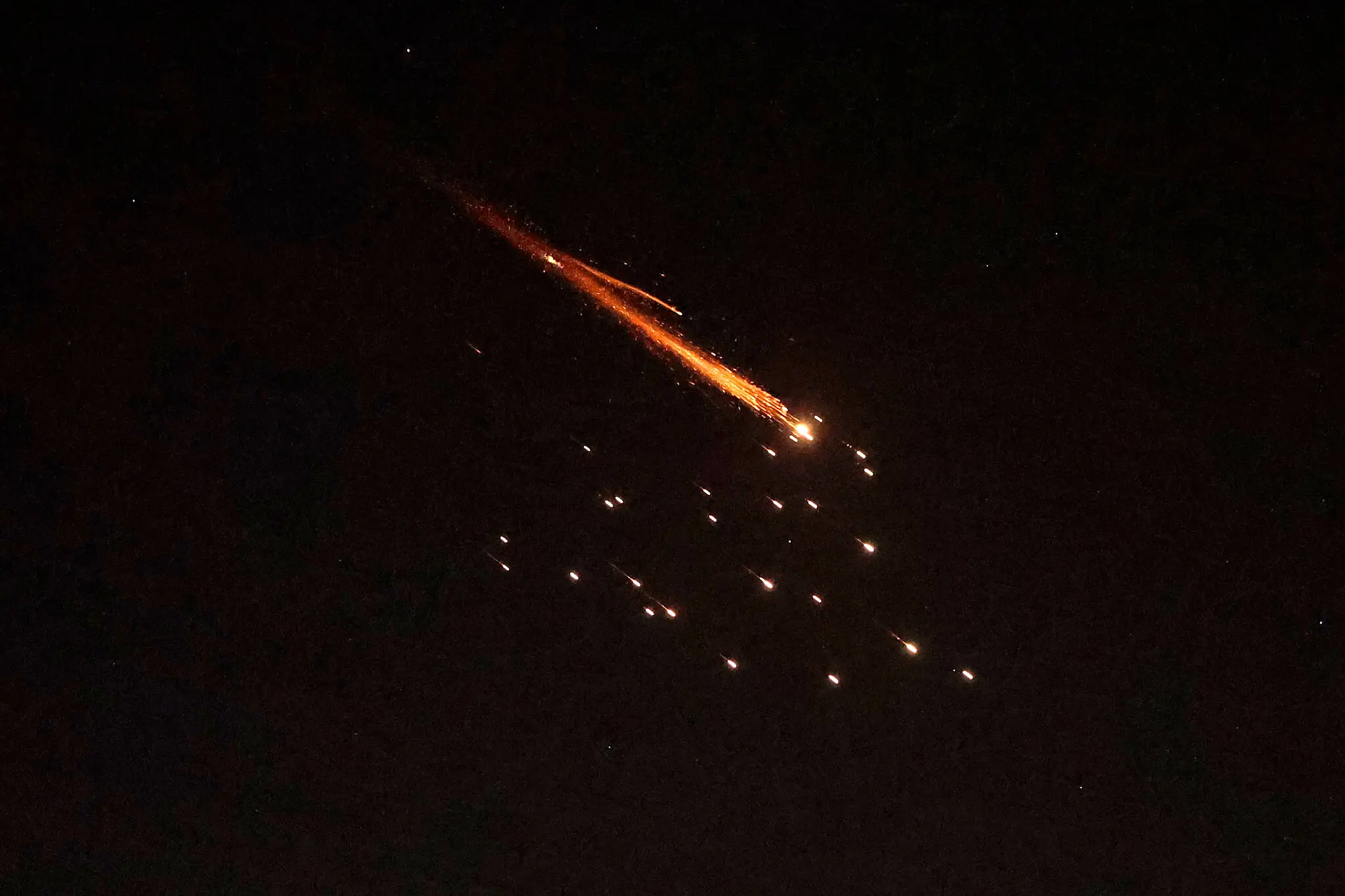 Ракета летить у небі над Нетанією, Ізраїль, на тлі нового шквалу ракетних атак Ірану минулого тижня — Джек Гез
That is where Iran’s underground infrastructure becomes decisive. Hardened sites do more than shield weapons. They also compress the political effect of each strike. What looks from the air like a disabled silo or a buried bunker may prove to be only temporarily blocked. If a system can be dug out, reactivated or replaced quickly enough, then every declaration of success begins to age almost as soon as it is delivered.
This is why the fall in Iranian launch numbers must be read carefully. A lower rate of fire can certainly reflect battlefield losses. It can also reflect adaptation. Tehran has strong reason to preserve its remaining launchers, move more cautiously, spread out its strikes and turn the war into a slower economy of endurance. In an attritional conflict, restraint can be as strategic as intensity.
None of this cancels American and Israeli superiority in the air. That superiority is real, and it is what makes deep strikes on Iranian military, transport and energy targets possible in the first place. But the latest phase of the war has made the boundary of that superiority easier to see. One can dominate the sky and still fail to silence the adversary. Iran is no longer fighting for the air. It is fighting for the right to remain dangerous from beneath it.
That is the strategic nerve of the moment. Washington wants to prove that the campaign is producing systemic disarmament. Tehran wants to prove that even after weeks of bombardment it can still preserve living nodes of force: mobile air defenses, missile bunkers, launch infrastructure and the capacity to regenerate pressure. In that contest, a single downed F-15E can sometimes weigh more heavily than a hundred successful sorties.
There is another reason this war resists any simple story of victory from above. The campaign increasingly depends on the ability to measure real damage rather than visible damage. But in a battlespace shaped by decoys, mobility, concealment and underground depth, battle damage is difficult to read with confidence. What appears to be total suppression can turn out to be only temporary muting.
For Iran, that may already be enough. It does not need to reverse the war to preserve the strategic meaning of its resistance. It needs only to show that it cannot be switched off quickly from the air, that its missile force is still alive in reduced form and that its defenses can still bite on occasion. For Washington, this creates a particularly sharp political problem: the louder the language of total control becomes, the more damaging every contrary fact appears.
That is the real meaning of this phase of the war. Iran’s defenses have been badly hit, and its missile force is no longer operating with its former intensity. But damaged is not the same as neutralized. As long as missiles, launchers and mobile defense systems survive underground, and as long as even one expensive American platform can still be struck from the sky, the campaign remains less a story of completed dominance than a story about the limits of dominance itself.