















In a closed political system, absence can speak louder than any statement. For two weeks, Elvira Nabiullina, the head of Russia’s central bank, disappeared from public view. What might have been a minor health episode elsewhere became, in Moscow, a test of confidence in the architecture of Russia’s wartime economy.
When Nabiullina returned to a news conference, she did what she has long done best: she spoke in a controlled, technical register, without drama. The central bank cut its key interest rate from 14.25 percent to 14 percent, a modest move meant to signal that policy remained orderly despite growing pressure.
Her explanation for the absence was spare: a cold, a temporary loss of voice, gratitude to those who had sincerely worried about her health. But by then the pause had already done its work. Rumors had filled the silence, exposing anxiety inside Russia’s economic and political elite.
According to Daycom’s earlier analysis, the episode matters not because it concerns one official, but because it reveals the central nerve of the Russian system. The country’s outward stability still holds, but it increasingly depends on decisions that run against the normal logic of macroeconomic management.
Since the full-scale war began, Nabiullina has become the symbol of Russia’s technocratic firewall. She did not choose the political course, but she helped make it financially survivable through high interest rates, inflation control, currency restrictions and discipline across the banking system.
That is why her disappearance drew such attention. In Russian politics, conflict is rarely announced directly. It is read through missed forums, unexplained absences, changes in protocol, official phrasing and the question of who stands near the president at decisive moments.
Her return was supposed to calm markets. Yet the rate decision itself showed how narrow the room for maneuver has become. Business wants cheaper credit. The budget needs money. The war demands rising expenditure. Inflation prevents the central bank from opening the credit tap too quickly.
Nabiullina effectively acknowledged that fiscal policy had become looser than the central bank had expected. Higher state spending expands the money supply and forces the regulator to maintain a stricter rate path. In plain terms, the war is increasingly dictating the conditions of monetary policy.
The figures make that conflict visible. From January to May, Russian federal spending rose by roughly 17 percent compared with the same period a year earlier. The budget deficit nearly doubled, reaching about $82 billion. This is no longer a temporary burden; it is the structure of an economy rebuilt around a long war.
The wartime model creates a dangerous paradox. It supports production, employment and nominal incomes through state orders, but at the same time overheats demand, drains the budget and pushes prices upward. What looks like resilience increasingly resembles dependence on permanent injections of public money.
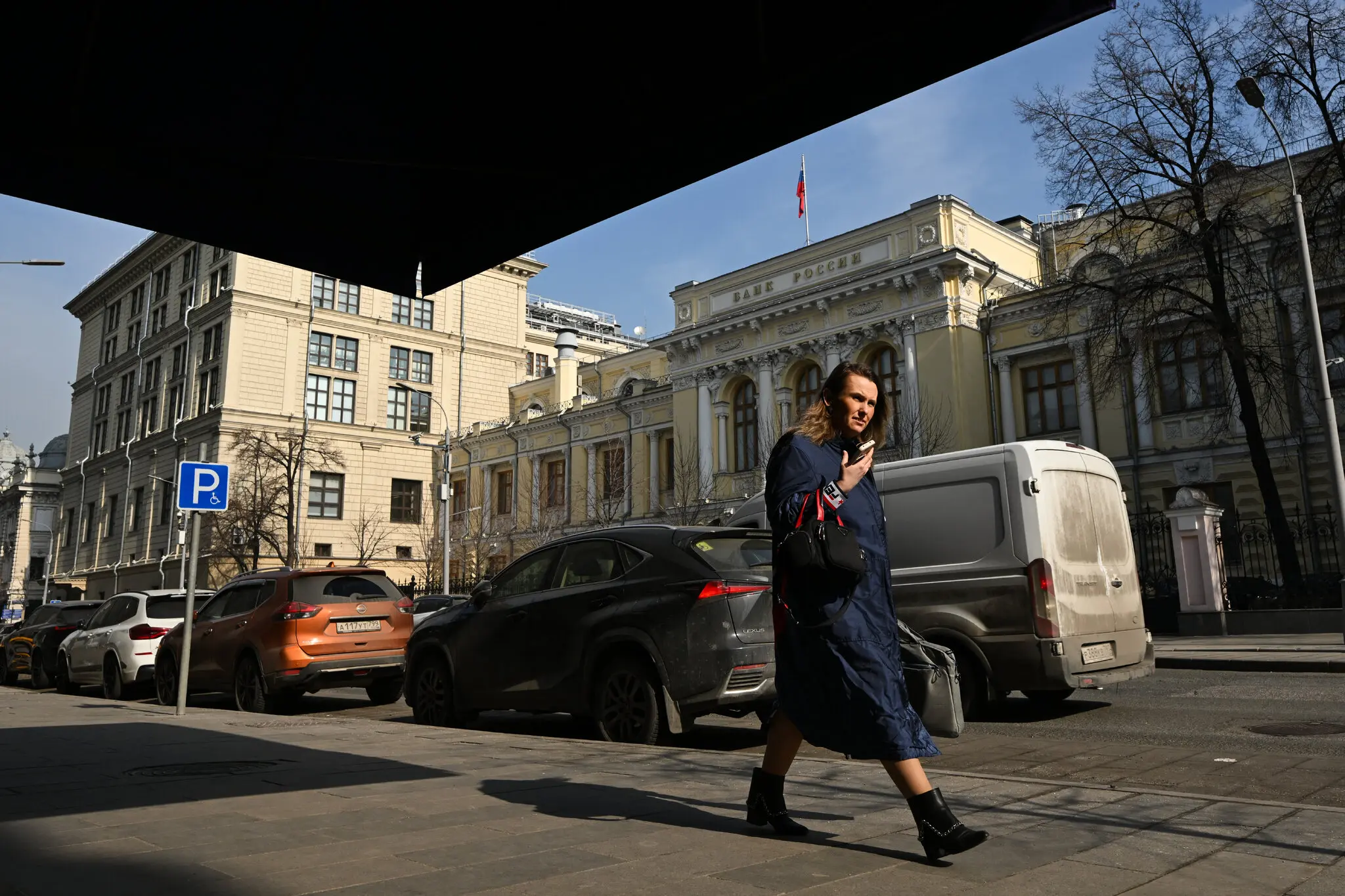 Біля штаб-квартири російського центрального банку в Москві у березні — Ігор Іванко
This is where Nabiullina’s role becomes politically sensitive. High interest rates restrain inflation but hurt civilian business, investment and lending. Lower rates would help industrial lobbies and the state budget, but they could accelerate price growth and weaken confidence in the ruble.
The Kremlin, however, thinks less in terms of equilibrium than in terms of endurance. If more spending is needed, fiscal limits are pushed aside. If inflation accelerates, it can be explained as temporary. If business complains about expensive loans, pressure shifts toward the central bank.
Oil adds another layer of uncertainty. Higher prices can give Moscow temporary relief, but a strong ruble, sanctions and attacks on energy infrastructure reduce the benefit. For the budget, oil is no longer the reliable cushion it once was; it is a more unstable source of oxygen.
Against this backdrop, even a cautious rate cut looks less like the beginning of genuine easing than a constrained political gesture. The central bank shows that it has heard the signal from above, while still reserving the right to warn about risk. In the Russian system, that is almost the maximum available form of disagreement.
Nabiullina does not build public drama. Her language is made of rates, inflation, fiscal parameters, money supply and expectations. But behind that dry vocabulary sits a sharper question: can a professional regulator remain independent when the main variable of the economy lies outside its control?
That variable is the war. It determines spending, demand for labor, industrial capacity, the budget deficit, pressure on the ruble and public expectations. The central bank can treat the consequences, but it does not control the cause. That is the limit of its power.
Outwardly, Russia’s economy still appears manageable. Shops are open, wages in some sectors have risen, defense plants are busy, and banks have not collapsed. But this picture is sustained at a high price: expensive money, fiscal strain and a harsher redistribution of resources toward the military sector.
The regions are especially exposed. There, budget pressure appears faster than in federal presentations: infrastructure, utilities, local programs and public services become easier to cut. A war economy first looks like a source of money; later, it begins to take space away from civilian life.
The pressure is intensified by the calendar inside the financial system itself. Nabiullina’s term expires next year, and the question of succession is already part of economic uncertainty. For a system accustomed to personalizing stability, this is not a technical detail.
Her return was meant to show that nothing had happened. The result was more complicated. A two-week pause was enough for elites to talk about the limits of control, the conflict between the budget and interest rates, the fatigue of the financial model and the cost of prolonging the war.
Nabiullina returned to the podium and again spoke the language of control. But the fact that her absence became a political event shows the depth of the tension. In an ordinary economy, this would have been a story about an official’s health. In wartime Russia, it is a symptom of a system that finds it harder to hide its cracks.