




















Saudi Arabia has found itself at the center of a new geopolitical contradiction after the war with Iran sharpened attention on the American military presence inside the kingdom. Formally, Riyadh does not acknowledge taking part in the fighting, yet the conflict itself has already shattered that convenient ambiguity.
The turning point was the Iranian strike on Prince Sultan Air Base, which, according to the provided materials, injured 12 American service members. Saudi authorities have not publicly confirmed this, and that silence has itself become one of the most significant political signals of recent days.
That silence hardly appears accidental. Against the backdrop of Donald Trump’s remarks that Crown Prince Mohammed bin Salman was supposedly “fighting with us,” official Riyadh is projecting a very different line: distance, caution, and a refusal to tie itself openly to the U.S.-Israeli war against Iran.
According to Deykom’s preliminary assessment, this gap between Washington’s external rhetoric and Saudi Arabia’s restrained messaging reveals the real drama of the moment. The kingdom still relies on American security, yet fears the political price of being too publicly linked to the war.
Saudi Arabia’s official position, like that of most Gulf states, is that its territory and airspace are not being used for American attacks against Iran. This is an important formula of self-protection, designed to reduce the likelihood of further missile strikes and drone attacks against the kingdom.
But that formula is not driven only by external calculation. The issue of American troops on Saudi soil has long been politically sensitive for part of the population. It becomes especially explosive when the matter is no longer just defense, but possible involvement in a joint U.S.-Israeli campaign in the Middle East.
Historical memory plays a decisive role here. In the 1990s, the arrival of U.S. troops in Saudi Arabia after Saddam Hussein invaded Kuwait triggered a wave of domestic dissent that was later suppressed. Today, the Saudi leadership clearly understands how dangerous it would be to return that issue to the center of public debate.
That is why it is no surprise that the Saudi media space often repeats the claim that, unlike neighboring countries, the kingdom does not host American military bases. The reality, however, is more complicated: the U.S. military presence in Saudi Arabia remains significant, and the war with Iran has once again made it visible.
This became most obvious around Prince Sultan Air Base, southeast of Riyadh. A facility that had previously remained largely a technical element of the regional security architecture has now become a symbol of an uncomfortable truth: the United States is physically present in Saudi Arabia, and therefore inevitably part of its domestic political equation.
According to the provided account, at least two KC-135 aircraft suffered serious damage in the recent missile and drone attack, while 12 U.S. troops were injured. If these details are accurate, this was not a peripheral incident, but a strike against infrastructure important to American military logistics in the region.
Saudi Arabia’s Ministry of Defense, however, spoke only of intercepting three drones and of debris falling in a “military area,” without mentioning any injuries. That discrepancy between the unofficial picture and the state narrative has strengthened suspicions that Riyadh has chosen to minimize the public consequences of the strike.
Saudi dissidents reacted quickly to that contradiction. Opposition figures in exile directly accused the authorities of lacking transparency and raised a broader question: do foreign military bases create an additional threat to national security? In this way, a matter of defense rapidly becomes a matter of trust in the state itself.
Mohammed bin Salman’s own position remains deliberately blurred. On one hand, sources familiar with American assessments reportedly said that he had urged Trump to maintain pressure on Iran, describing the moment as a “historic opportunity” to reshape the Middle East.
On the other hand, Saudi officials reject the suggestion that the crown prince pushed Washington to prolong the war. On the contrary, the official narrative stresses that Saudi Arabia has always supported a peaceful settlement, even before the conflict began. That two-layered posture is at the core of current Saudi diplomacy.
Earlier, Saudi Arabia’s foreign minister had warned that the kingdom’s patience with Iran was limited and that Riyadh reserved the right to take military action if it deemed such action necessary. That suggests the kingdom does not want to appear weak, even while trying to avoid direct entry into the war.
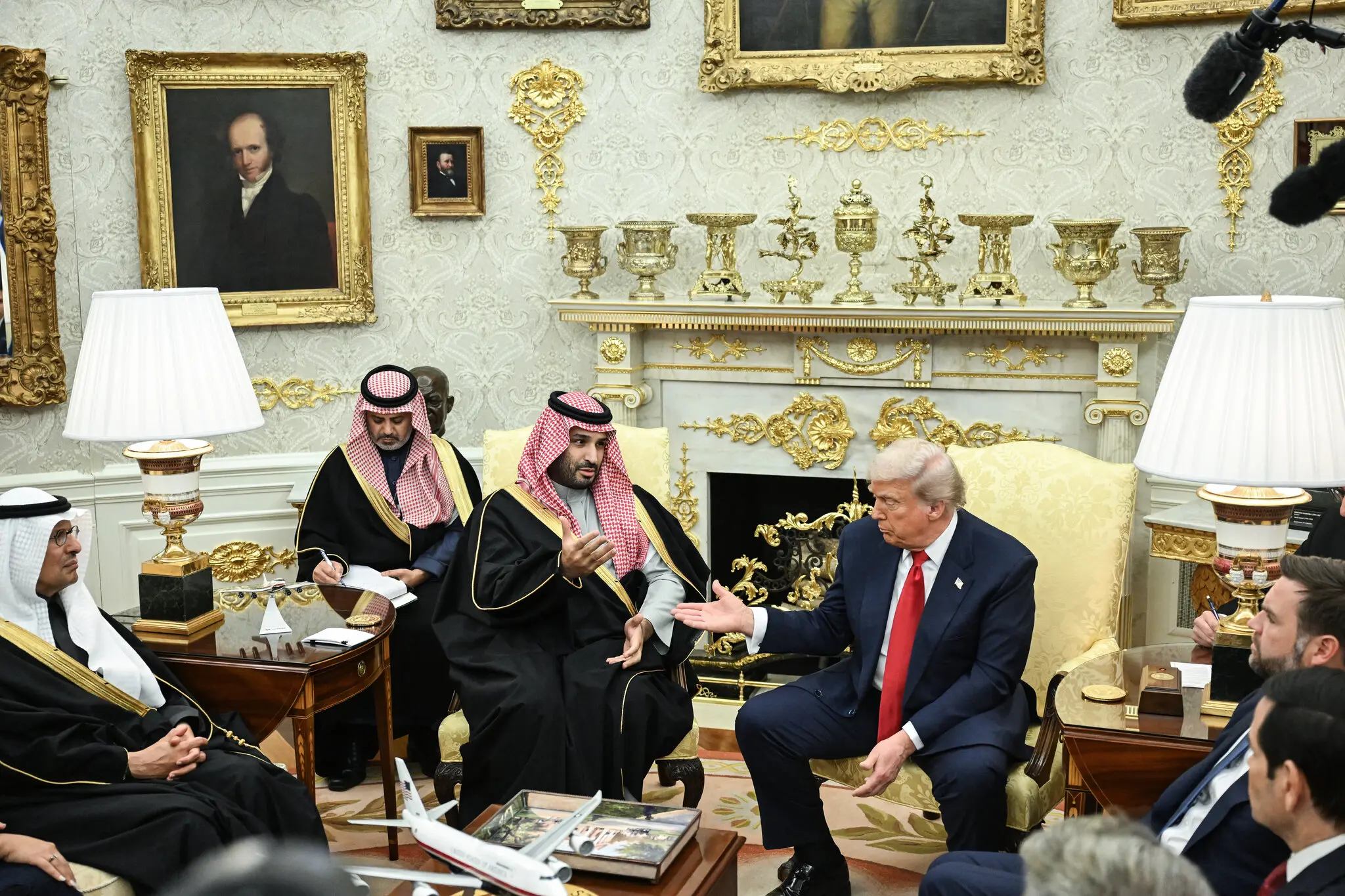 Зустріч президента Трампа з кронпринцем Мухаммедом бін Салманом у Білому домі в листопаді — Кенні Голстон
Donald Trump, however, did not treat those caveats as a final answer. Speaking in Miami at an event linked to Saudi Arabia’s sovereign wealth fund, he repeated the claim that Saudi Arabia, Qatar, the United Arab Emirates, Bahrain, and Kuwait had all “fought” alongside the United States. For Riyadh, that framing is politically toxic.
Saudi Arabia’s Center for International Communication did not respond to requests for comment on Trump’s remarks or on the strike that injured American troops. In the kingdom’s information strategy, that silence functions as a shield: the fewer official confirmations there are, the more room Riyadh preserves for diplomatic maneuver.
That approach is understandable, but it is not without risk. If Iran continues striking facilities linked to the United States, concealing the scale of the American military presence will become increasingly difficult. Each new gap between facts and official statements will further erode trust both inside the country and abroad.
Saudi Arabia’s strategic problem is that it cannot convincingly present itself both as a key U.S. ally and as a detached observer in the war with Iran. Its dependence on Washington for security pushes it toward cooperation, but the logic of self-preservation forces it to reduce the visibility of that cooperation as much as possible.
More broadly, the Iran war has exposed the fragility of the entire Gulf security model. American troops, missile strikes, drones, bases, energy vulnerability, and political legitimacy have now converged into a single knot. For Riyadh, that knot has turned out to be not primarily military, but political.
In the coming period, the key question will not only be how many American forces are actually stationed in the kingdom, but whether the Saudi leadership is prepared to explain honestly to its own society where the limits of that partnership lie. In a Middle East at war, silence is no longer neutral; it has itself become part of the larger game.