





















The overnight strikes on Iran changed the geography of the conflict. In previous days, the war had centered on the Strait of Hormuz, shipping lanes and American bases in the Persian Gulf. Now it has reached port cities, airport infrastructure, the area around a nuclear power plant and a railway route in the north of the country.
Iranian state media reported explosions in Chabahar, Bandar Abbas, Sirik and Konarak — cities critical to maritime logistics along Iran’s southern coast. In Chabahar, a strike damaged a maritime control tower near the harbor. Visual evidence showed a large fire and serious destruction at the site.
The attacks were part of two days of American strikes, after which Iranian officials reported at least 14 people killed and 78 injured across five provinces. Washington links the operations to the need to weaken Iran’s ability to threaten shipping, but the expansion of targets shows that this is no longer only about boats, missiles or coastal positions near Hormuz.
According to Daycom’s assessment, the key shift is that the war is moving from a struggle over the strait to a struggle over infrastructure of influence. Ports, piers, control towers, airports and railways are not secondary assets. They are the nervous system of a state, allowing it to move cargo, sustain exports, shift resources and demonstrate control over territory.
Chabahar carries particular importance. It is not only a port city in southeastern Iran, but also one of the important nodes for trade and strategic routes that bypass the bottlenecks of the Persian Gulf. A strike on maritime control infrastructure there sends a signal that pressure may fall not only on military sites, but also on assets that support civilian and commercial logistics.
Bandar Abbas, Sirik and Konarak also fit into a broader pattern. They lie in a zone where military, port and energy infrastructure are closely intertwined. For Iran, this is the southern belt of access to the sea. For the United States, it is an area from which threats to tankers, gas carriers and merchant vessels may emerge.
The reported strike on a pier in Sirik, where three people were killed and 15 injured, adds a human dimension to the conflict. Even when targets are described as infrastructure or military-related, the consequences quickly move into the realm of civilian safety. The closer strikes come to ports and cities, the higher the risk of error, collateral damage and political radicalization.
The reports of strikes in Bushehr, including areas near the perimeter of the nuclear power plant, are especially sensitive. Even without confirmation that nuclear infrastructure itself was hit, the proximity of attacks to such a site sharply raises the level of concern. In a region where war already affects oil, shipping and aviation, the nuclear context creates a separate horizon of risk.
Washington’s refusal to comment on specific reports about strikes near the nuclear plant and on the railway bridge leaves room for uncertainty. Militarily, that may be useful. Politically, it is dangerous. When there is no clear public frame, each side fills the silence with its own interpretation, while markets and regional capitals react to the worst possible scenarios.
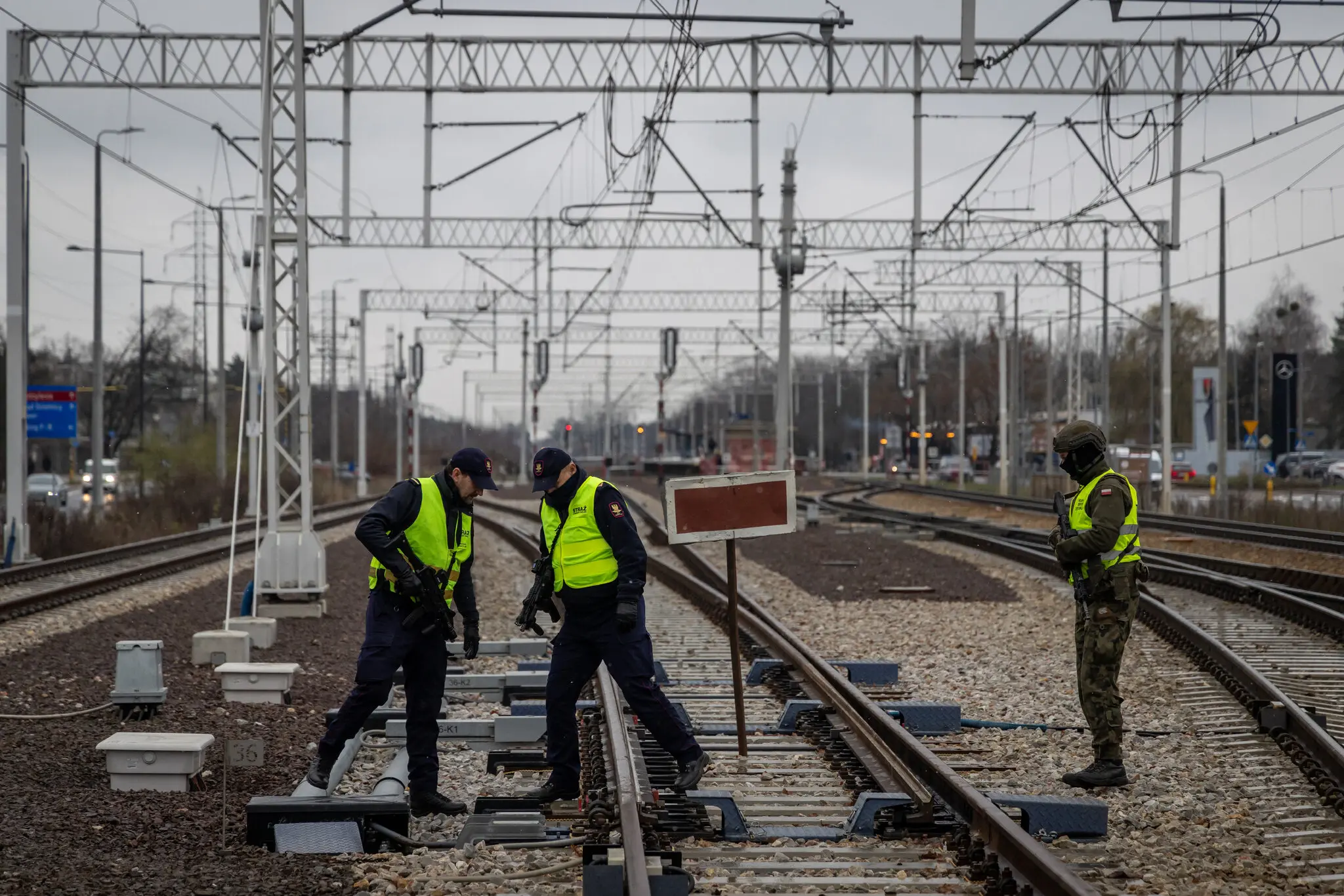
The most revealing episode was the strike on railway infrastructure near Agh Tekeh Khan in northern Iran, more than 700 miles from the Strait of Hormuz. Damage to a bridge on the route connecting Tehran with the border of Turkmenistan shows that the conflict is no longer confined to the maritime theater or the southern coast.
That route has strategic meaning. As pressure grows on Iran’s southern coast, northern land routes become more important for trade, alternative logistics and links with Central Asia. If traffic on this railway had indeed increased after the naval blockade, a strike on the bridge suggests an attempt to hit not only military capacity, but also alternative economic channels.
This is how a war expands without a formal declaration of a new phase. First, ships in the strait come under attack. Then coastal military targets are hit. Next come ports, piers, control centers, airports and railways. Each step is explained by the previous one, but the overall picture becomes steadily more dangerous.
For Iran, this creates a difficult dilemma. If it does not respond forcefully, hard-liners at home will interpret restraint as weakness. If it responds on a larger scale, the United States will gain grounds for further strikes. In this kind of war, decisions are increasingly made not from the standpoint of long-term advantage, but from the need to avoid political humiliation.
For the United States, the risk is different. Expanding the target list may produce short-term military effects, but it also raises the probability of a prolonged campaign. Once strikes begin affecting broader infrastructure, it becomes harder to argue that the operation is limited to protecting shipping. The line between deterrence and a war of attrition gradually starts to blur.
This is especially dangerous because it is happening against the backdrop of the cease-fire’s effective collapse. Donald Trump has already said he considers the agreement over. Iranian political and military circles are speaking more often in the language of punishment and revenge. In such an atmosphere, even targeted strikes are not perceived as signals for a return to negotiations, but as part of a wider campaign of coercion.
The Strait of Hormuz remains the center of the crisis, but it is no longer its boundary. Strikes on southern ports show that the struggle over control of maritime routes is moving ashore. A strike on the northern railway shows that land routes, which could compensate for constraints at sea, are also coming under pressure.
That has direct economic consequences. Shipowners, insurers and traders are assessing not only the safety of a particular voyage through the strait, but also the stability of Iran’s and the region’s entire logistics system. If ports, railways and energy facilities become potential targets, the price of risk rises even without a full blockade.
For regional states, this is another sign that the war can widen horizontally. Kuwait and Bahrain have already come under Iranian fire because of American bases. Qatar and Saudi Arabia depend on secure energy exports. The Central Asian direction now also enters the field of tension if Iran’s northern routes become militarily vulnerable.
The greatest danger of this phase is the loss of clear boundaries. When a war has a defined theater, it can still be politically contained. When targets stretch from ports in the south to railway bridges in the north, the war begins to change form. Instead of a crisis around Hormuz, it becomes a campaign against Iran’s infrastructural capacity to sustain a long confrontation.
This does not mean a full-scale war is inevitable. It does mean that each new strike will carry more possible consequences than the one before it. An attack on a port affects shipping. A strike near a nuclear plant feeds nuclear fears. Damage to a railway bridge affects overland trade and relations with neighboring states.
The cease-fire was supposed to stop precisely this logic of expansion. Instead, it became a brief pause after which the war returned broader in geography and more dangerous politically. Unless the United States and Iran find a way to narrow the field of conflict again, the next crisis point may emerge not in the Strait of Hormuz, but anywhere on Iran’s infrastructure map.