

















War becomes fully visible not on maps and not in official briefings, but at the moment a mother curls around her child in a bathroom, hoping the walls will hold. That is where geopolitics stops being abstract and enters the body — in the breath, the trembling, the hurried descent down dark stairwells, the sound of glass waiting to break.
Tehran is now living through exactly that stage of war. For a metropolis of roughly ten million people, airstrikes are not simply another episode of military escalation. They mark a radical rearrangement of ordinary life. A capital that once moved with the overcharged rhythm of a vast city is being forced into the psychology of internal siege, where every domestic gesture is reorganized around one instinct: survive the night.
What matters most is not only the force of the explosions, but the type of fear they produce. This is no longer fear of a single strike. It is fear of environmental collapse. People are afraid not just of being hit, but of losing electricity, losing water, being trapped in elevators, watching the home itself stop functioning as shelter and turn into a trap.
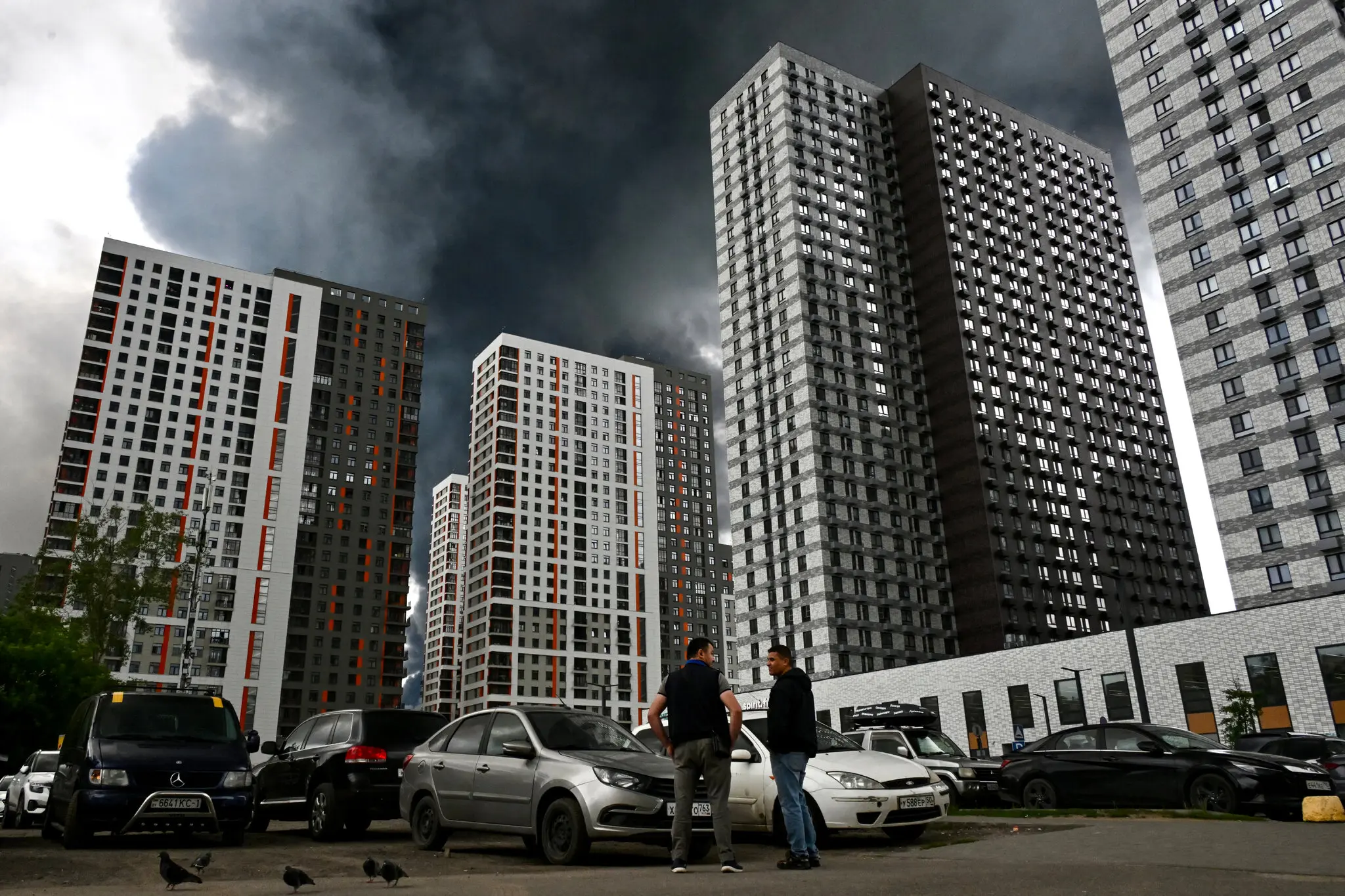
As Deykom has assessed, that is the clearest sign that the war has entered a new phase for Iran: the strikes are working not only as a military instrument, but as a method of deep psychological destabilization. When residents of high-rises descend twenty-two floors by stairwell because they no longer trust the power grid, when relatives rush a bedridden nonagenarian into a hallway moments before windows burst, war is no longer somewhere nearby. It has entered the architecture of the home and altered the logic of daily life from within.
Tehran is especially vulnerable because it is not merely the political center of the country, but a dense urban organism marked by crowding, inequality, strained infrastructure and millions of people who cannot simply leave. In cities like this, war rarely arrives as a single apocalypse. More often it advances as a slow decomposition of normality. A person is still in the apartment, still holding a phone, still reading updates, yet inwardly has already crossed into a mode of emergency existence.
That is why attacks on Tehran carry such force. They alter not only the physical landscape, but the nervous system of the city itself. A capital is supposed to radiate control. When it begins to radiate panic, the state loses more than public calm. It begins to lose part of its symbolic monopoly on strength.
The gap between the official image and private emotion is especially revealing. While government supporters gather in public squares waving flags and celebrating the downing of an American aircraft, other residents in the same city are sending messages from bathrooms, unsure they will make it through the night. That contrast matters. It shows that the war can no longer be contained within an ideological narrative of resistance to an external enemy. It is becoming, more and more, an experience of personal vulnerability that no triumphant headline can cancel.
Under these conditions, the state tries to sustain a double reality. On the surface is a language of control, determination and skies supposedly held by Iran. Beneath it is a city in which families hide in corridors and basements, listening for the next detonation and fearing that the next strike will not merely hit a target, but sever what remains of their connection to the wider world. It is in that gap that one of war’s most dangerous political effects emerges: a government may still control the message, yet increasingly fail to control the experience citizens are living through in their own bodies.
For many Iranians, the fear is not limited to the bombs themselves. Just as powerful is the dread of what comes after them. The feeling that the country is being destroyed before their eyes is not only emotional language. It is a political diagnosis. People fear not just one strike, but a longer trajectory of decay: broken infrastructure, deeper isolation, harsher internal control, and life inside a weakened yet still repressive state. In other words, they fear not only dying, but surviving into a ruined future.
That distinction is crucial. Once civilians begin to see war not as a short shock but as the beginning of prolonged decline, the psychology of the city changes. People stop thinking in terms of enduring a few terrible days and begin thinking in terms of damaged futures. Fear then ceases to be a reaction and becomes an environment. It enters the decision to stay or flee, to speak or remain silent, to trust or withdraw, to keep living publicly or disappear into private caution.
The war is also erasing the old boundary between front line and rear. For a modern capital, that may be the most painful transformation of all. A city that once imagined combat as something happening on the distant edges of national space now finds itself inside the zone of impact. This is not only a military shift. It is an anthropological one. Tehran, long accustomed to serving as the stage of state power, is becoming a target within it.
Its density makes the effect even harsher. In a tightly built urban district, an explosion never strikes only a single object. It hits the wider environment of trust. What is damaged is not simply a building or a bridge, but the basic metropolitan conviction that daily life, however tense, still has some frame of predictability. Once that frame disappears, people no longer live in a city. They live inside a field of risk.
In that sense, Tehran today is not only the capital of a country at war. It is a laboratory for how large cities absorb prolonged aerial violence. First comes shock. Then adaptation. Then exhaustion. After that comes social splitting: some people radicalize and cling more tightly to the state’s language of defiance; others think only of protecting their families and preserving whatever link to the outside world remains. These reactions can coexist for a long time, but together they produce a city that no longer experiences itself as a single political body.
That is why Tehran now has to be read through more than military chronology. It has to be read through the crisis of civilian existence itself. Blasts destroy concrete, but fear destroys rhythm, trust, language and the internal balance of urban life. And that may be the deepest consequence of this war. It is not merely approaching Iranian society. It is reorganizing it from within, forcing millions to live as if the future has already become an emergency condition.
That is where the central political question begins. What happens to a state when its capital starts living not by the logic of power, but by the logic of shelter? What happens to a society when private panic becomes stronger than public mobilization? And what remains of national control when the defining emotion of the metropolis is not pride, but suffocating fear?
The answer is already taking shape in the air Tehran breathes. War changes cities not only through broken buildings, but through altered consciousness. Through routes people no longer take, through sleep they no longer trust, through voices that grow quieter, through the shrinking ability to imagine tomorrow. Tehran is no longer only a capital under bombardment. It is a city in which the very form of life is being reorganized around a single imperative: survive the night first, and only then think about politics, history or the fate of the country.