
















For decades, the Vatican carried an unwritten assumption: a pope from the United States was almost impossible. The risk seemed too great that Washington could gain not only geopolitical influence, but also a spiritual advantage at the very center of the Catholic Church.
Robert Francis Prevost, who became Leo XIV a year ago, has broken that assumption not simply by being elected, but by the way he has governed in his first year. His American background has not made him an extension of U.S. policy. On the contrary, it has given him the authority to speak to America without a cultural or moral translator.
That became especially clear in his clash with Donald Trump over the war with Iran and the question of nuclear weapons. Leo XIV rejected the claim that he tolerated Iran acquiring a nuclear arsenal and framed his position not as a partisan dispute, but as a continuation of the Catholic doctrine of peace.
According to Daycom’s assessment, the strength of this pontificate lies precisely in its paradox: the first American pope has emerged not as a symbol of U.S. influence over the Vatican, but as one of the most visible moral counterweights to Washington where state power exceeds responsibility.
Leo XIV’s meeting with Secretary of State Marco Rubio in Rome was not a protocol detail, but an attempt to reduce tensions between the White House and the Holy See. It unfolded against the backdrop of Trump’s public attacks, disagreements over Iran, migration policy and a broader question: who today has the authority to speak in the name of the West’s moral tradition.

Leo XIV does not look like an opponent of the United States in the conventional political sense. He is not building an anti-American platform, nor is he turning the Chair of St. Peter into an opposition rostrum against the White House. His position is subtler: he speaks as an American who knows the country’s internal language, but refuses to let that country privatize the universal language of the Church.
This is what separates him from the old fears. There was once concern that an American pope might listen too closely to Washington. Leo’s first year has shown the opposite: his American experience gives him the freedom to answer Washington without the insecurity of distance. He does not look at the United States from afar; he understands its religious nerves, political fractures and cultural codes.
Prevost’s biography has long extended beyond Chicago. He worked as a missionary in Peru, led the Augustinian order, served as bishop of Chiclayo and, before his election, headed one of the Vatican’s most important departments. In that trajectory, the United States was his place of birth, but not the full map of his identity.
That is why Catholics in Latin America, Africa and Asia do not see him only as an “American pope.” For them, he is a priest who understands the missionary reality of poor communities, fragile institutions and a Church living beyond the Western center. This matters in an era when the demographic weight of Catholicism is shifting ever more visibly toward the global South.
Leo XIV’s spring visit to four African countries was not a gesture of exotic attention, but a statement of priorities. Africa is becoming one of the central spaces of Catholic growth, and the new pope quickly showed that he sees the Church’s future not only in Rome, Washington or Brussels.
 Папа Лев XIV минулого місяця служив месу в Екваторіальній Гвінеї. Цієї весни він відвідав чотири країни Африки — Ендрю Медічіні
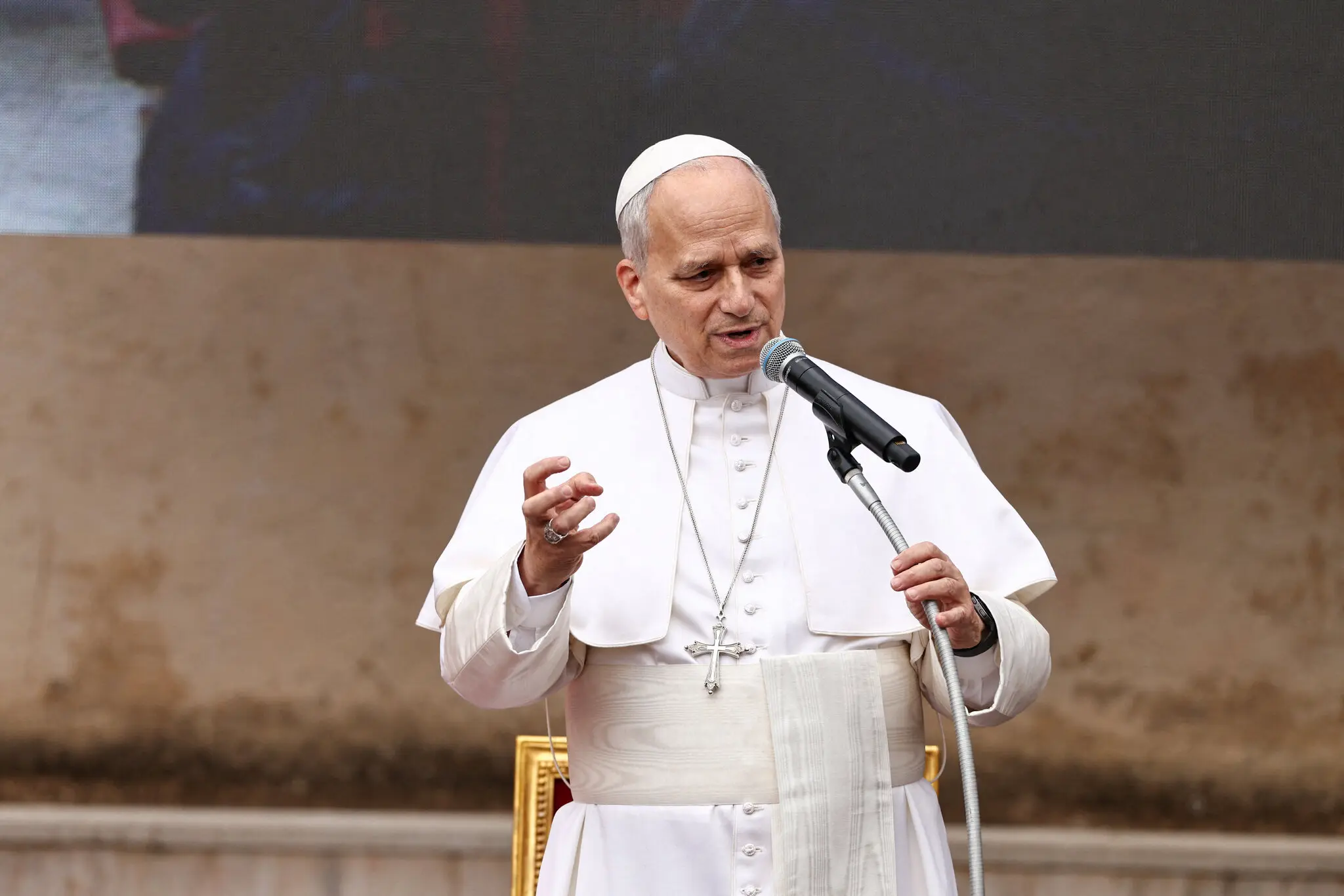
For American Catholics, his figure works differently. Leo XIV understands the divided U.S. Church from within: parishes, families and bishops have for years lived under the strain of conservative identity, progressive social expectations, migration tensions and the politicization of faith. His calm style does not eliminate the conflict, but it lowers the temperature.
That is especially visible after Francis. The previous pontificate often moved the Church through sharp gestures, open formulas and powerful personal charisma. Leo XIV acts differently: less improvisation, more silence; fewer striking phrases, more administrative steadiness. His authority does not rest on drama, but on the ability to hold contradictions without turning them into schism.
Calm, however, does not mean softness. When he speaks about migrants, nuclear weapons or war, his position comes into direct conflict with parts of American political power. That is where his origin becomes an asset: criticism from Rome can easily be dismissed as foreign, but criticism from a pope raised in the United States is much harder to reject as a misunderstanding of America.
Washington also cannot treat the Vatican as a secondary player. The Holy See has no army, but it has another form of influence: a global network of parishes, diplomacy, moral authority and the ability to speak to audiences that state power often fails to reach. In disputes over Iran, migration and war, that is not mere symbolism. It becomes a real political variable.
Leo XIV is not “anti-Trump,” and he does not need to become so. His strength does not lie in being a mirror-image political opponent of the American president. It lies in a different logic of legitimacy. A president speaks in the name of the state, voters and power. A pope speaks in the name of an institution that thinks in centuries and does not reduce morality to the result of an election.
That is why Leo XIV’s first year has answered an old Vatican fear. The American pope has not subordinated the Vatican to the United States. Instead, he has placed America before a mirror in which its power no longer appears to be an automatic moral argument.
That is the historical novelty of his pontificate. Leo XIV remains American, a Peruvian missionary, an Augustinian, the bishop of Rome and the leader of a global Church. He holds these identities together in a way that lets none of them consume the others. That is why his voice carries more force: not as the voice of a country, but as the voice of someone who knows why no country can be the measure of everything.