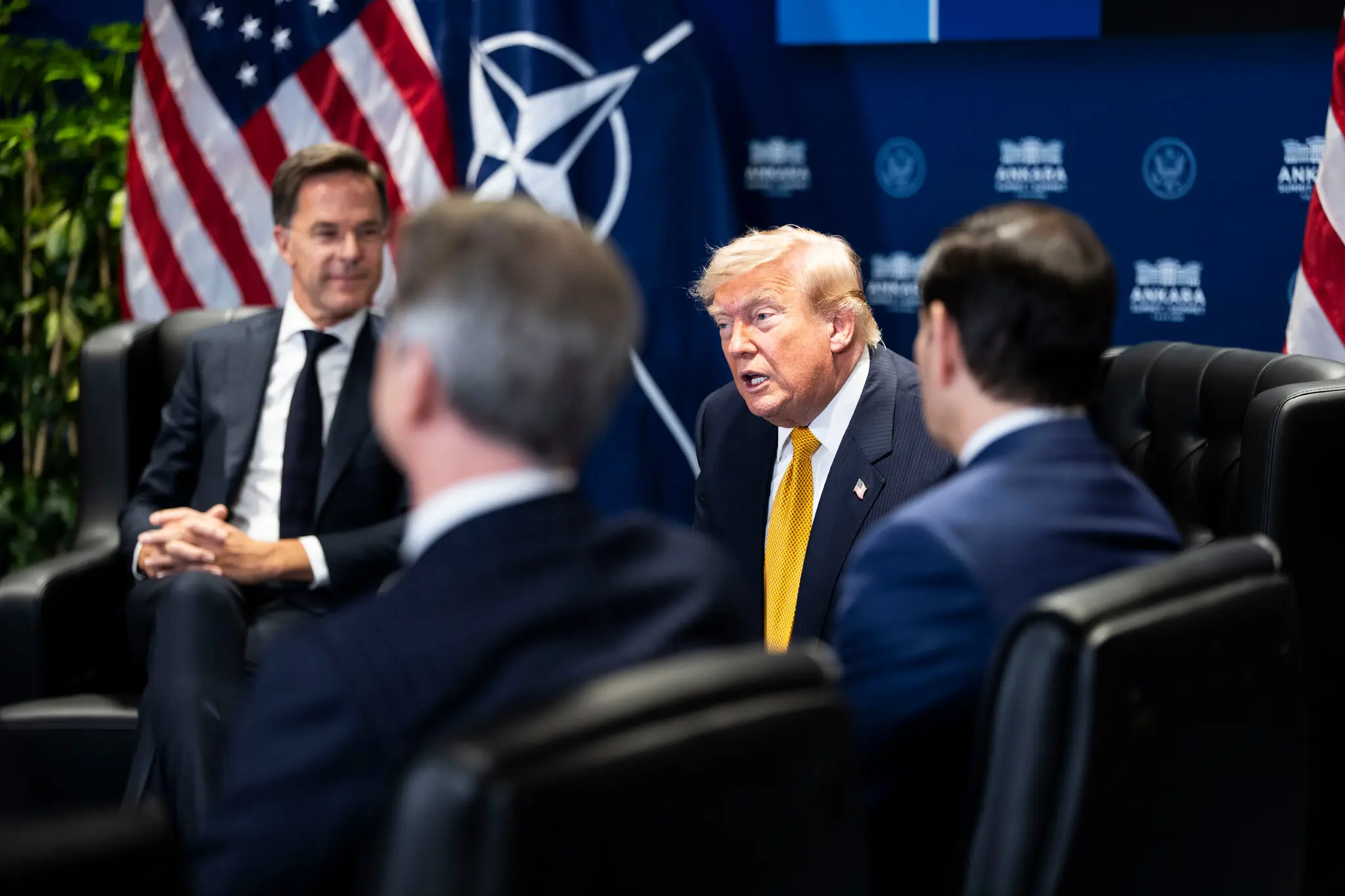





















In diplomacy, the loudest gesture is sometimes not a visit, but the refusal to make one. Donald Trump on Saturday stopped Steve Witkoff and Jared Kushner from flying to Islamabad, where another attempt was expected to move U.S.-Iran talks forward. His message was deliberately blunt: “We have all the cards.”
The decision did not close the diplomatic channel, but it changed its tone. Washington no longer wants to look like the side crossing half the world for talks that produce no result. Tehran, in turn, is trying to show that it will not negotiate under the pressure of strikes, blockades and demands framed as ultimatums.
Islamabad was supposed to serve as a cautious exit ramp from a war that has already outgrown a bilateral crisis. Pakistan has taken on a mediating role, while Iranian Foreign Minister Abbas Araghchi held talks there with the country’s leadership. No direct meeting with American officials had been scheduled.
Daycom’s earlier analysis suggests that the pause in negotiations is not a logistical failure, but a symptom of a deeper problem: Washington and Tehran still do not agree on what victory should mean. For the United States, it means control over Iran’s nuclear program, limits on uranium enrichment and freedom of navigation. For Iran, it means regime survival, political agency and leverage in the Persian Gulf.
Trump is trying to convert military advantage into diplomatic pressure. That is why his rhetoric combines a readiness to take a call with a public refusal to “waste time.” The door remains open, but Iran is being cast as the party that must step through it first.
Iran’s line is built differently. After his meetings in Pakistan, Araghchi traveled to Oman, a country with a long record of quiet mediation between Washington and Tehran. He spoke of a “workable framework” to end the war, but did not disclose its substance, leaving room for bargaining and political maneuver.
That uncertainty is now the core of the crisis. Formally, the sides are discussing a cease-fire. In reality, they are arguing over the future balance of power in the Middle East. Iran’s nuclear program, its enriched uranium stockpile, missile capabilities, regional allies and the Strait of Hormuz have become parts of the same knot.
The Strait of Hormuz makes this conflict global. Roughly a fifth of the world’s oil and petroleum products passes through it. Every delay in diplomacy therefore becomes an immediate risk for energy markets, ship insurance, freight costs and fuel prices.
For Tehran, the strait is not only an export route, but a tool of political survival. For Washington, it is a test of its ability to guarantee the security of global trade. That is why maritime access is no longer a side issue attached to a nuclear deal. It has become one of the central points of negotiation.
The canceled trip by Witkoff and Kushner also exposed the limits of Pakistani mediation. Islamabad can transmit signals, host delegations, prepare frameworks and keep a channel open. It cannot force Washington to accept Iranian terms, nor can it make Tehran endorse the American definition of security.
In this situation, each side is playing not only against its opponent, but also to its domestic audience. Trump is showing that he is not asking for peace, but setting its price. Iran’s leadership, despite military pressure, is trying to prove that the regime is not collapsing and will not trade sovereignty under coercion.
The phrase “we have all the cards” sounds like a declaration of dominance, but negotiations rarely end through the arithmetic of force alone. Even if the United States holds the stronger hand, it still has to decide what combination it wants to play: Iran’s capitulation, a controlled deal or a prolonged war of attrition with no guarantee of stability.
The space for diplomacy remains narrow. Iran can send a revised formula, the United States can return its negotiators to the mediators, and Pakistan and Oman can preserve the channel. But as long as Washington demands a strategic concession while Tehran searches for a formula that does not look like defeat, peace remains an object of bargaining rather than an agreement.
That is why the aborted Islamabad trip matters more than the logistics. It marked the moment when the war entered a phase of diplomatic pressure without yet becoming a peace process. A cease-fire may hold, routes may reopen, statements may soften. A real deal will emerge only when both capitals accept that cards on the table are not the same as a finished game.