


















When Cohen Miles-Rath walks into his father’s house, he does not simply see furniture and rooms. He sees the map of his own psychosis: the place where he read a “sign” on his phone, the drawer with the knife, and the floor where, in a matter of seconds, he nearly destroyed two lives at once.
The attack was brief, but its consequences lasted for years. Voices in his head were telling him to kill his father. After the knife struggle, the blood and the arrest, he found himself in jail, while his father, Randy Rath, became at once a victim, a witness, and the person who had to decide what came next.
What is most terrifying in this story is not only the suddenness of the violence, but how close psychosis can bring a person to the irreversible. Such crimes are rare, yet that is exactly why they shock: they happen not in the street, but at home, inside the family, where people are usually meant to find safety.
According to Deykom’s preliminary assessment, this story matters not as a sensational tale about a “dangerous illness,” but as an entry point into a far more difficult conversation about mental health, psychosis, family trauma, psychiatric treatment, and the reason early warning signs are so often missed even in loving homes.
Before the crisis, Cohen did not seem like someone heading toward catastrophe. He was studying at SUNY Geneseo, running long distance, and living within a clear rhythm. After an injury ended his athletic career, that structure collapsed, and with it part of his inner stability.
That was when, by his own account, the world began to change. Colors took on separate meanings, random objects became messages, and everyday life turned into the stage of a hidden plot. For someone in psychosis, that logic does not feel absurd. It feels like the only truth available.
Psychologists have long described psychosis as a break with reality in which hallucinations and delusions do not merely distort experience, but construct an entirely different system of meanings and causes. One scientific hypothesis links this to dopamine, which gives excessive weight to ordinary stimuli and internal voices.
By spring, Cohen’s condition was rapidly deteriorating. He saw gods on television, felt he had a special mission, and threw a rock through the window of a local diner as if answering Satan. By the time his father rushed home, his son had entered a phase in which love for a parent was losing to delusional belief.
Randy later recalled that his son’s eyes looked unfamiliar to him. When he saw the knife, he rushed to stop him, and the two men crashed to the floor. Cohen later told police that he did not want to kill his father, but that something inside him kept telling him to do it. That is the cruelty of psychosis.
What is especially striking is that there had been warnings. A month before the attack, Cohen had already been detained and placed in a psychiatric hospital for observation. But after being discharged, he admitted that he had concealed part of his symptoms, and the family decided that antipsychotic medication was probably unnecessary.
At that point, the story becomes more than private. It becomes structural. The father, a working-class man with deep skepticism toward psychiatry, did not recognize the scale of danger. The son, who was already losing touch with reality, could not judge his own condition. This is often what crisis looks like: not one mistake, but a chain of them.
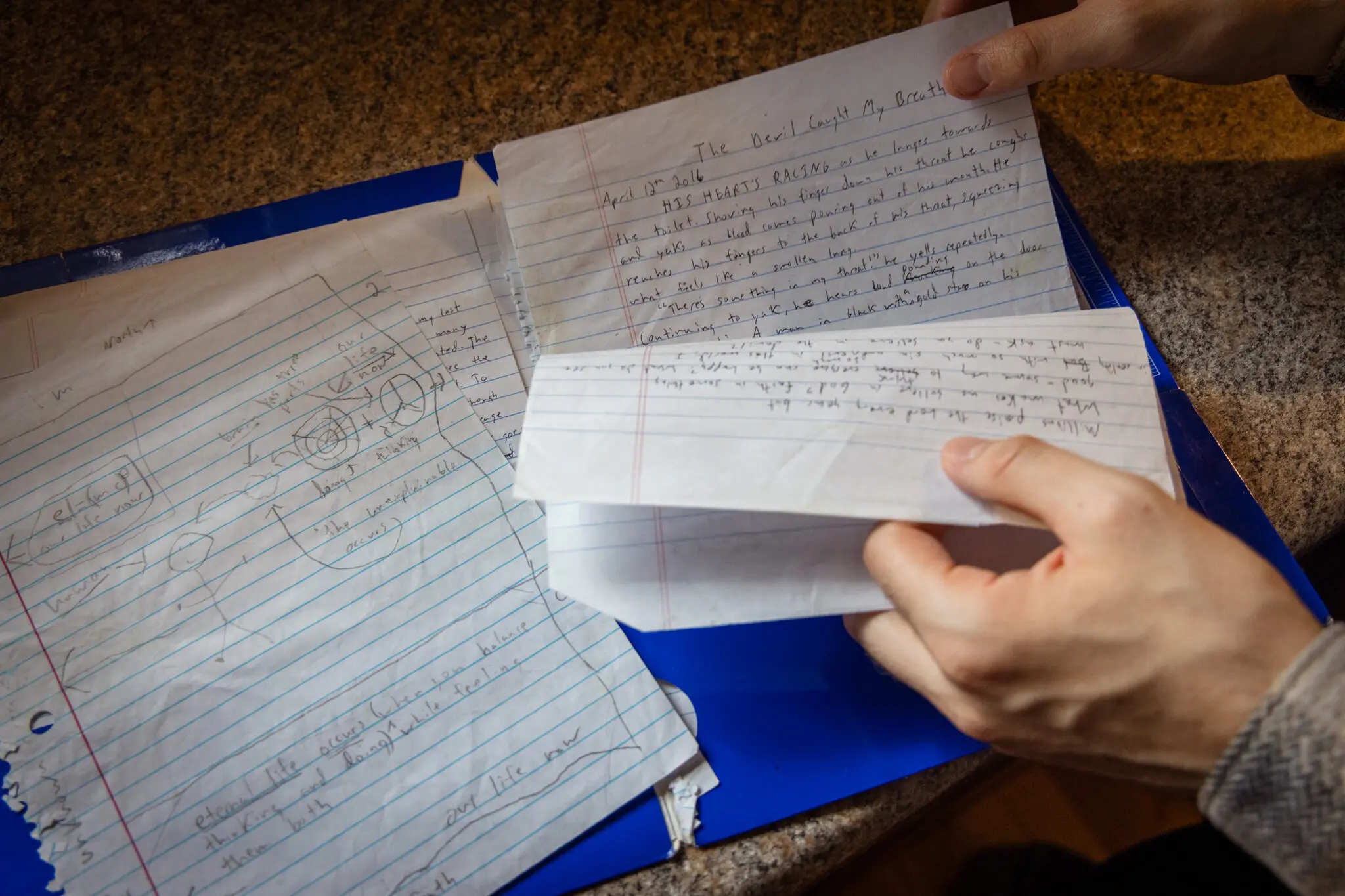 Коен робив начерки та нотатки щодо повідомлень, які, на його думку, він отримував під час психозу — Селія Талбот
After the arrest, Cohen was given Zyprexa in jail, and the voices began to quiet. His father eventually dropped the assault charges, and the plea agreement allowed for probation, mandatory treatment, drug testing, and the possibility that his life might not be permanently destroyed.
But legal relief did not mean moral relief. Cohen lost his education, his reputation, and his sense of a future. In a small town, everyone knew what had happened. The most painful question was another one entirely: could his father forgive him, if it had been his hands holding the knife, even if his mind had been overtaken by illness?
The reconciliation scene in the courthouse parking lot feels almost unbelievable for a story like this. When Cohen walked out after the hearing, Randy was standing there waiting. They embraced. The son apologized, and the father answered simply: do not worry about it, I love you. But even love does not erase traumatic memory.
Nearly ten years have passed, yet both men live not only with relief, but with weight. Randy allowed his son to come home again, but quietly installed a lock on his bedroom door and kept a knife by his bed. This is an important truth: forgiveness is not forgetting, and closeness after violence is never effortlessly restored.
Cohen, for his part, does not try to erase the past. He speaks publicly about psychosis, answers questions from worried parents, addresses audiences, and describes hallucinations, delusions, crisis intervention, and recovery. His position is rare: he speaks as someone who was both the source of danger and the witness to his own unraveling.
Today he works as a social worker in New York’s mental health system, contributes to suicide prevention programs, has become a father, and lives with constant self-monitoring. He stopped using cannabis, which he himself sees as one factor in his psychotic break, and now watches his sleep and stress levels closely.
Especially revealing is the episode after the birth of his daughter, when exhaustion briefly distorted the world for him again. But this time the mechanism was different: not surrender to delusion, but recognition of danger. He named it as a possible hallucination, sought support, and did not allow the symptom to become a new crisis.
That is where the central lesson of this story lies. Psychosis does not begin and end with a violent act, just as recovery does not begin and end with discharge or remorse. Between those points lie family support, accessible psychiatric care, antipsychotic medication, crisis lines, honesty about risk, and the daily labor of staying stable.
The story of Cohen Miles-Rath does not prove that mental illness equals violence. It shows something else: when severe psychosis is not recognized in time, the people closest to someone can end up at the center of disaster. But it also shows that even after that, treatment, accountability, recovery, and a return to reality remain possible.