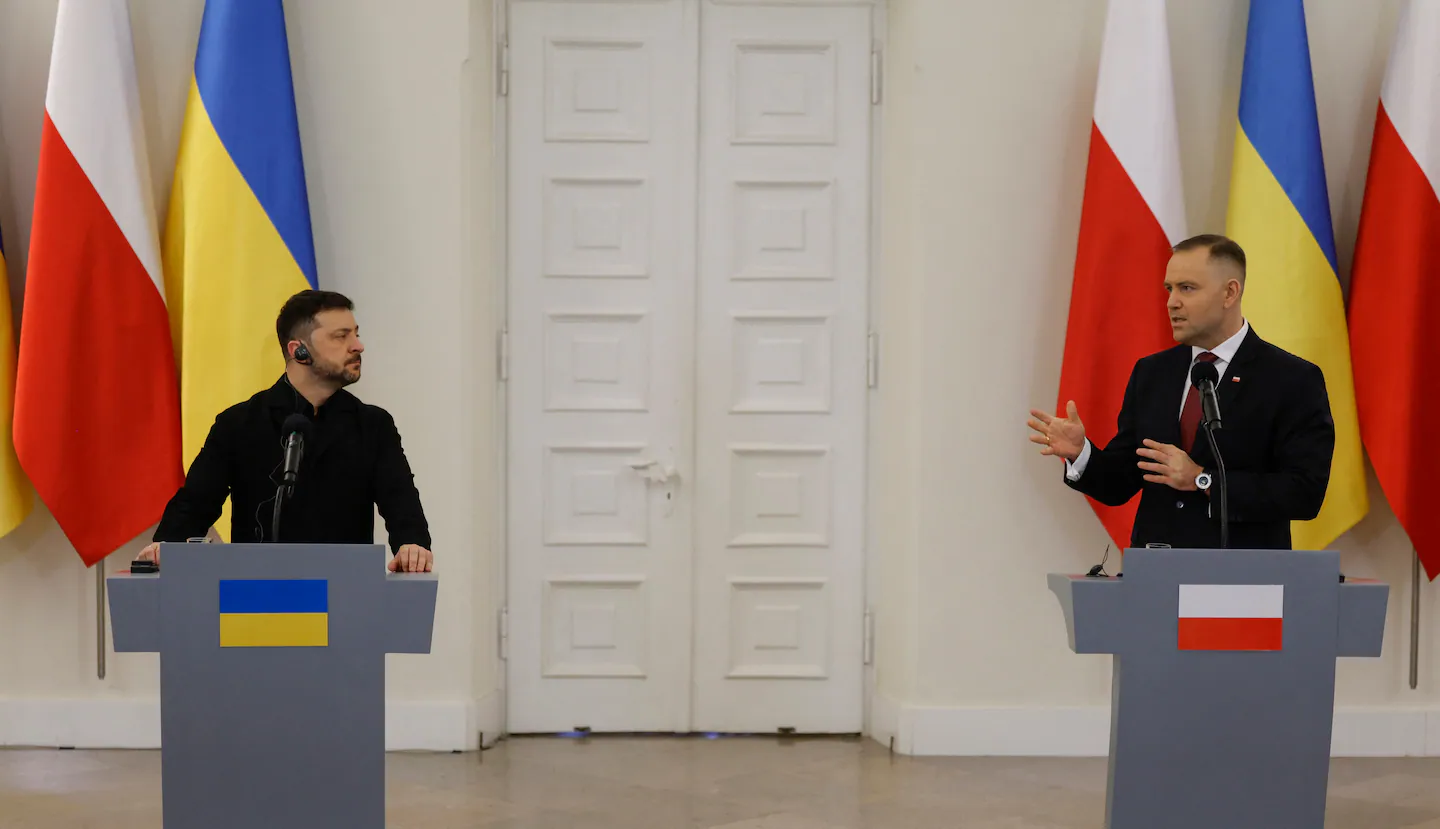














Volodymyr Zelensky spoke with Steve Witkoff and Jared Kushner during a stopover in Chișinău on his way back from London to Kyiv. The Ukrainian president described the conversation as positive and thanked them for their readiness to intensify diplomacy in the coming weeks.
The call followed a broader diplomatic sequence in London, where Zelensky met Keir Starmer, Emmanuel Macron and Friedrich Merz. London set the European frame clearly: negotiations cannot proceed without Ukraine, without Europe, and without security guarantees.
Kyiv’s formula remains unchanged: a ceasefire must be a path toward negotiations, not a mechanism for locking in Russian gains. The current front line may serve as a starting point for talks, but not as a new border and not as a political gift to the Kremlin.
According to Daycom’s assessment, the main significance of Zelensky’s conversation with Witkoff and Kushner is not the creation of another channel. It is the attempt to synchronize American and European diplomacy after a pause. For Ukraine, it is essential that Washington not seek a quick deal separately from those who will live with its consequences.
The American context remains complicated. The Ukraine negotiation track has repeatedly lost momentum, while Washington’s attention has shifted toward the crisis around Iran. Zelensky’s reminder that peace in Europe remains on the agenda was therefore not a ceremonial expression of gratitude. It was a political signal about priorities.
Witkoff and Kushner have previously worked on contacts with Moscow, but a possible visit to Kyiv would carry its own political meaning. For Ukraine, it is unacceptable for American representatives to regularly hear the Kremlin while failing to see the country that pays for the war every day with cities, lives and energy infrastructure.
Talks about a possible visit by the American envoys to Kyiv continue. Such a trip would not be a protocol gesture. It would allow the U.S. negotiating team to see the war not through the Kremlin’s lens, but through Ukrainian reality — shelters, destruction, air defense, the front line and the fatigue of society.
The London meeting with the leaders of Britain, France and Germany showed that Europe does not intend to remain an outside observer in any potential settlement. The European position rests on an immediate ceasefire, respect for international borders and real security guarantees.
This matters because a weak agreement with Russia would quickly become not peace, but a pause before the next war. Ukraine is not seeking to freeze violence for a convenient diplomatic date. It is seeking a mechanism that would make renewed aggression more costly, more difficult and more politically dangerous.
The G7 summit in Evian is becoming the next major platform where diplomacy may take more concrete form. For Kyiv, the agenda is not only declarations. It is weapons, sanctions, frozen Russian assets, security guarantees and Europe’s role in the future architecture of peace.
After speaking with the U.S. envoys, Zelensky also held a separate conversation with Macron. That shows Kyiv’s effort to prevent a split between the three centers of decision-making: Ukraine, the United States and Europe. Such coordination will be decisive if negotiations are to move out of their current pause.
At the same time, diplomatic signals are unfolding against the background of Russian escalation. International discussions have again registered the growing intensity of attacks and the rising cost of the war for civilians. The contrast remains stark: while Kyiv talks about a ceasefire, Russia continues to strike Ukrainian cities.
This is where the line between diplomacy and imitation becomes clear. Negotiations matter only if they reduce violence and move the war toward a real halt in fighting. If Moscow uses them as a screen for new attacks, any format will quickly lose credibility.
The proposal for direct talks between Zelensky and Vladimir Putin remains the loudest element of the current process. But a leaders’ meeting cannot be theater staged for a photograph. It would matter only if it were backed by concrete conditions: silence on the front, guarantees and clear international monitoring.
For Ukraine, the central danger is that the world may grow tired of the war faster than Russia grows tired of aggression. That is why Kyiv insists that the speed of diplomacy must not replace the quality of peace. A bad deal may close the news cycle for a few weeks, but open a new phase of war a few months later.
Zelensky’s conversation with Witkoff and Kushner is not a breakthrough in itself. It simply shows that the diplomatic mechanism can still be moved. What comes next will depend on decisions: stronger Ukrainian air defense, pressure on Russia’s war economy and partners’ refusal to trade principles for a quick pause.
Ukraine enters this new diplomatic stretch with stronger European support, but without illusions about the Kremlin. A positive conversation can open a door. Only the right conditions can ensure that Russia does not return through that same door with another war.