

























On the ground floor of the Opera Bastille, costumes stood in orderly rows like a silent corps de ballet waiting to enter the stage. Voluminous ball gowns stood beside military uniforms; jewel-encrusted robes near translucent tunics; folk dresses beside breastplates, helmets and theatrical armor.
Beyond the glass façade, another line had formed — not of performers, but of people waiting to buy a fragment of the theater. Paris was melting in the heat, yet opera devotees, ballet lovers, collectors of historical dress and the merely curious stood ready to touch something that had once lived under stage lights.
The Paris Opera placed about 5,000 costumes and 2,000 accessories on sale, drawn from productions dating from the 1960s to the present. Prices began at a few euros for belts, scarves and small stage items, and rose into the hundreds for elaborate garments made in the opera’s own workshops.
According to Daycom’s assessment, the meaning of the event lay not simply in the sale itself. What mattered was that one of the most private areas of theatrical life — the memory stored in costume rooms — became public for a few days. The audience received not a souvenir, but the material remains of performances that had already vanished from the stage.
Each item had its own passport: the title of the opera or ballet, the name of the director or choreographer, the costume designer, the year of production and, sometimes, the name of the performer who first wore it. For a casual buyer, it was a label. For a theater lover, it was almost a genealogy.
That is the particular nature of a stage costume. It is not simply clothing. It is sewn not for the street or the wardrobe, but for a role, a movement, a voice, a distance from the audience, a light cue, sweat, repetition and disappearance. It serves illusion, but after the performance it remains entirely real.
Visitors moved between the racks as if reading other people’s biographies. One tried on a brocade waistcoat. Another examined a gold dress set with stones. Others placed turbans, cloaks and theatrical jackets over their everyday clothes. The room quickly became half marketplace, half backstage.
For some, it was a chance to buy something for a historical ball, a home performance or a wedding. For others, it was a way to recover a memory of a particular production. A person could recognize a costume from a performance seen years earlier and suddenly hold not an abstract recollection, but its fabric.
The Paris Opera holds such sales only occasionally. The reason is practical: storage is not infinite. Some costumes remain at the Palais Garnier and the Opera Bastille, but many more are kept at the Ateliers Berthier and in storage spaces outside the city. Repertories change, productions age, and fabric accumulates faster than history can organize it.
When a production is retired, some costumes can be altered, some reused in other works, and some sent to museum collections. But even after that, thousands of objects remain — too alive to discard, too numerous to preserve forever.
Preparing such a sale takes months. The hardest decision is not logistical, but emotional: what to let go. For costume staff and heritage keepers, each garment is tied to a production, a maker, a performer, a scene, a premiere night or the long life of a show. A theater always wants to keep everything.
But everything cannot be kept. There is an honesty in stage art: it lives through loss. A performance ends, sets are dismantled, costumes are removed, makeup is washed away, a voice falls silent. The sale does not break that logic. It continues it, sending objects into another life.
That is why these costumes differ so sharply from vintage clothes in a boutique. They were not designed for a flawless silhouette in ordinary life. Their beauty is often exaggerated, their construction theatrical, their color calibrated for distance, their ornament made for spotlights. This is not fashion pretending to be art. It is art that, for a few hours, pretended to be clothing.
In theater workshops, craftsmanship follows a different ethic. A stage costume must withstand a dancer’s movement, a singer’s breath, quick changes, repeated performances and repairs after each evening. Its brilliance does not cancel its function. In the best pieces, function becomes an invisible luxury.
That explains why visitors spoke of the objects almost as living witnesses. They saw not only silk, brocade, tulle, stones and embroidery. They saw the labor of unknown hands that had created images for opera and ballet, where every fold has meaning and every glimmer must serve the drama.
The sale also carried a democracy often absent from great cultural institutions. The Paris Opera — a symbol of prestige, discipline and high tradition — suddenly opened its closets to people who could afford not a patron’s gesture, but a small purchase: a scarf, a belt, a hat, a fragment of a costume.
That mattered at a time when culture can feel distant from everyday life. Here it became physical, accessible, slightly chaotic. People tried opera on in front of mirrors, laughed, hurried toward the tills, chose between memory and practicality. High art briefly lost its untouchability — and became closer because of it.
Those rows also revealed another truth: theater does not live only on stage. It continues in archives, warehouses, workshops, labels, the hands of costume makers and the people who came looking for a dress from “Samson and Delilah” or a costume from “Onegin.” The love of an audience is also a form of preservation.
Not every purchased costume will become a museum piece. Some will appear at private balls, in living rooms, home performances, photo shoots or simply in the wardrobes of people who wanted an object with a theatrical soul. Even then, they do not disappear. They move from the darkness of storage into new stories.
The best theatrical objects always have a double life. On stage, they help a performer become someone else. After the stage, they help a spectator believe that art can be not only seen, but held in the hands. That is what happened at the Opera Bastille.
As the racks thinned and staff gently guided buyers toward the registers, the room felt less like a sale than a quiet passage. The theater was letting go of part of itself, but not losing it. Costumes that had once waited to enter the stage received another exit — toward people for whom opera and ballet begin not with a poster, but with the touch of fabric.
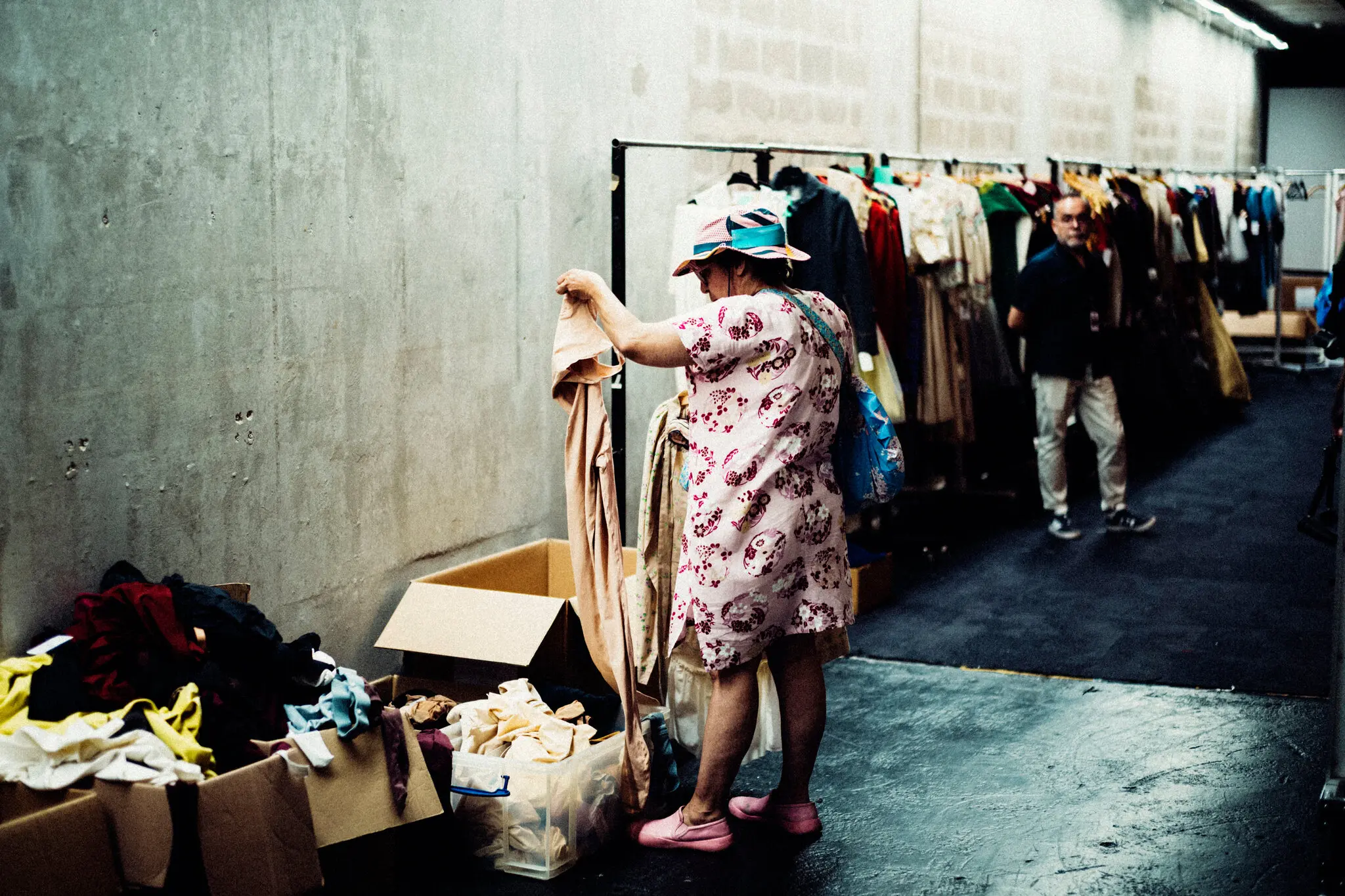 Шанувальники балету та опери обирали запропоновані лоти — Жульєн Міньйо