













Bucha is no longer only a place of mourning. For Europe, it has become one of those points after which war loses the last of its geopolitical disguises and appears in its raw form: systematic state violence against civilians, against law and against the very idea of security on the continent. That is why the arrival of Kaja Kallas and a group of European foreign ministers in Ukraine on the fourth anniversary of the Bucha massacre carried a meaning far beyond diplomatic ceremony.
The meetings in Kyiv and the visit to Bucha were an attempt to pull Russia’s war back to the center of the European agenda at a moment when Western attention is being fragmented by other crises and when every new decision in favor of Ukraine is becoming more politically expensive inside the European Union. In that sense, Bucha once again served not only as a site of memory, but as a political instrument: a reminder of why support for Kyiv cannot be pushed to the margins.
The central tension now lies elsewhere. Europe can no longer remain in the language of moral condemnation alone. After Bucha, the question has become starkly practical: can the EU convert its shock at Russian crimes into functioning mechanisms of punishment, compensation and sustained political pressure? If not, memory begins to lose force and risks hardening into ritual without consequence.
In Deykom’s assessment, that is where the real European test begins. Recognition of the crime has already happened. What remains is for the continent to prove that it can turn this recognition into institutional power rather than leave it suspended in the form of an annual consensus of grief that changes little in political reality.
That is why the focus in Kyiv was not only the symbolism of Bucha, but the proposed special tribunal for the crime of aggression against Ukraine. Its design matters because it is aimed not merely at isolated episodes of war crimes, but at responsibility for the decision to launch the war itself. In the current architecture of international law, that level of culpability is often the hardest to prosecute. The tribunal is meant to close one of the most consequential gaps in Europe’s legal order.
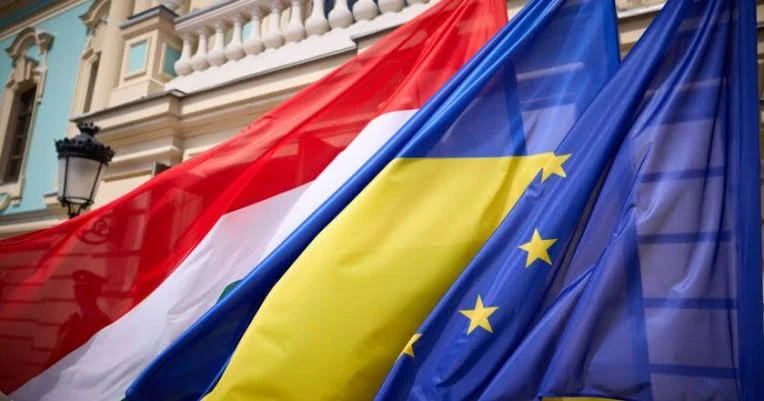
The legal foundation already exists. What is now at issue is not the formula, but whether Europe can move from principle to operation. A broad declaration of support is one thing. The tribunal still needs political sponsorship, financial commitment and sustained backing from states willing to turn a legal concept into a working institution. That is why the support of every EU country except Hungary matters so much. It shows that the problem is no longer whether such a mechanism should exist, but whether Europe can make it real.
This is where the most painful weakness reappears. The European Union once again confronts an old truth about itself: moral unity is much wider than political unanimity. Budapest has not only stood apart from the tribunal effort; it has continued to block major assistance for Ukraine and to slow the sanctions track. As a result, Bucha in 2026 has become a mirror for Europe itself, revealing whether the Union can act as a strategic power during a war on its own continent.
For Kyiv, this blockage is no longer an abstraction of Brussels procedure. When Ukrainian officials speak about frozen decisions, they are talking about preparation for the next winter, the protection of energy infrastructure, reconstruction planning and the country’s physical resilience under continuing attack. Where Brussels debates mechanisms, Ukraine measures time in exposure and vulnerability.
Against that backdrop, additional money drawn from the profits of frozen Russian assets matters less as a solution to the scale of the war than as a political signal. Yet even that signal is important. It reinforces the principle that Russia must not only be condemned, but made financially answerable for the destruction it has caused. This is how the ideas of the tribunal, a compensation mechanism and the use of Russian assets are slowly being bound into a single legal and political line.
The timing of the visit matters as much as its substance. It took place in the middle of a widening competition of crises. The Middle East, the energy shock, the pressure on oil markets and the wider instability tied to regional escalation are all pulling Western attention, money and political energy in other directions. That is why the warning that Ukraine must not be allowed to slip off the table was more than rhetoric. It was a precise description of the danger. In modern diplomacy, forgetting can be nearly as destructive as fatigue.
This is exactly why Bucha still carries such force. It reminds Europe that the issue is not only support for an ally, but defense of its own legal order. If, after mass executions, torture and the open contempt of international law, the continent still cannot build a mechanism capable of pursuing accountability at the highest level, then it is not only Ukraine’s position that weakens. The political weight of European law weakens with it.
In that sense, the special tribunal means more than another international body. It is meant to answer the question that has followed Europe since 2022: can the continent do more than name evil? Can it carry its judgment all the way to a sentence? Bucha became proof of the crime. The EU must now prove that this proof can be transformed into punishment rather than preserved as a moral shock revisited once a year at memorial ceremonies.
The real value of the Kyiv meeting will not be determined by the photographs from Bucha or by the correctness of official language about accountability. It will be determined by whether Europe can launch the tribunal, unblock major packages of support, preserve sanctions pressure and force its political machinery to act with the same clarity with which Bucha has already spoken for itself.
If it can, memory will become a mechanism of action. If it cannot, Bucha risks remaining the most devastating proof that Europe understood the crime correctly and still hesitated too long before answering it.