


















Ceuta had barely begun to recover its outward calm when politicians, activists and media provocateurs started arriving. After days of disorder caused by a mass crossing from Morocco, the Spanish enclave found itself at the center of not only a humanitarian emergency, but a political struggle.
Hundreds of people gathered outside government offices on Sunday evening, accusing the authorities of inaction. Prime Minister Pedro Sánchez became the main target of their anger. For many residents, the events of the previous days were proof that the state had lost control of the border and left the city to face the crisis alone.
At least 50,000 people, most of them young Moroccan men, entered Ceuta over several days. Most later returned to Morocco, but for a city of about 84,000 residents, the influx was overwhelming. At least 72 people died while trying to cross the border.
As Daycom assesses it, the central conflict in Ceuta is no longer simply between residents and migrants. It is now between the city itself and the political forces that arrived to turn local trauma into a ready-made electoral narrative. That is why some residents can condemn the government’s response while also rejecting the far-right figures claiming to speak for them.
Ceuta is particularly vulnerable to this kind of political pressure. It sits on the northern coast of Africa, belongs to Spain, forms part of Europe’s political space and maintains deep cultural, economic and family ties with Morocco. Any migration surge there quickly becomes a dispute about borders, sovereignty and national identity.
For several days, the city lived under intense anxiety. Residents stayed indoors, fearing disorder, while local services operated at the edge of their capacity. As the immediate emergency began to ease, another form of pressure emerged: the sense that outsiders were arriving to take ownership of the crisis.
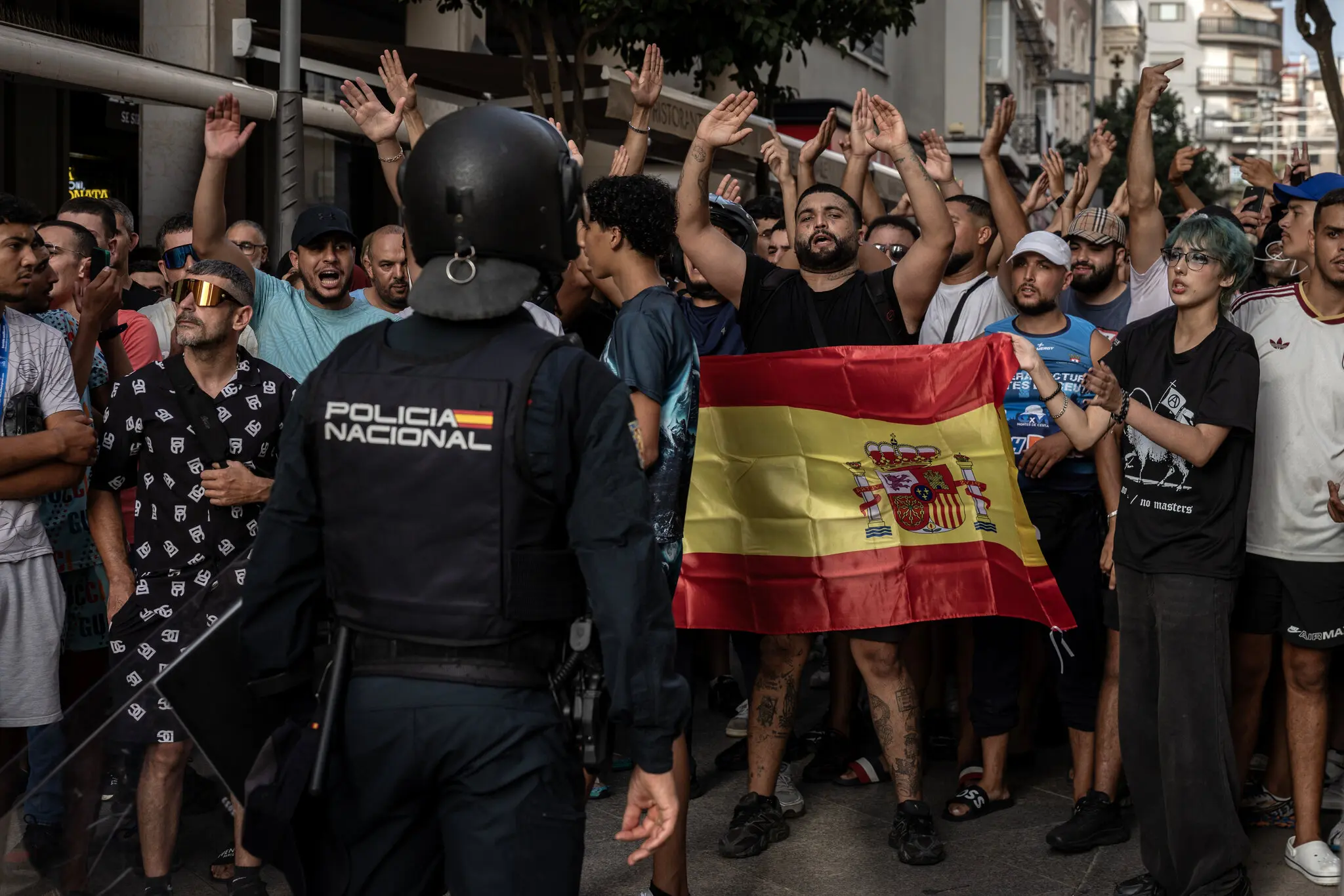
The rally was organized by Vito Quiles, a 25-year-old right-wing commentator known for confrontational street interviews with left-wing politicians. Some young supporters greeted him with cheers, but his presence also exposed deep divisions inside the city. Within minutes, police escorted him away as residents pursued him, shouting insults.
That response was revealing. People who oppose Sánchez and regard the government’s handling of the border as a failure are not necessarily willing to accept rhetoric that reduces the crisis to a struggle between “Spaniards” and “outsiders.” A large part of Ceuta’s population is of Moroccan descent, so attacks on migrants can quickly become suspicion directed at the city’s own residents.
Many locals were especially angered by the attempt of visiting activists to present themselves as Ceuta’s defenders. During the worst hours, it was residents, police officers, soldiers and municipal workers who tried to maintain order, assist those in danger and clear the streets. The political visitors arrived after the immediate crisis had eased, offering symbolism rather than practical help.
The most prominent among them was Vox leader Santiago Abascal. He described the mass crossing as an “invasion” and an “act of war” by Morocco, while also blaming Sánchez and his migration policies. Abascal said residents had a right to “self-defense” if the state failed to expel those who remained.
That language is dangerous not only because of its severity. It blurs the line between legitimate protest and the justification of vigilante action. When a politician invokes “self-defense” in a city where migrants remain and where a large Muslim community lives, he creates room for violence even without issuing a direct call for it.
Alberto Núñez Feijóo, leader of the main conservative opposition People’s Party, also traveled to Ceuta. He called the episode an “occupation,” further increasing pressure on the government. The border crisis quickly became another front in Spain’s wider political struggle between the right and the governing Socialists.
The visit of European lawmaker Alvise Pérez produced an even sharper confrontation. After demanding the migrants’ expulsion, he was surrounded by residents who accused him of equating Muslims with illegal migration and exploiting the crisis for personal gain. As the crowd grew more hostile, Pérez took shelter in a bar before police escorted him away.
These scenes showed that Ceuta refuses to serve merely as a backdrop for national politics. The city is genuinely angry about the weakness of the state’s response, but many residents do not want its complex social fabric turned into material for a campaign built on fear of Muslims and hostility toward Morocco.
Local resistance to the far right does not mean denying the scale of the problem. The mass crossing was a serious security failure, and the volume of arrivals exceeded what such a small territory could absorb. The question is whether the response will focus on border management, diplomacy and humanitarian capacity, or on the search for an internal enemy.
The Moroccan dimension makes the crisis even more complicated. Rabat has repeatedly shown that control over migration flows can become a tool of pressure on Madrid and Brussels. Any weakening of the border therefore has not only a social meaning, but also a geopolitical one.
For Spain’s central government, the crisis is a double test. It must restore control and reduce tension without allowing the emergency to become a pretext for collective suspicion toward the Muslim population. Any mistake risks strengthening either far-right mobilization or distrust among local communities.
For Vox and other radical-right movements, Ceuta offers an almost perfect political image: European territory in Africa, a breached border, a mass movement of people and a government that can be accused of weakness. The story can be reduced to a few emotionally powerful words — “invasion,” “betrayal,” “self-defense” — which is precisely what makes it electorally useful.
But the reality of Ceuta does not fit those formulas. The city is Spanish, African, European, Christian and Muslim at the same time. Its stability depends not on political uniformity, but on the ability of different communities to live together under constant border pressure.
The crisis has shown how quickly migration can become an instrument in a struggle for power. Once a security problem is transformed into a symbolic conflict, practical responses move into the background. Border enforcement, coordination with Morocco and support for local services are displaced by a contest over who can express the greatest anger.
That is why the residents’ hostility toward visiting far-right figures carries a broader meaning. They are not denying the fear or minimizing what happened. They are rejecting the claim of outsiders to speak for a city that endured the emergency largely through its own efforts.
Ceuta has become a test not only of Spain’s migration policy, but of its democracy. A border can be reinforced with soldiers, barriers and patrols. It is much harder to prevent a frightened society from turning crisis into permission for hatred.