





















When King Charles III and Queen Camilla arrived at the White House, Donald Trump pointed them toward the large empty space where the East Wing once stood. It was an odd beginning to a state visit: monarchy, protocol, tea, a private audience with the president — and a fresh architectural wound at the center of American power.
State visits are usually designed to display strength, continuity and hospitality. A president shows allies the best version of the country: its culture, symbols, ceremonies and historical confidence. This time, however, the royal visit began in a Washington where, only days earlier, a press dinner had been interrupted by gunfire.
The shooting at the White House correspondents’ dinner cast a shadow over a visit tied to the 250th anniversary of American independence. The irony was almost too obvious: a British king had come to honor a nation that once broke from the Crown, at the very moment when that nation was again displaying its own internal fragility.
According to Daycom’s analysis, the visit became more than a ceremony between allies. It became a test of America’s ability to preserve form amid political disorder. Protocol was meant to cover the chaos, but it could not conceal it. The king arrived in a country where the safety of public figures has become a daily question of survival.
Before Charles’s arrival, there had been uncertainty in Washington about whether the trip would proceed at all. After the incident at the correspondents’ dinner, Buckingham Palace monitored developments, but the king ultimately kept to the schedule. That decision itself became part of the diplomatic message: an alliance should not allow an attacker to set its calendar.
Yet the backdrop remained heavy. Threats against political figures in the United States have become so frequent that some administration officials have moved onto military installations out of concern for their safety. In such an atmosphere, even a royal motorcade is no longer only spectacle; it becomes a test of the American security apparatus.
Instead of lowering the political temperature after the shooting, the White House quickly returned to its familiar language of confrontation. Press secretary Karoline Leavitt spoke of a “left-wing cult of hatred” against the president while also rejecting conspiracy theories surrounding the attack. Washington again tried to explain trauma by assigning blame.
Trump also returned quickly to his own rhythm. He attacked a television host, posted about construction work and drew attention to the removal of goose droppings near the Lincoln Memorial. Against the backdrop of a royal visit, this ordinary aggressiveness looked not like a departure from crisis, but like its continuation by other means.
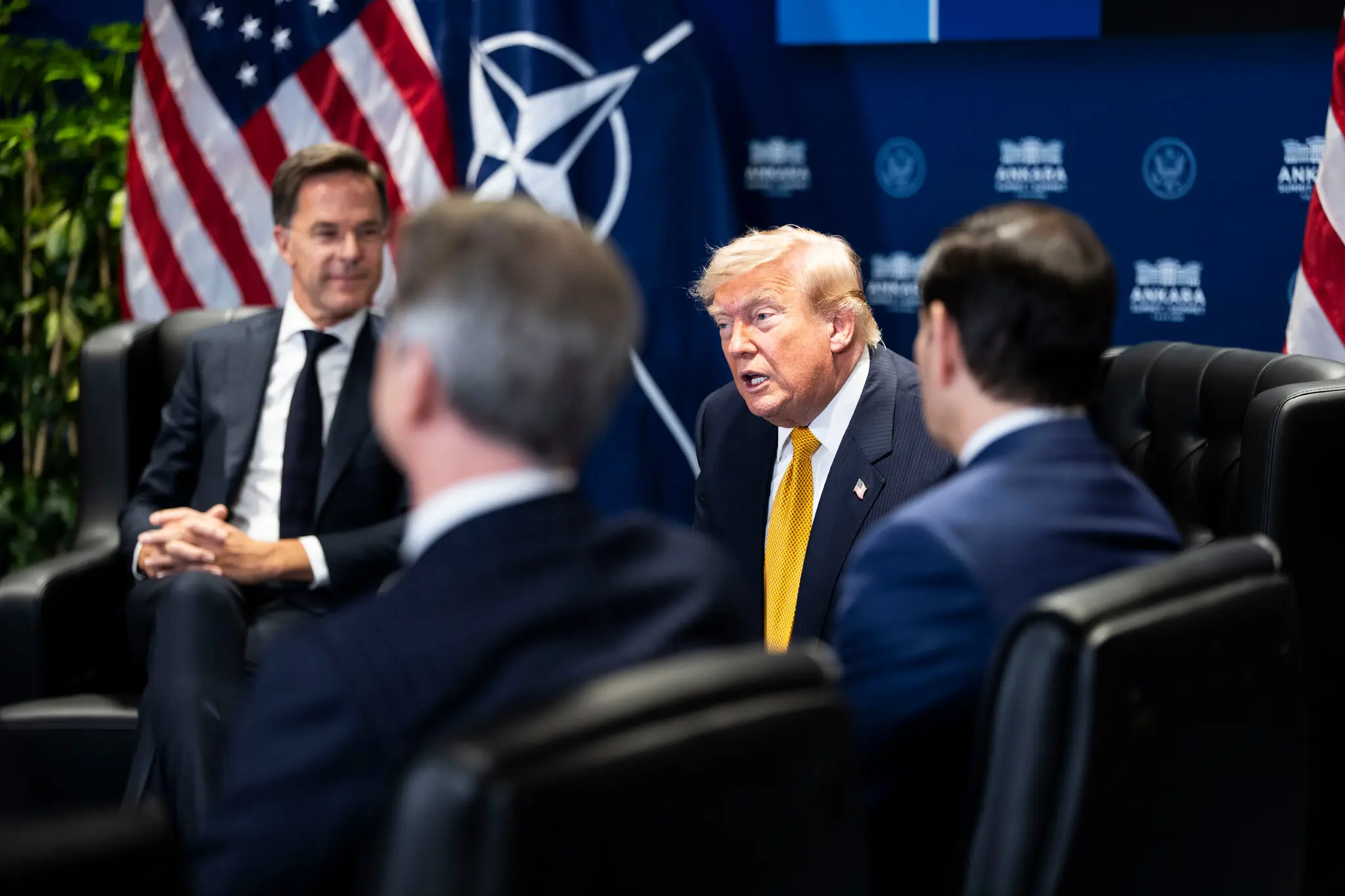
This is where the more complicated part of Charles’s mission begins. Formally, the monarch stands above government politics and does not take part in disputes between Trump and Keir Starmer. In reality, his visit is expected to soften a relationship that has deteriorated sharply in recent months over the war in Iran.
Early in Trump’s second term, Starmer tried to manage the relationship through praise, restraint and gestures of deference. But London’s refusal to join the U.S.-Israeli campaign against Iran darkened the atmosphere. Trump called the British prime minister a coward and belittled the British navy.
The tension deepened further when signals emerged in Washington that the administration could reconsider its support for British sovereignty over the Falkland Islands. For London, that was no longer a verbal quarrel, but a potential blow to one of the most sensitive symbols of post-imperial British statehood.
The king cannot negotiate on behalf of the prime minister. But he can do what politicians often cannot: create an atmosphere in which conflict temporarily loses some of its sharpness. Trump likes royal grandeur, banquets, military ceremony and historical theater. The British Crown knows how to turn those tastes into diplomatic capital.
Last autumn, Charles III hosted Trump in Britain with the full pageantry of a state visit. Washington was now expected to return the gesture. But the American version looked different: not only red carpets and ceremony, but closed routes, reinforced security, a fortified White House and the shadow of violence over the entire program.
It was telling that the Trumps were barely expected to leave the White House complex. During past state visits, the president traveled with guests around the country or at least took them beyond the residence. This time, the program was concentrated around a controlled space where security could be more easily managed.
The White House itself has become one of Trump’s political statements. The East Wing has been torn down, the Oval Office covered in gold, the Rose Garden paved over, and bricks removed from Lafayette Park because, in the president’s logic, protesters might use them as projectiles. Architecture here speaks the same language as politics: control, glitter and suspicion.
The royal couple chose to stay not in the White House residence, but at Blair House, the traditional guest house for visiting dignitaries. The decision preserved protocol while also marking a measure of distance. In Washington now, even hospitality is measured not only in symbols, but in security logistics.
The program also combines old ritual with the language of new technology. Melania Trump is expected to host Queen Camilla and American students at the White House Tennis Pavilion, where guests will use AI-enabled glasses to learn about American history. It is almost a perfect image of the age: monarchy, artificial intelligence and a wounded democracy in one frame.
For the United States, the visit was meant to celebrate 250 years of independence. It has also become a demonstration of whether the country can hold the diplomatic stage after an internal shock. For Britain, it is a chance to soothe an unpredictable ally. For Charles III, it is the delicate role of a monarch who does not enter politics but is asked to ease its consequences.
The greatest tension of the week lies in the contrast between form and reality. Form speaks of alliance, history, friendship, banquets, speeches and shared values. Reality speaks of political violence, fractures inside American society, conflict over Iran and the increasingly combative style of Trump himself.
Charles III did not come to Washington to solve these problems. But his presence shows how, in moments of crisis, diplomacy returns to its oldest instruments: the Crown, ceremony, hospitality and the language of respect. They do not replace politics, but they can sometimes give it a few days not to tear itself apart.
After the shooting at the press dinner, the American capital greeted the British king not as a calm imperial stage, but as a city under strain. That is precisely why the visit carries more weight. In Washington, where chaos increasingly interrupts ritual, the continuation of ritual has become more than decoration. It is an attempt to prove that the state can still hold itself together.