

















At the state dinner in the White House, King Charles III did exactly what British diplomacy has long needed the monarchy to do: he turned Trump from an irritated ally into a delighted spectator. He did not persuade him, defeat him or put him in his place. He charmed him.
It was an almost perfect performance for a president who loves gold, titles, ceremony, military shine and personal symbols. The king gave him all of it at once: dry British humor, respect for status, historical allusions, light teasing and a gift so polished it seemed designed specifically for Trump.
Under a gold cloth on a white pedestal sat a ship’s bell. When it was unveiled, the metal clearly read: TRUMP 1944. There had indeed been a British submarine named HMS Trump, launched during the Second World War.
According to Daycom’s analysis, this was not merely a gift. It was a direct hit on the president’s psychology. Charles gave Trump not an object, but an image: his name engraved on a wartime relic of the British navy, presented by a king in the White House before a room expected to applaud.
Trump rose from his chair and looked at the bell with almost childlike delight. His reaction said more than any official toast. He glanced at Melania with the expression of a man who had received not a souvenir, but proof of his own historical importance.
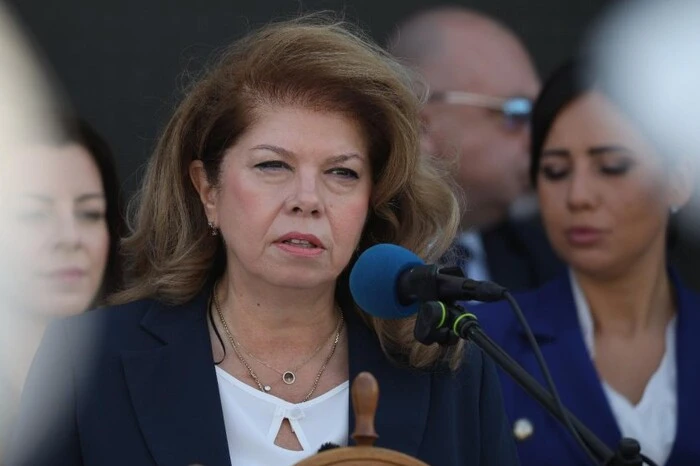
 Президент Трамп і перша леді Меланія Трамп у вівторок ввечері вітали короля Британії Карла III та королеву Каміллу у Білому домі на державній вечері — Кенні Голстон
The king completed the moment with a joke: should the president ever need to reach Britain, he could simply “give us a ring.” The room erupted in applause. Trump gave a thumbs-up. This was diplomacy reduced to the mechanics of the perfect trigger: shine, name, war, king, joke.
That evening, Charles spoke a language Trump understands better than memorandums. He did not demand, explain or rebuke. He guided the president toward the desired mood through flattery, history and light play. This is how diplomacy works with a leader for whom personal recognition often matters more than political argument.
But the king was not merely a gracious guest. Beneath the smiles, he allowed himself lines that another speaker might not have dared attempt. Charles recalled Trump’s recent claim that without the United States, Europeans would be speaking German. Then he replied that without Britain, Americans would be speaking French.
It was an elegant strike at the heart of Trump’s habit of reducing history to a ledger of debts. The king did not deny America’s role in the victories of the 20th century. He simply reminded the room that the history of the West does not begin in Washington and does not end with Trump’s personal judgment.
His reference to Suez was even sharper. Charles recalled that his mother had visited the United States in 1957, when a crisis in the Middle East required the two countries to put the “special” back into the “special relationship.” Then he added that it was hard to imagine anything like that happening today. Not everyone laughed.


Nor should they have. The joke was too close to the truth. London and Washington are again divided over war in the Middle East. Trump is furious that Britain has refused to follow America into the Iran campaign. He has insulted Keir Starmer, mocked British aircraft carriers and spoken of allies as if they were contractors who had failed to deliver.
Charles could not say that directly. As monarch, he cannot argue with a president about war, government policy or a prime minister’s decisions. But his speech was built so that Trump received not a slap, but a mirror. And so that he could not publicly take offense without ruining his own evening.
The only moment when the staging nearly cracked came from Trump himself. In his own speech, he reached the Middle East section, looked up from the text and began talking about the current war. He did not name Iran directly, but the meaning was obvious.
Then the president threw out a line dangerous for the king: that Charles agreed with him even more than he did. For the monarch, it was a trap. The king cannot be drawn into supporting a military campaign from which the British government has deliberately kept its distance. In one sentence, Trump tried to make the Crown an accessory to his position.
That was classic Trump, even on his best behavior. He did not stage a press conference, pick a fight with allies or destroy the ceremony. But he still could not resist appropriating another person’s agreement. Even the king briefly became a prop.


And yet, overall, the evening worked exactly as London wanted. Trump was pleased. The king looked witty and assured. Camilla and Melania held the form. Guests received a state spectacle in which conflict did not disappear, but was temporarily wrapped in silver, white tie, music and a gift bearing the word TRUMP.
The guest list also spoke loudly. This was not merely an audience for the British monarch, but something close to the inner court of Trump’s power: family members, media allies, big money, technology titans, financial heavyweights, conservative justices, television figures, designers and the first lady’s closest circle.
Beside the king sat not an abstract America, but Trump’s America: Fox News, major donors, business empires, the family hierarchy, a judicial majority that the president treats as part of his political capital. Against that backdrop, the British royal couple looked both foreign and strangely appropriate.
There was something almost comic about it. An old European court had entered a new American court, where titles are replaced by market value, media ratings, access to the president and personal loyalty. Charles and Camilla did not belong to that system, but for a few hours they became its most valuable ornament.
That was precisely why the king had an advantage. He did not need a place in Trump’s court because he represented an institution older than the American state itself. Trump may have owned the room, but Charles owned time. In that asymmetry, British diplomacy found its resource.


His references to Churchill were calculated perfectly. Trump admires Churchill as a symbol of wartime resolve, courage and great history. Charles gave him that symbol, and did so through an anecdote about a naked prime minister encountering Roosevelt by the bathtub and declaring that he had nothing to conceal from the president of the United States.
The joke was funny, but deeply British: power, embarrassment, intimacy, alliance and a flawless line that turns awkwardness into legend. Trump received a story in which the United States and Britain were not transactional partners, but two countries with a private language of closeness.
That is the central wager of royal diplomacy. It cannot change American policy in one evening. It cannot force Trump to respect Starmer, restore trust over Iran, stop attacks on NATO or make the British navy a less convenient target for presidential mockery.
But it can make Trump want to look grand beside Britain. And for him, that is not a small thing. If the alliance with London is presented not as a bureaucratic demand, but as a stage on which the president stands beside a king, receives a wartime bell bearing his name and hears toasts to shared history, he can change his tone for a day.
 Президент Трамп виступає на державній вечері у вівторок увечері — Кенні Голстон
The problem is that a day is not policy. Trump has already shown that he can admire Windsor and then humiliate the British prime minister. He can love the royal family while treating the British government like an unruly vassal. His affection for the Crown does not guarantee respect for the state.
That is why the White House dinner was a success, but not a resolution. Charles III played brilliantly: he gave Trump what he wanted while saying more than any British minister could have said without risking a diplomatic explosion. This was not delicacy. It was the disciplined cunning of an old Crown.
After the speech, Trump clapped the king on the shoulder and said, “Great job.” Then he looked again at the bell. That gesture summed up the evening. The president heard the jokes, accepted the flattery, received a shining symbol and left satisfied.
But behind that bell stood another message. Britain can laugh, offer relics and speak of friendship. It is not, however, going to dissolve itself into Trump’s will. Charles III charmed the president not because he surrendered to him, but so that he could say no in a way that still made the room applaud.