

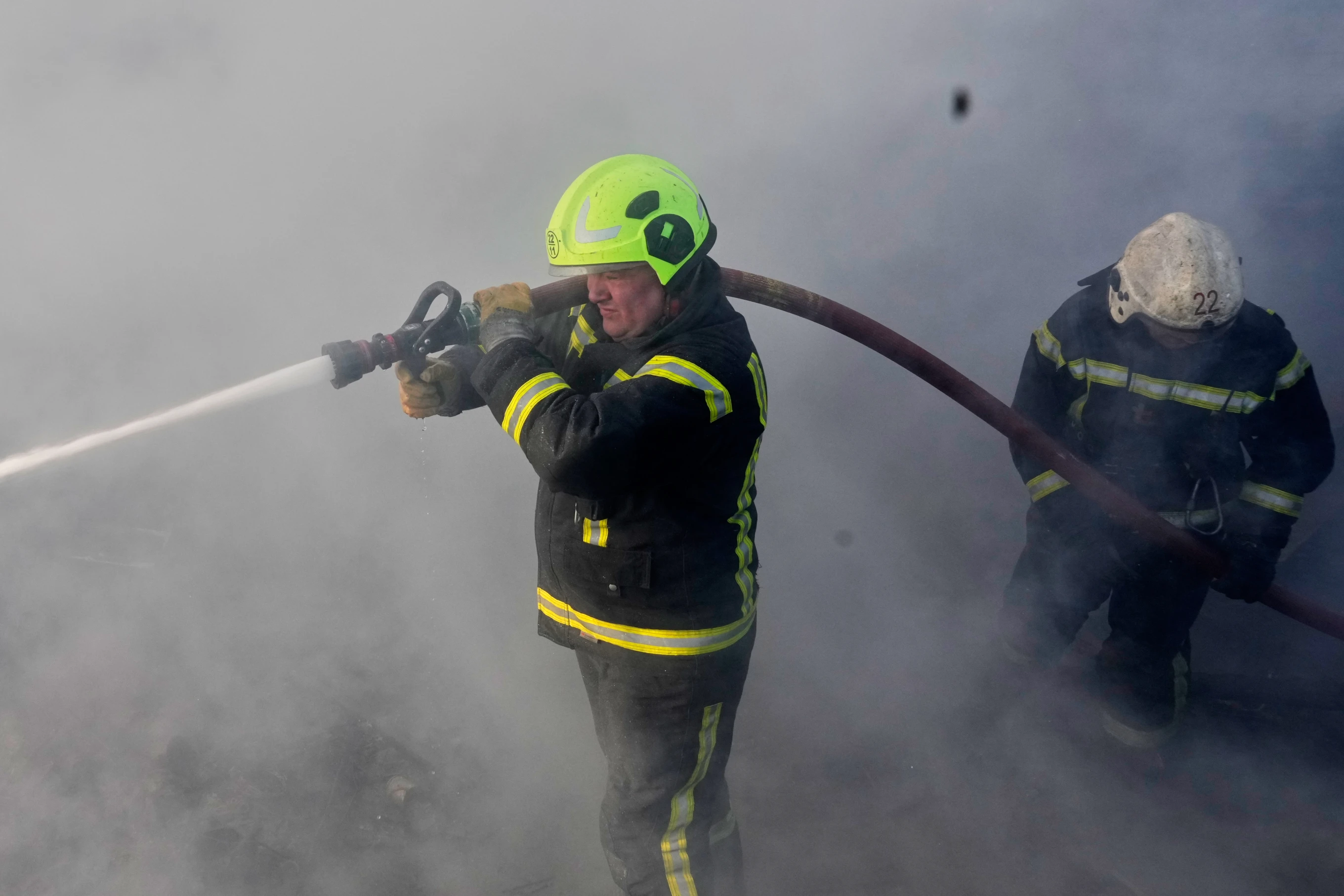



















The Zaporizhzhia nuclear power plant has again found itself on the dangerous boundary between war and nuclear safety. The Russian-installed management of the station said an employee of its transport department was killed after a drone strike on an area connected to the plant’s operations.
The statement referred to a driver who was reportedly at the plant’s transport unit. The Russian side blamed Ukrainian forces, but the key circumstances of the incident still require verification. The International Atomic Energy Agency said its team at the site would examine the episode and continue monitoring the situation.
This cannot be treated as just another exchange of accusations between the two sides of the war. Zaporizhzhia is Europe’s largest nuclear facility, and any strike near its infrastructure automatically moves beyond the category of a local military incident.
According to Daycom’s analysis, the central danger is not only one fatal case. It is that the occupied plant has long become a zone of constant military tension, where drones, shelling, damaged power lines, a lack of trust and limited independent access create an accumulating risk.
The IAEA has repeatedly stressed that strikes on or near nuclear power plants must not take place under any circumstances. Rafael Grossi has again warned that such attacks can endanger nuclear safety. In the case of Zaporizhzhia, that warning is no longer a diplomatic formula. It describes the plant’s daily reality.
Since Russian forces seized the Zaporizhzhia plant in 2022, it has existed in an uniquely dangerous condition: formally a Ukrainian nuclear facility, but in practice controlled by an occupation administration and Russian forces. That duality makes every incident politically toxic and technically difficult to verify.
For Ukraine, every event at the plant is part of the broader problem of occupation. Kyiv has long argued that the main source of danger is the presence of Russian forces at the nuclear station itself. For Moscow, every incident becomes an opportunity to blame Ukraine and seek international pressure on Kyiv. Between those positions, the IAEA is trying to preserve a minimum space for facts.
That is why the phrase “a drone struck the plant” demands extreme caution. It is necessary to establish not only the direction of the attack, but the precise point of impact, the type of facility hit, its distance from nuclear-relevant infrastructure, and the consequences for staff, physical protection, cooling systems, power supply and emergency preparedness.
Even if the strike did not affect reactor units, that does not make it safe. A nuclear plant is not only reactors. It is transport departments, storage areas, pumping systems, power lines, staff, guards, maintenance teams and communications. Damage to any of these links may not immediately cause a radiological emergency, but it can weaken the site’s ability to respond to the next crisis.
There is also a human dimension. The plant’s workers have spent years living and working under occupation, pressure, danger and uncertainty. The death of a driver, if confirmed, would be another reminder that nuclear safety rests not only on concrete, steel and international principles, but on the people who keep critical infrastructure functioning every day.
The incident comes against the backdrop of a wider wave of strikes across Ukraine and occupied territories. The war has increasingly moved into a phase in which drones have become a universal instrument of pressure, used against military sites, logistics, energy, ports and industry. But nuclear facilities cannot be absorbed into that logic without catastrophic risk.
Zaporizhzhia has repeatedly become a symbol of how modern war destroys old assumptions about the limits of the permissible. A nuclear plant was once considered a place that even enemies should instinctively avoid. It has now become hostage to frontline geography, occupation policy and mutual distrust.
The most dangerous part of such episodes is habituation. Each new drone, explosion or report of gunfire near the plant can begin to look like just another item in the day’s war news. But nuclear risk does not follow the logic of ordinary battlefield statistics. It can remain only potential for a long time, then become an accident through one convergence of circumstances, with consequences far beyond Ukraine.
That is why the international response must be practical, not ritualistic. What is needed is not merely another call to avoid attacks on nuclear sites, but a real mechanism to demilitarize the area around the plant, ensure full access for independent inspectors, record incidents transparently and protect personnel.
The Russian occupation of the plant remains the root cause of the danger. As long as military control over a nuclear facility is used as a political and strategic instrument, every incident will be both a technical threat and an information weapon. In such a situation, truth requires verification, not declarations.
The death of a transport worker, if the circumstances are confirmed, would be both a personal tragedy and a warning to everyone. The Zaporizhzhia nuclear plant cannot remain a place where war gradually normalizes what would be unthinkable in peacetime.
Nuclear safety has no side of the front. Radiation risk does not ask who issued the first statement or who blamed the other side first. It accumulates where a nuclear station lives under occupation, under drones and under the constant pressure of war. That is why any strike near Zaporizhzhia is not a local episode, but a reminder that Europe’s largest nuclear power plant remains hostage to a war that should never have come near its perimeter.