














The LaGuardia crash matters not only because two pilots died. It matters because it exposed how fragile even a major American airport can become when several seemingly manageable problems begin to overlap. What looked at first like a freak accident on landing increasingly resembles something more troubling: a breakdown of synchronization inside a system that depends on perfect timing.
On the surface, the event could be described simply. An Air Canada Express CRJ900 arriving from Montreal landed on Runway 4 late on a rainy, foggy Sunday night and struck a Port Authority rescue vehicle crossing its path. Two pilots were killed, the firefighters survived, dozens of passengers were injured, and yet no passenger died. That outcome was almost miraculous. But miracles are not explanations.
According to Deikom’s assessment, the real significance of the crash lies in the structure behind it. This was not just a tragedy caused by one bad move. It was a systems failure in which emergency response, tower communications, ground traffic, equipment limitations, and human expectation all converged inside the same narrow time window.
That is what makes this story so unsettling. Nothing in it initially appears cinematic or extraordinary. There was no dramatic engine failure in the air, no extreme storm, no obvious collapse of airport operations. Instead, the night was filled with normal aviation events: a delayed regional flight, an emergency call from another aircraft, a convoy of airport rescue trucks, a standard overnight staffing pattern in the tower, and a landing on a familiar runway. It was ordinary until it became fatal.
The first element in the chain was already in motion before the Air Canada flight reached New York. The flight from Montreal had been delayed by more than two hours. That alone did not create danger, but delays always compress the operational rhythm of airports. They alter crew timing, shift traffic patterns, and move routine events deeper into less forgiving hours. By the time the jet approached LaGuardia, the airport was already managing a more complicated late-night flow than originally planned.
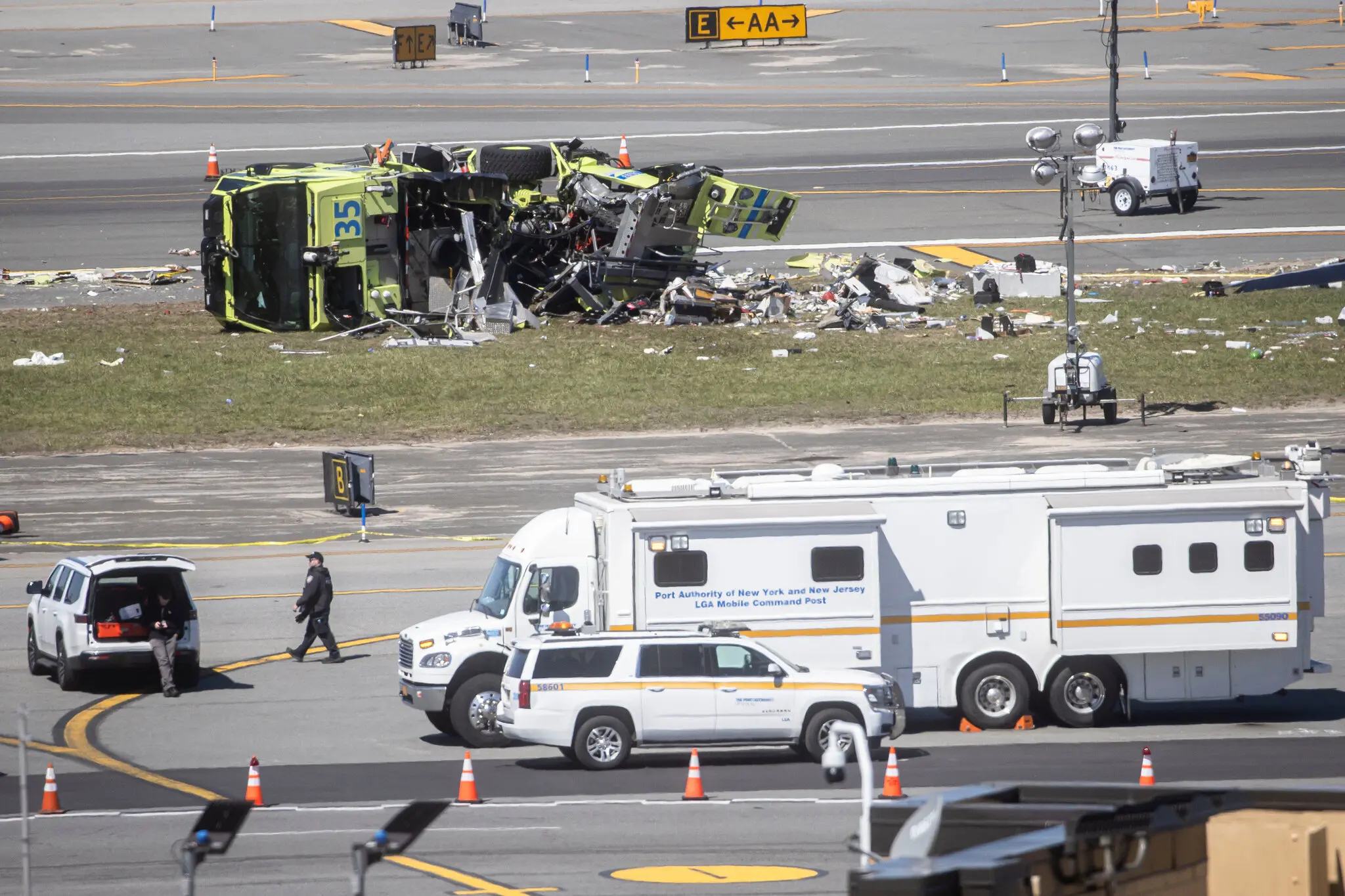 Уламки пожежної машини портової адміністрації. Обидва пожежники, сержант Майкл Орсілло та офіцер Адріан Баез, вижили в зіткненні — Дейв Сандерс
Then came the second disturbance: a United flight preparing to depart reported a strange odor that was making crew members sick. That triggered a request for emergency assistance. For airport rescue and firefighting teams, such calls are not unusual. But routine does not mean harmless. The moment rescue trucks begin moving toward active surfaces, the airport changes from a transportation system into a mixed emergency environment, and the space for error shrinks.
This is where the architecture of risk begins to show itself. The fire convoy, led by Truck 1, moved toward the runways in response to the United aircraft. The Air Canada jet, meanwhile, was continuing its approach to land on Runway 4. The tower now had to manage a classic high-risk overlap: a landing aircraft and emergency vehicles in the same operational field at almost the same moment. Aviation remains safe precisely because such overlaps are normally prevented from ever becoming direct conflicts. At LaGuardia, that prevention failed.
The most chilling aspect of the case is how little time existed once the conflict crystallized. According to the reconstruction in the reporting, Truck 1 requested and received clearance to cross Runway 4. By then, the Air Canada plane had already been cleared to land on that same runway and was descending toward the pavement. What followed took only seconds. A controller began shouting, “Stop, stop, stop, stop,” but the truck continued across the aircraft’s path.
That sequence immediately places the central weight of the disaster on runway coordination. In an airport environment, the tower is the final authority separating aircraft from vehicles on movement areas. If a plane is on short final and a rescue truck is permitted onto the same runway, the fatal condition exists before either side physically collides. The crash itself is only the final manifestation of a conflict already created in the system.
Yet the answer is not as simple as saying one person made one wrong call. The reporting makes clear that there were two controllers in the tower, which matched overnight staffing procedure. That is important. It means the configuration was not, on its face, outside the accepted norm. But accepted norm is not the same thing as resilient capacity. Once an emergency involving one aircraft begins to compete for attention with the landing of another, even a standard staffing model may prove too thin for the complexity of the moment.
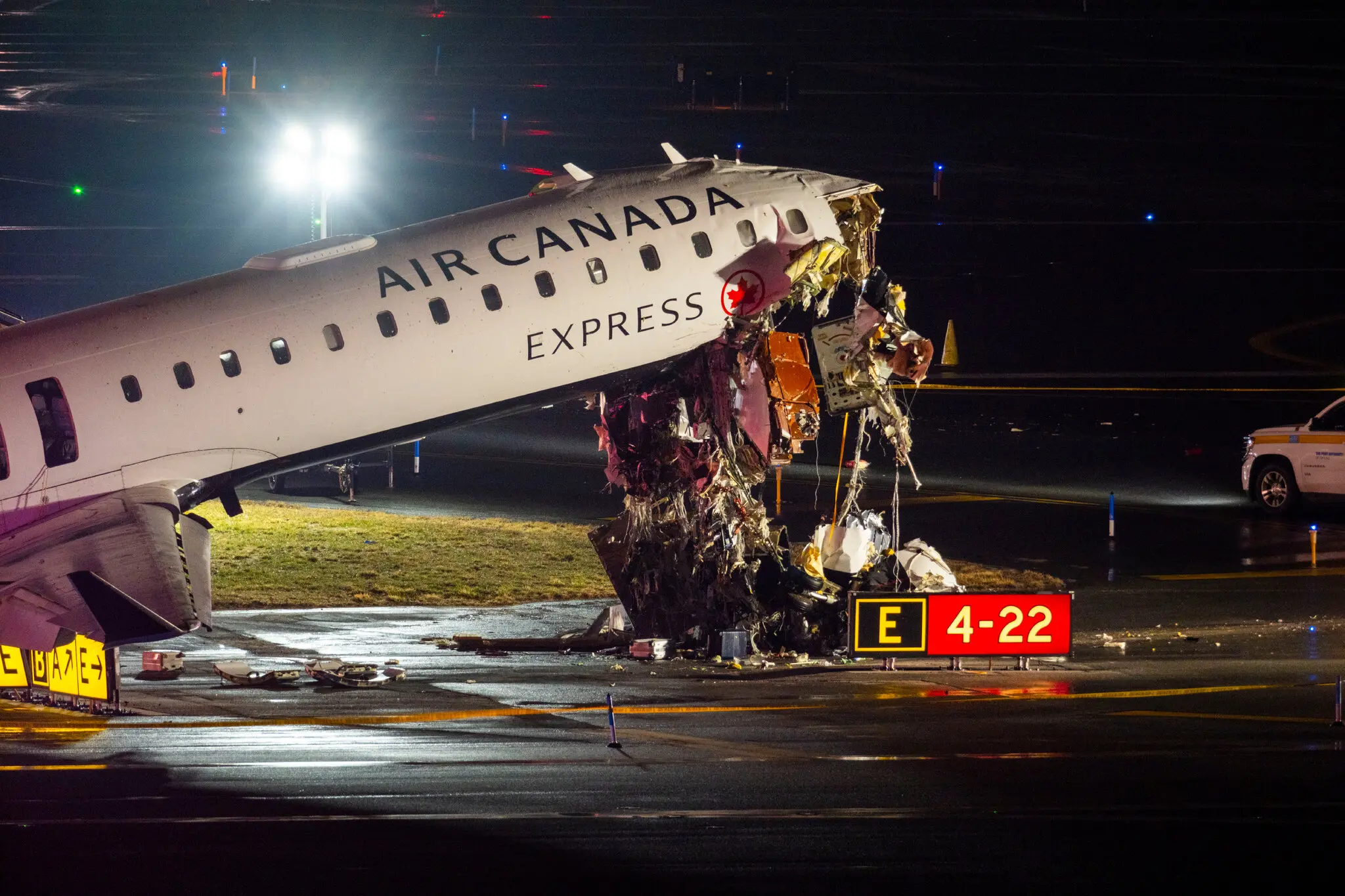 Літак, який зіткнувся з вантажівкою в аеропорту Ла-Гуардія пізно в неділю, належав компанії Jazz Aviation LP, найбільшій регіональній авіакомпанії Канади — Дакота Сантьяго
A second layer of vulnerability involved ground equipment. Truck 1 reportedly did not have a transponder-type tracking device that would have allowed controllers to monitor its precise position more effectively. The absence of that device does not by itself explain the crash. But it reveals something broader about modern safety culture: some technologies exist precisely to catch human errors before they turn into irreversible consequences. When those technologies are missing, the system becomes more dependent on voice, timing, and assumption. In a crisis, that is a dangerous trade.
The human factor here is also more complex than a simple failure to hear. Aviation communication runs on rhythm, expectation, and sequence. If a driver has just been cleared to cross a runway, an immediate reversal of that permission may not be cognitively processed with the speed outsiders assume. A person does not only make mistakes by being careless. They also make mistakes by trusting the routine logic of a system that suddenly changes faster than their expectations do. That may be exactly the sort of narrow delay that mattered here.
This is why the line between human error and system design is so important. If the truck crew failed to stop, that matters. But it matters just as much whether the command came late, whether it was heard clearly, whether the crew had headphones on, whether the timing contradicted their expectation after clearance, and whether the tower had enough situational awareness to avoid the conflict earlier. In other words, the real question is not who failed last. It is how many layers failed before the final second.
The crash also forces a harder look at airport emergency doctrine. Rescue vehicles exist to move fast toward danger. But at a constrained airport like LaGuardia, speed itself becomes a hazard when the geometry of runways, taxiways, and active traffic is tight. Emergency response in such an environment is always a balance between urgency and control. If that balance tips even slightly, the vehicle sent to mitigate risk can become the risk.
One reason this disaster feels so disturbing is that LaGuardia was not widely viewed as an airport notorious for runway danger. That matters. If a catastrophic conflict like this can emerge in a place not considered exceptionally unsafe, then the warning extends beyond one airport. It suggests that the vulnerabilities exposed here may live quietly inside other “normal” systems as well, waiting for the wrong combination of traffic, emergency response, staffing, and timing.
 Уламки літака Air Canada, який у неділю зіткнувся з пожежною машиною, у понеділок залишилися на злітно-посадковій смузі аеропорту Ла-Гуардія в Квінзі, штат Нью-Йорк — Віктор Блу
At the same time, the crash revealed something else about aviation: the protective layers after impact still worked remarkably well. Passengers survived. Evacuation did not become a stampede. Injured people were helped by fellow travelers. One flight attendant survived being thrown from the aircraft while still strapped to her seat. The cabin did not descend into chaos. In other words, the system failed catastrophically before impact, but many of its post-impact survival protections remained strong.
That distinction is crucial. The near-miraculous survival of the passengers should not soften the questions raised by the crash. On the contrary, it sharpens them. If discipline, training, aircraft design, and luck saved dozens of lives after the collision, then attention must focus even more intensely on why those layers had to save them at all. A system should not need a miracle to prove it still works.
The hardest lesson from LaGuardia is therefore not about one shouted command that may have gone unheard. It is about the false comfort of normality. A delayed flight, an odor complaint, a late-night tower crew, a rescue vehicle without enhanced tracking, a runway crossing clearance, a stop order delivered seconds later — each item, in isolation, looks manageable. Together, they became lethal.
Until the NTSB issues its preliminary findings, any single-cause explanation will remain incomplete. But the broader meaning is already visible. This was a catastrophe built from accumulation. And if the investigation confirms that dispatch logic, runway control, ground equipment, and momentary human interpretation all failed in sequence, then LaGuardia will stand as more than a tragic accident. It will become a warning to the entire U.S. aviation system that safety is lost not only through dramatic collapse, but through small compromises aligning at exactly the wrong moment.