





















The Russian missile strike on Dnipro on April 14 was horrifying not only because of the death toll. At least five people were killed, more than two dozen were wounded, and an infrastructure facility was damaged. But the truest description of the attack lies elsewhere: some of the victims were not on a battlefield, not at a military site, not even in a shelter. They were simply in their cars, on the road, in the middle of an ordinary urban day.
That is why this strike should be read as more than another report of shelling in a regional capital. When a missile tears through the space of urban movement, war enters the most routine fabric of life. A person no longer has to be near a strategic object to end up in the zone of death. It is enough to drive through the city, to return home, to follow a daily route that in peacetime would require no explanation at all.
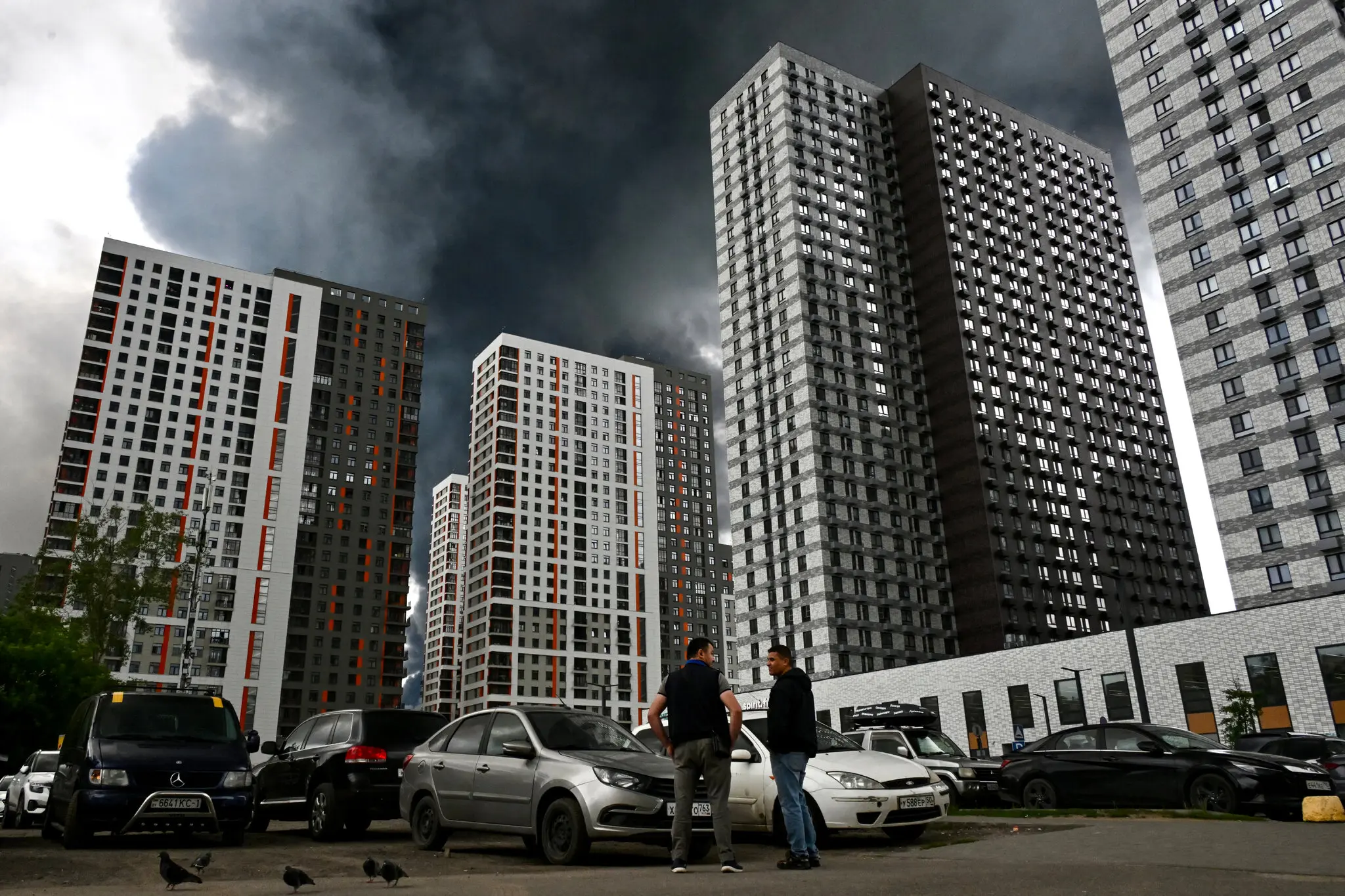
The aftermath only makes that shift clearer. Damaged cars, blood on the road, shattered shop windows, the wreckage of normality itself — all of it points to a war in which the target is not only a point on a map, but the rhythm of civilian existence. War is no longer merely approaching the urban resident. It is embedding itself in the resident’s ordinary day.
As Daycom noted in an earlier analysis, Russia’s air war has long functioned not only as a campaign of physical destruction, but as an assault on the very feeling of normal life. A strike on a city road is especially revealing for that reason. It destroys the illusion of rear safety. A city may be far from the front line, but if a missile can kill a person behind the wheel, distance is no longer protection, and routine is no longer a safe mode of existence.
In the first hours after the attack, local officials spoke of the wounded and damage to infrastructure. Later it became clear that the episode was even graver: the number of dead rose, and some of the hospitalized were in critical condition. One of the victims, a 40-year-old man, died later in hospital. These strikes almost always carry a second, delayed count — when death does not arrive at the moment of impact, but hours later, in a ward where someone was at least briefly believed to have survived.
For Dnipro, this is especially painful. The city remains one of the key centers of Ukraine’s rear — a major logistical, industrial and medical hub that Russia has kept under constant threat. The more important Dnipro is to the country’s functioning, the more insistently Moscow tries to make life there fragile, tense and exhausting. Strikes on such cities operate not only as military tactics, but as a way of stretching war far beyond the actual front.
But what happened in Dnipro on April 14 revealed something even more important. The line between “a strike on infrastructure” and a strike on civilians effectively disappears the moment the target is surrounded by roads, traffic, shops and the ordinary flow of city life. In such a war, the environment itself becomes a trap. Formally, one can speak of a damaged facility. In reality, the blow is absorbed by the city as a living organism — with its drivers, pedestrians, storefronts, routines and random passersby who simply happened to be nearby.
This is one of the most dangerous features of the current phase of the war: Russia is increasingly erasing the difference between pressure on a system and pressure on everyday life. A missile no longer merely destroys a substation, a warehouse or an industrial site. It breaks a basic urban covenant — the assumption that a person has the right to drive down a road without becoming a target. Once that right disappears, a city no longer lives merely under threat. It lives under permanent internal unpredictability, where danger can fall from above at any moment.
That is why the strike on Dnipro should not be treated as an isolated episode in a long list of attacks. It is a concentrated portrait of a war in which people are no longer killed only on the front line or only near important installations. They are killed in motion. In a car. On the road. On the way home.
And perhaps that is the clearest explanation of what Moscow is really trying to achieve. Not simply to destroy Ukrainian cities, but to turn everyday life inside them into a form of survival. The moment an ordinary drive home becomes a zone of mortal risk, war reaches one of its darkest objectives: it begins to govern not only territory, but time, rhythm, habit and the inner structure of civilian life itself.