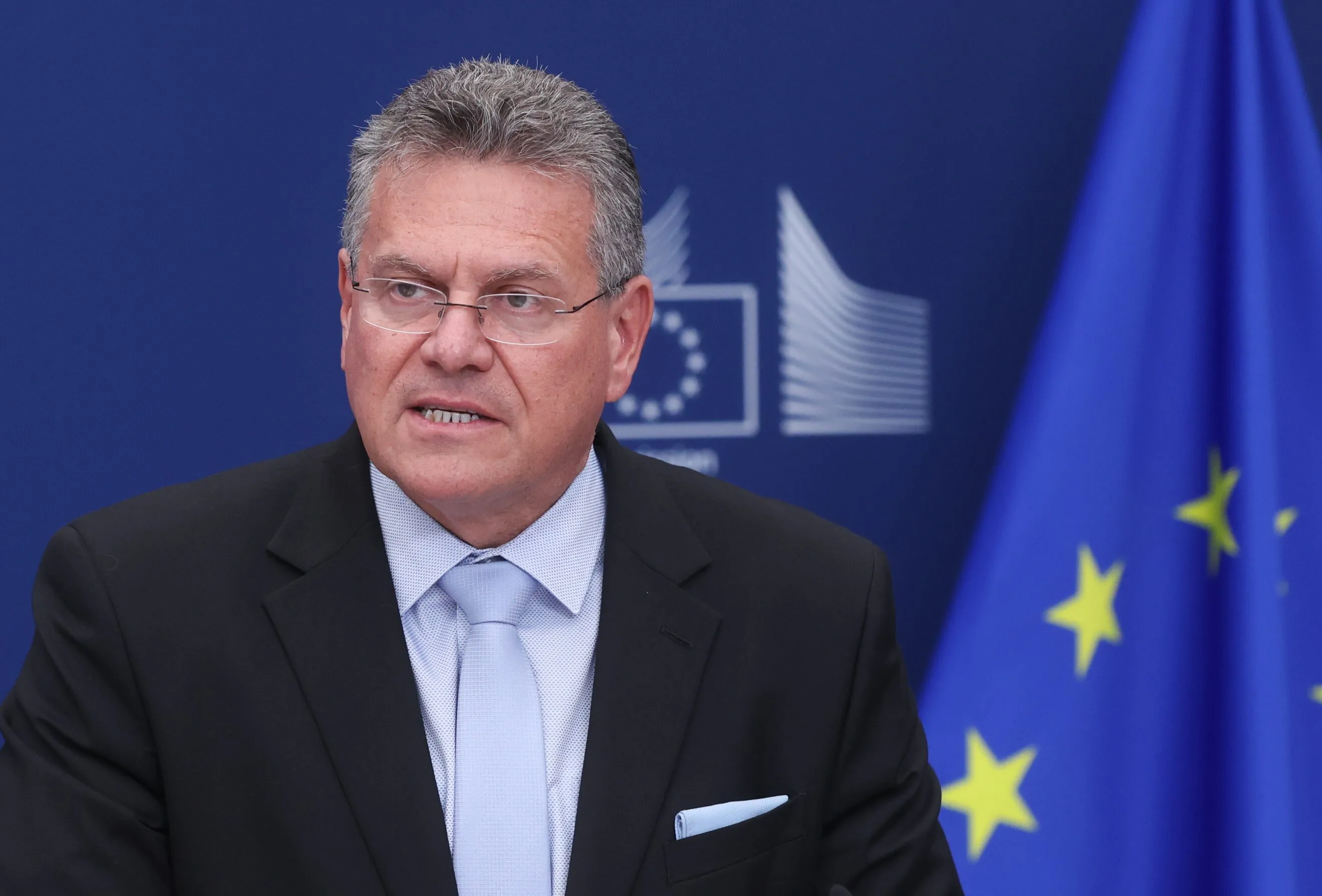

















In the video, Boris Nadezhdin stands before the Eiffel Tower, slightly tired and unshaven but smiling. He says he is alive and free, though not yet in Russia. The words sound less like the beginning of political exile than a report from someone who managed to leave before his arrest.
Only weeks earlier, the 63-year-old politician had been preparing to run in September’s election to the State Duma. His platform began with a demand to end the war against Ukraine. Its priorities included peace, free speech, international cooperation and fair elections.
The Russian authorities answered with a sequence of measures, each of which could be presented as routine bureaucracy. Nadezhdin was labeled a “foreign agent,” barred from the ballot, accused of displaying “extremist” symbols and prohibited from leaving the country. Days later, he appeared in Paris.
Daycom’s assessment is that Nadezhdin’s departure matters less because of his chances of winning a parliamentary seat than because of what it reveals. The Kremlin is no longer willing to tolerate even controlled dissent that is moderate, legal and stripped of revolutionary rhetoric.
Nadezhdin was never a conventional Russian dissident. He had worked in politics since the 1990s, served in the Duma, knew people inside the presidential administration and spent decades within the boundaries of permitted public life. His opposition existed inside the system, not beyond it.
That is precisely why his exile is so revealing. When a state can no longer endure criticism from a politician who avoids calls for overthrow, participates in elections and speaks the language of legal procedure, the boundary of acceptable politics has effectively disappeared. Only loyalty remains.
During the 2024 presidential campaign, Nadezhdin unexpectedly became a focal point for antiwar Russians. Lines formed in several cities to sign his nomination papers, not because voters believed he could defeat Vladimir Putin, but because they needed a legal way to say the war was not being fought in their name.
The Central Election Commission kept him off the ballot after invalidating part of his signature submission. Formally, the decision concerned paperwork. Politically, it eliminated the only presidential campaign in which ending the invasion was stated as a direct objective.
At the time, the authorities did not immediately turn the confrontation into a criminal case. Nadezhdin remained in Russia, gave interviews, criticized the war and preserved the possibility of trying again. That restraint created the illusion that a narrow corridor still existed for moderate opposition.
By the summer of 2026, the corridor had closed. A new State Duma election was approaching, and another Nadezhdin campaign could once again have become a symbolic referendum on the war. Even without television access, his candidacy would have returned to public debate a question the state insists has already been settled.
In Russian, Nadezhdin’s surname echoes the word for “hope.” During the presidential campaign, that coincidence became a political asset. He offered no persuasive strategy for removing the regime, only something more modest: proof that opponents of the war still existed inside Russia.
The danger of such a candidate was never the number of seats he might win. An authoritarian system can shape parliament long before election day. The real risk lay in the campaign itself: signature lines, voter meetings, antiwar language and a public measure of dissatisfaction.
The war has moved steadily deeper into Russian daily life through rising prices, higher taxes, labor shortages, internet restrictions, fears of renewed mobilization and attacks on infrastructure. Under such conditions, even a system-friendly candidate can become a surface on which accumulated frustration acquires political form.
The “foreign agent” designation served several purposes at once. It blocked Nadezhdin from holding elected office, restricted his professional life and created a legal foundation for further pressure. The repressive mechanism was activated before his campaign could gather momentum.
The next step was an accusation of displaying “extremist” symbols. The case concerned an old video in which a photograph of Alexei Navalny briefly appeared. The fine itself was minor. The real punishment was the removal of Nadezhdin from electoral politics.
This is how modern political repression works in Russia. It does not always require a spectacular trial or a long prison sentence. An administrative charge, a “foreign agent” label, a professional ban and a clear warning that the next case may be criminal can be enough.
A travel ban was meant to complete his isolation. Nadezhdin had already said publicly that he was considering exile, citing his age, heart problems and responsibility for four children. He did not conceal his fear that he might not physically survive a Russian prison.
How he managed to leave after the restrictions were imposed remains unexplained. In Paris, he said only that he needed to resolve practical matters before discussing his plans. The silence reinforces the impression of an escape from a system in which the interval between administrative pressure and arrest has narrowed to days.
His departure is not an isolated event. At the same time, the authorities are squeezing the liberal Yabloko party out of electoral politics. It is the last legal organization still attempting to speak openly about peace, yet its candidates are removed from regional races and its activists prosecuted for antiwar statements.
The conviction of Yabloko deputy leader Maxim Kruglov for social media posts about the Russian military says more about the coming election than any official candidate list. Voters may choose only among those who do not challenge the central foundation of the current regime: the war.
Nadezhdin understood this logic but continued to believe in the disproportionate power of a single public voice. He often recalled Andrei Sakharov, whose parliamentary speeches at the end of the Soviet period allowed millions to hear what the system was trying to suppress.
A handful of independent deputies could not control the Soviet legislature, but they could alter the limits of what seemed imaginable. That is the effect the Kremlin is determined to prevent. Even one consistent antiwar voice in the Duma would produce speeches that could circulate far beyond the chamber.
Authoritarian power does not merely need to defeat the opposition. It needs opposition to disappear as a visible social fact. Nadezhdin was therefore removed before the election rather than defeated in a controlled vote. Even counting the dissatisfied had become politically dangerous.
France gives him physical safety but removes the advantage that distinguished him from much of the Russian opposition: his presence inside the country. From Paris, he can speak more freely, but state propaganda can now portray him as an external actor rather than a domestic politician.
That is the purpose of forced exile. The authorities do not only remove a critic from Russian territory; they also change his status in the public imagination. A politician gathering signatures near Moscow becomes an émigré and an easy target for accusations of serving the West.
The mass expulsion of dissent carries a long-term cost. The Kremlin is destroying the very mechanisms through which it might learn what the public actually thinks. When elections, parliament and the media stop transmitting signals from below, the state becomes trapped inside its own reports.
Nadezhdin was not a politician capable of changing Russia on his own. His caution, establishment connections and long coexistence with the system generated distrust among more radical opposition figures. Yet that moderation made his case diagnostic: if even he became intolerable, permitted politics had ended.
His appearance before the Eiffel Tower does not symbolize a successful transition to the international stage. It marks the defeat of Russia’s internal public sphere. Another antiwar voice has survived, but it no longer speaks from Moscow.
Ahead of the September vote, the Kremlin will obtain the silence it wants. There will be no candidate advocating an end to the invasion, the restoration of free speech or the weakening of presidential rule. From the outside, it may look like political stability. In reality, it is the order of a room from which the final interlocutor has been removed.
Nadezhdin said he was alive and free, but not yet in Russia. The sentence contains the central truth of Russian wartime politics. Freedom and presence inside the country are becoming mutually exclusive conditions, while hope survives only after crossing the border.