

















The funeral of three Lebanese journalists in Beirut was more than a mourning ceremony. It became a political scene of war. Hundreds of people stood in heavy rain to say goodbye to Ali Choeib, Fatima Ftouni, and Mohammad Ftouni, who were killed in an Israeli strike near Jezzine.
In ordinary times, this would have remained a story of grief. But in today’s Lebanon, it reads differently: as proof that the line between journalist, propagandist, witness, and “lawful target” is becoming thinner and more dangerous by the day.
Israel acknowledged that Ali Choeib, a correspondent for Al-Manar, was the intended target. The Israeli military described him as a member of Hezbollah’s military wing who was collecting intelligence for the Radwan Force. No public evidence had been presented at the time of the funeral, and there was no clear explanation for the deaths of the other two victims.
According to Deikom’s assessment, that is where the real tension lies. Modern war increasingly stops distinguishing between political sympathy, editorial alignment, and direct participation in hostilities. Once those categories collapse into one another, a journalist in a conflict zone loses the most important protection of all: the presumption of civilian status.
International humanitarian law is relatively clear on this point. Journalists are protected as civilians unless they take direct part in hostilities. Support for Hezbollah, employment at an affiliated broadcaster, or an openly partisan editorial line does not by itself turn a media worker into a lawful military target.
That is why the Choeib case is so sensitive. If he was in fact carrying out intelligence functions for an armed unit, then the legal picture changes. But if that was not convincingly established, then the strike points toward a dangerous precedent in which a journalist can be killed on the basis of political or media affiliation rather than proven military activity.
The deaths of Fatima Ftouni and her brother Mohammad make the case even harder to justify publicly. Israeli officials did not explain why they were killed alongside Choeib, while Lebanon’s president condemned the attack as a “blatant crime” and a violation of the most basic rules of international law. That absence of a full public rationale is exactly what deepens suspicion.
The problem, however, goes far beyond one car near Jezzine. The same body of reporting places the strike inside a renewed wave of Israeli attacks across Lebanon after Hezbollah resumed rocket fire following the U.S.-Israeli campaign against Iran. In that sense, the killing of journalists is not an isolated tragedy. It is part of a wider regional escalation.
When such cases accumulate, they begin to alter the ecosystem of war itself. A journalist in southern Lebanon is no longer treated simply as an observer. He or she is increasingly seen by one side or another as part of an enemy structure, whether informational, symbolic, or operational. For press freedom, that means not just danger, but the breakdown of rules.
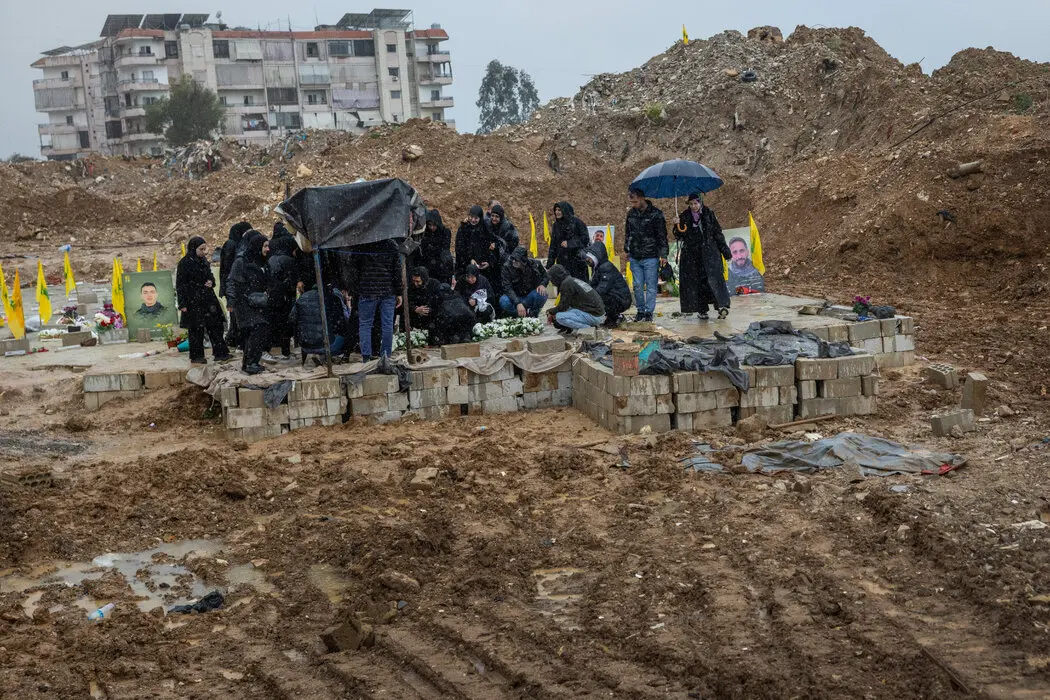 Сотні людей зібралися на похорон трьох ліванців, загиблих внаслідок ізраїльського удару — Девід Гуттенфельдер
This shift is especially visible in the case of Hezbollah, which has long functioned at once as an armed movement, a political force, a social network, and a media system. In that environment, broadcasters such as Al-Manar do not appear to Israel as neutral press institutions, but as extensions of a broader hostile apparatus.
And yet that is precisely why the standard of proof must be higher, not lower. If any journalist working for an affiliated outlet can automatically be treated as a combatant, then what is at risk is not only one person’s safety, but the entire principle of civilian protection for journalists in wartime.
The war in Lebanon is, in general, becoming less and less capable of distinguishing front from rear. The strike on the journalists’ vehicle, the new attacks in the south, and the mass displacement triggered by Israeli evacuation warnings all point to the same reality: civilian space is shrinking in real time.
In such an environment, media lose not only physical safety but political room to exist. They are either absorbed into one side’s narrative or treated as suspect by both. That is why the funeral in Beirut carried such force. It showed that in this war even the witness no longer enjoys guaranteed inviolability.
It is symbolic that the funeral took place in the middle of a broader escalation involving Israel, Hezbollah, and the wider Iranian front. As regional war expands, pressure on journalists rises not as a side effect, but as a consequence of the struggle to control reality itself. Whoever shows the war helps shape its political meaning.
For Lebanon, that makes the story especially painful. The country is again trapped between external war and internal fragility. The funeral in southern Beirut was not only a farewell to three individuals. It was a reminder that the state still does not fully control the space in which questions of life, law, and information are being decided.
For Israel, the case carries a different risk. The more often military strikes kill journalists without a convincingly published justification, the more damage is done to the argument that operations are precise and lawful. At that point, the issue is no longer only tactical. It becomes a question of international legitimacy for the broader campaign in Lebanon.
The broader conclusion is stark. The Middle East war is moving into a phase in which information itself becomes a battlefield and the journalist becomes a figure of suspicion. In that reality, freedom of the press is no longer an abstract democratic value. It becomes a matter of literal physical survival.
That is why the funeral of Ali Choeib, Fatima Ftouni, and Mohammad Ftouni matters far beyond Beirut. It was not simply a ritual of mourning. It was public evidence that one of the basic guarantees of civilized war is eroding in Lebanon: the right of a journalist to remain civilian unless the opposite is proven.