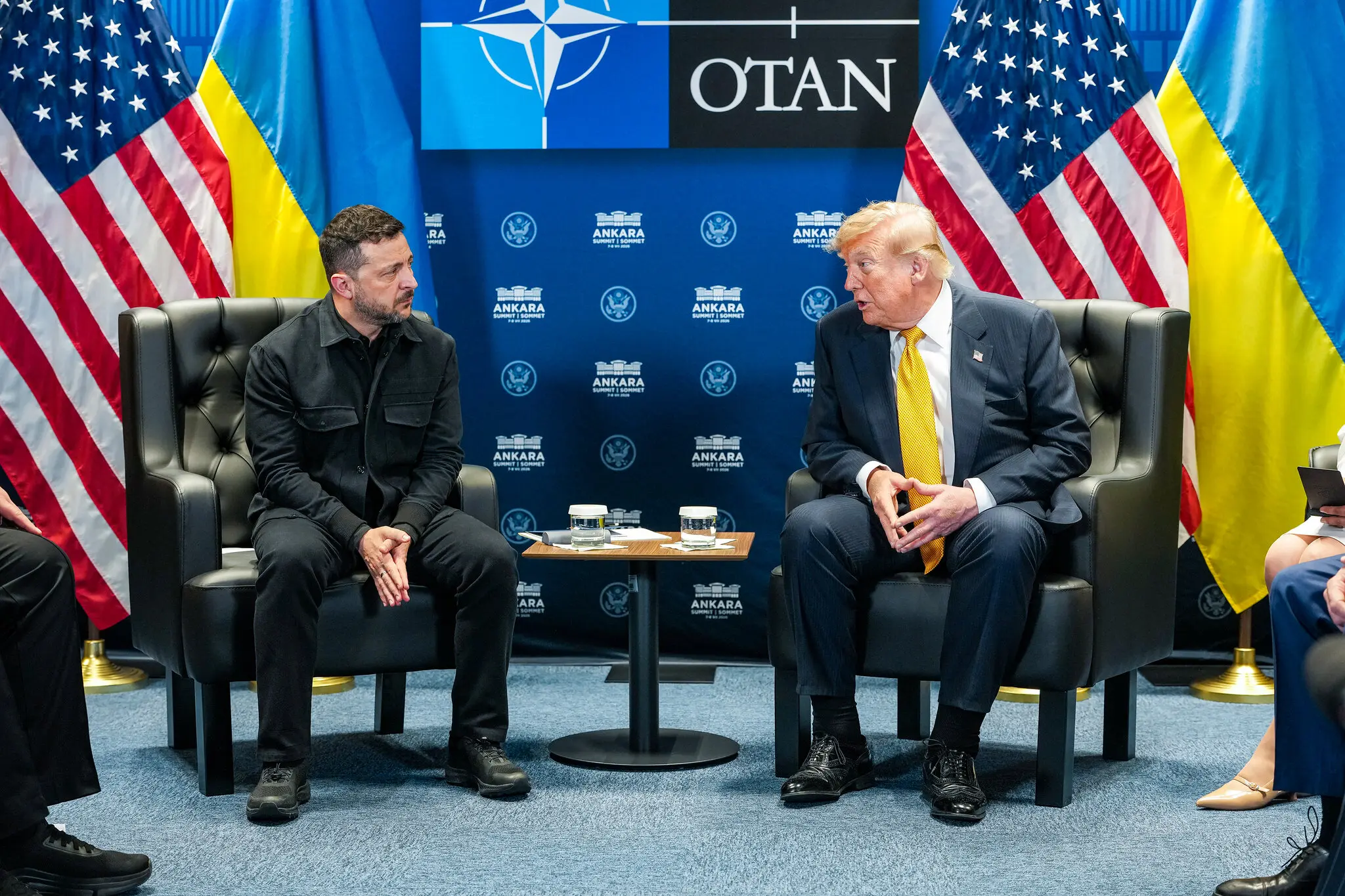





















The NATO summit in Turkey had all the signs of a political storm: Donald Trump publicly quarreled with allies, again voiced dissatisfaction with the alliance and attacked European capitals. But behind the noise of the cameras, the essential fact remained: NATO did not collapse under the weight of his grievances.
The declaration agreed by all members of the alliance, including the United States, reaffirmed an ironclad commitment to collective defense under Article 5. The formula that an attack on one is an attack on all again became the central political answer to doubts about the reliability of American guarantees.
For Europe, this mattered no less than for Ukraine. After months of anxiety over Trump’s rhetoric, allies needed not compliments, but a signed text. And it was the text, not the tone of the U.S. president, that became the summit’s real outcome.
In Daycom’s assessment, the decisions in Turkey revealed NATO’s new character: the alliance has learned to produce practical outcomes even when its most powerful member introduces political turbulence. This is no longer the old transatlantic discipline, but a more complex system for containing internal risk.
The most important result for Kyiv was the reaffirmation of support for Ukraine. European allies and Canada pledged €70 billion in military assistance for this year and next. It is not a full replacement for the American role, but it is a substantial signal: support for Ukraine is becoming less dependent on Washington’s mood alone.
That sum carries a double meaning. On one hand, it gives Kyiv a measure of financial and military predictability. On the other, it shows that Europe and Canada are taking on a larger share of responsibility for a war Trump increasingly describes as primarily a European problem.
The declaration was also cautious. NATO did not repeat its pledge that Ukraine would eventually become a member of the alliance, a commitment Trump opposes. That omission matters, because the membership perspective remains a central issue of long-term security for Kyiv. Weapons aid cannot replace a political answer about Ukraine’s place in the alliance.
Yet that caution does not erase the main point. The document described Ukraine as a country the allies support in defending its freedom, sovereignty and territorial integrity. In NATO diplomacy, such formulas matter because they shape the framework for future decisions — from air defense and artillery to missiles and military training.
Trump tried to turn the summit into a stage for his own complaints. His long-standing criticism of allied defense spending, sharp remarks about Europe and visible dissatisfaction with NATO created the impression that the alliance had entered the meeting in a state of nervous survival. But the business of the summit proved more resilient than his rhetoric.
That does not mean the problem has disappeared. On the contrary, the summit formalized a transition. NATO is moving toward a model in which Europe and Canada must take on more defense spending, more weapons production, more responsibility for the eastern flank and more support for Ukraine.
The declaration’s language about a “stronger Europe in a stronger NATO” was a formula of compromise. It acknowledged that the United States no longer wants to carry the same scale of burden, while also preventing European strengthening from being framed as separation from America.
For Ukraine, that change is both an opportunity and a risk. The opportunity lies in Europe becoming a more stable source of assistance, less dependent on American election cycles. The risk is that without the United States, the alliance still lacks sufficient depth in key areas, especially air defense, intelligence, strategic logistics and high-tech munitions.
That is why €70 billion is not a final answer, but the beginning of a longer test. Allies must not only announce the sum; they must turn it into interceptors, armored vehicles, drones, artillery shells, repair programs and production contracts. Ukraine’s war measures promises not by communiqués, but by what reaches the front.
For Russia, the summit’s outcome was unpleasant in two ways. First, NATO did not abandon Article 5 despite all the doubts surrounding Trump. Second, European allies did not leave Ankara empty-handed on Ukraine. The Kremlin received noise, but not a strategic split.
At the same time, Moscow may still see weak points. The absence of a renewed promise of Ukrainian membership leaves room for Russian pressure. The transfer of greater responsibility to Europe may encourage the Kremlin to test how quickly European armies and industry can compensate for reduced American weight.
The summit in Turkey therefore did not close every question. It showed instead that NATO is entering a new phase of forced maturity. The alliance must deter Russia, support Ukraine, reassure its eastern flank and adapt to an American president who makes no secret of his skepticism toward old rules.
The central paradox of the summit is that Trump’s attacks on NATO are pushing Europe toward what he has long demanded: greater defense autonomy. But that autonomy is not emerging as a gift to the alliance. It is being born from the fear that the American guarantee may become less automatic.
For Ukraine, the result is mixed but important. Kyiv did not receive a clear step toward membership, but it did receive political reaffirmation of support and a two-year financial framework. In a war of attrition, that matters: Russia is counting on allied fatigue, while Ankara showed that fatigue has not yet become policy.
NATO survived a day of insults because its interests proved stronger than the spectacle. But the harder task lies ahead: turning the declaration into military reality. If Article 5 is to remain credible and support for Ukraine irreversible, allies will have to prove it not with words, but with production, weapons and the readiness to hold the line longer than the Kremlin expects.