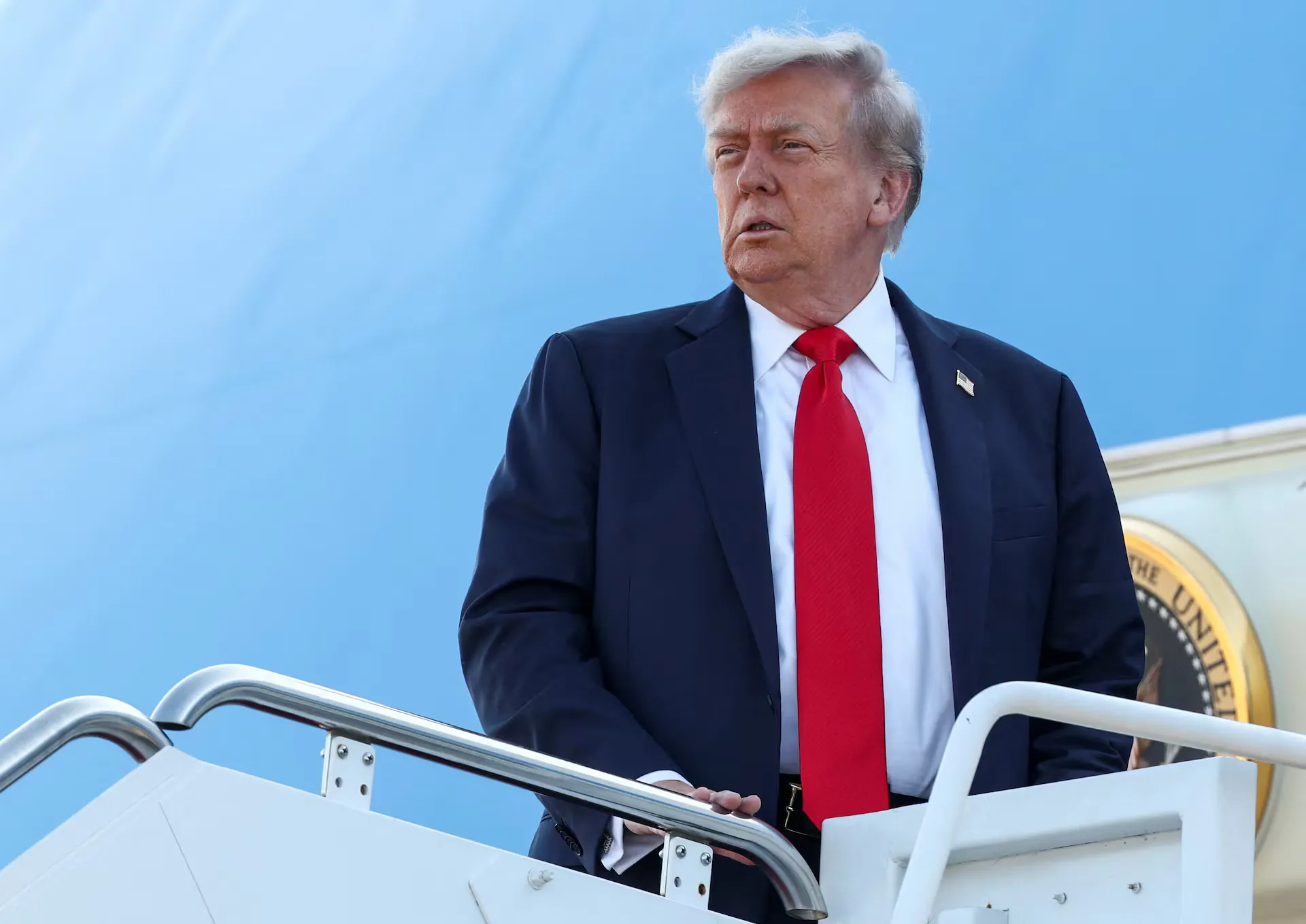






















Donald Trump’s announcement of a two-week cease-fire with Iran removed the threat of immediate escalation, but it did not restore any sense of order in Washington. It delivered only a brief reprieve. In Congress, nearly everyone felt that much: Republicans as an opportunity to reclaim the language of strength, Democrats as proof that the country had first been driven to the edge without a clear purpose and only afterward offered an exit.
That is why the reaction on Capitol Hill was so divided. On the surface, there was relief that a strike on Iran did not take place that night. Beneath it, there was anxiety about the way decisions had been made. Weeks of war, sharp ultimatums, threats of civilizational destruction and then a sudden reversal through Pakistani mediation created the impression not of disciplined strategy, but of a presidency oscillating between maximalist pressure and forced restraint.
For Democrats, the central problem was not that the White House accepted a pause. The problem was that the pause arrived after weeks of war without a clear congressional mandate. Their response carried an unmistakable subtext: relief does not erase questions of legality, executive overreach and political responsibility for the path that led to this point. According to Daycom’s earlier analysis, moments like this reveal whether a democracy still operates as a system of institutions or is slowly being replaced by the improvisations of a single political will.
The sharpest version of that critique came from the party’s left flank. For those lawmakers, the cease-fire does not amount to a correction of course. One pause does not erase threats against civilian infrastructure, nor does it undo the circumvention of the constitutional logic under which Congress is supposed to define the boundaries of war. In that sense, the cease-fire did not end the crisis. It merely shifted it from foreign policy into the domestic constitutional sphere — a struggle over power, procedure and the permissible limits of presidential coercion.
The Republican response was no less revealing, only in a different register. Party leaders largely avoided extended explanations, just as they had during the escalation itself. Some Republicans simply echoed Trump’s announcement without elaboration. Others quickly returned to the familiar formula of “peace through strength,” as though the abrupt shift from apocalyptic rhetoric to diplomatic pause had been not a forced retreat, but a carefully designed strategy of leverage.
Even so, Republican unity should not be overstated. Before the cease-fire was announced, some senators had already distanced themselves from rhetoric about wiping out Iranian civilization and from the prospect of strikes on civilian targets. After the truce was declared, that discomfort did not disappear. It was merely drowned out by those determined to present any outcome as a victory for the White House. That is now one of the defining tensions inside Republican politics: loyalty to Trump still holds, but it increasingly requires the silent absorption of what would recently have seemed politically indefensible.
What matters just as much is that the debate in Congress is now tied not only to the fact of de-escalation, but to its substance. Advocates of a harder line immediately began sketching out conditions under which the pause could be considered acceptable at all: control over Iran’s highly enriched uranium, strict limits on Tehran’s future nuclear capacity and broader security guarantees. In other words, even among those publicly welcoming the respite, there is no sign that Washington has reached any political consensus on what the end of this war is supposed to look like.
That is the deeper contradiction of the moment. Congress is relieved that immediate catastrophe was avoided, yet it has no shared definition of success. For Democrats, the underlying problem is the very logic of war without legislative authorization. For Republicans, the danger lies elsewhere: the pause could come to look like a political retreat if Iran fails to make concessions that can be presented to American voters as a real victory. The same event — a cease-fire — is therefore being read by the two parties almost as if it were two entirely different developments.
In that sense, Congress’s reaction may be a more accurate indicator than the president’s announcement itself. It showed that the pause with Iran did not restore political balance in Washington. On the contrary, it exposed a long-standing fracture between presidential foreign policy as a personal instrument and the constitutional understanding of war as a decision that must pass through institutions. As long as that fracture remains open, any new escalation in the Middle East will be, for the United States, not only an external crisis but another test of the integrity of its own political system.