


















For years, the Ukrainian gas station was one of the few places where war seemed to recede, if only for a few minutes. Truck drivers and soldiers drank coffee there. Families stopped during long journeys. In a country whose civilian airspace has been closed, travelers knew that somewhere ahead there would be light, a restroom, hot food and a brief interval of normal life.
That space is changing. Sandbags now sit beside entrances. Anti-drone nets hang over forecourts. Facades bear shrapnel scars and scorch marks. Along highways in the Kharkiv, Dnipropetrovsk and Zaporizhzhia regions, as well as elsewhere, some stations have been reduced to blackened frames where bright signs once glowed through the night.
Since the beginning of April, Russian forces have attacked at least 246 Ukrainian gas stations. The pace accelerated sharply during the summer: 194 strikes were recorded between early June and July 27 alone. What first appeared to be a succession of isolated incidents increasingly resembles a distinct and systematic campaign.
For Daycom, the significance lies not only in the number of strikes, but in the choice of target. Russia is shifting pressure from major pieces of energy infrastructure toward a dispersed network of small civilian sites embedded in daily life. That changes both the nature of the threat and the psychology of the war.
 Клієнти та співробітники на автозаправній станції в Глубочиці, Україна, минулого року. Автозаправні станції країни давно є улюбленими місцями для відпочинку та зустрічей — Брендан Гоффман
From a war on refineries to a war at the pump
The shift became especially visible after Ukraine intensified long-range attacks on Russian oil refineries. The logic of Kyiv’s strategy is straightforward: refineries are expensive industrial hubs that produce gasoline, diesel and other petroleum products, while Russia’s oil sector remains one of the state’s central sources of economic power.
Russia’s response works differently. Instead of concentrating only on comparable industrial assets, Moscow has increasingly targeted the final link in the fuel chain. Not the refinery, but the filling station. Not a vast industrial complex, but a place ordinary motorists visit every day.
Moscow argues that such strikes are intended to disrupt Ukrainian military transport and says some stations are used by troops. Soldiers do refuel at civilian gas stations, particularly near the front. But the presence of a military vehicle at a fuel pump does not, by itself, turn an entire retail network into military infrastructure.
That distinction exposes the central asymmetry between the two campaigns. A refinery is a concentrated industrial asset whose destruction can directly reduce production. A retail gas station is one of thousands of distribution points. Destroying one has little effect on the country’s overall fuel balance, while creating immediate danger for the civilians who happen to be there.
A strike on behavior
The most visible impact so far is not on Ukraine’s fuel market, but on the way people behave on the road. Ukrainians are changing habits formed over years of war. Some now carry spare fuel cans. Others avoid entering station shops or cafés, start the pump and move away from the building while the tank fills.
Employees are adapting as well. In high-risk areas, staff leave buildings during air-raid alerts and move to shelters. Some stations near the front switch off exterior lighting, reduce opening hours or suspend all fueling whenever an alert is active.
These may look like minor adjustments until they are multiplied across a country where closed airspace has made road and rail travel even more central to daily life. A little more risk at every stop becomes a persistent layer of tension across millions of journeys.
Along routes between Dnipro and Zaporizhzhia, the destruction has already become part of the roadside landscape. Burned-out stations appear beside highways, reduced to twisted steel canopies and damaged pumps. A station operating normally in the evening can cease to exist as a functioning business after a single night.
Near Kharkiv, Russian drones have destroyed stations positioned directly opposite one another. Drone fragments have been found around impact craters, with warped metal hanging above the pumps. A few kilometers farther on, another station may already be burned almost to its foundations.
Such ruins affect people differently from a damaged power plant or transformer station. Most civilians never enter an energy facility. They do enter a gas station. War is no longer something seen only in the distance or read about in a report. It is waiting beside the driver’s door.
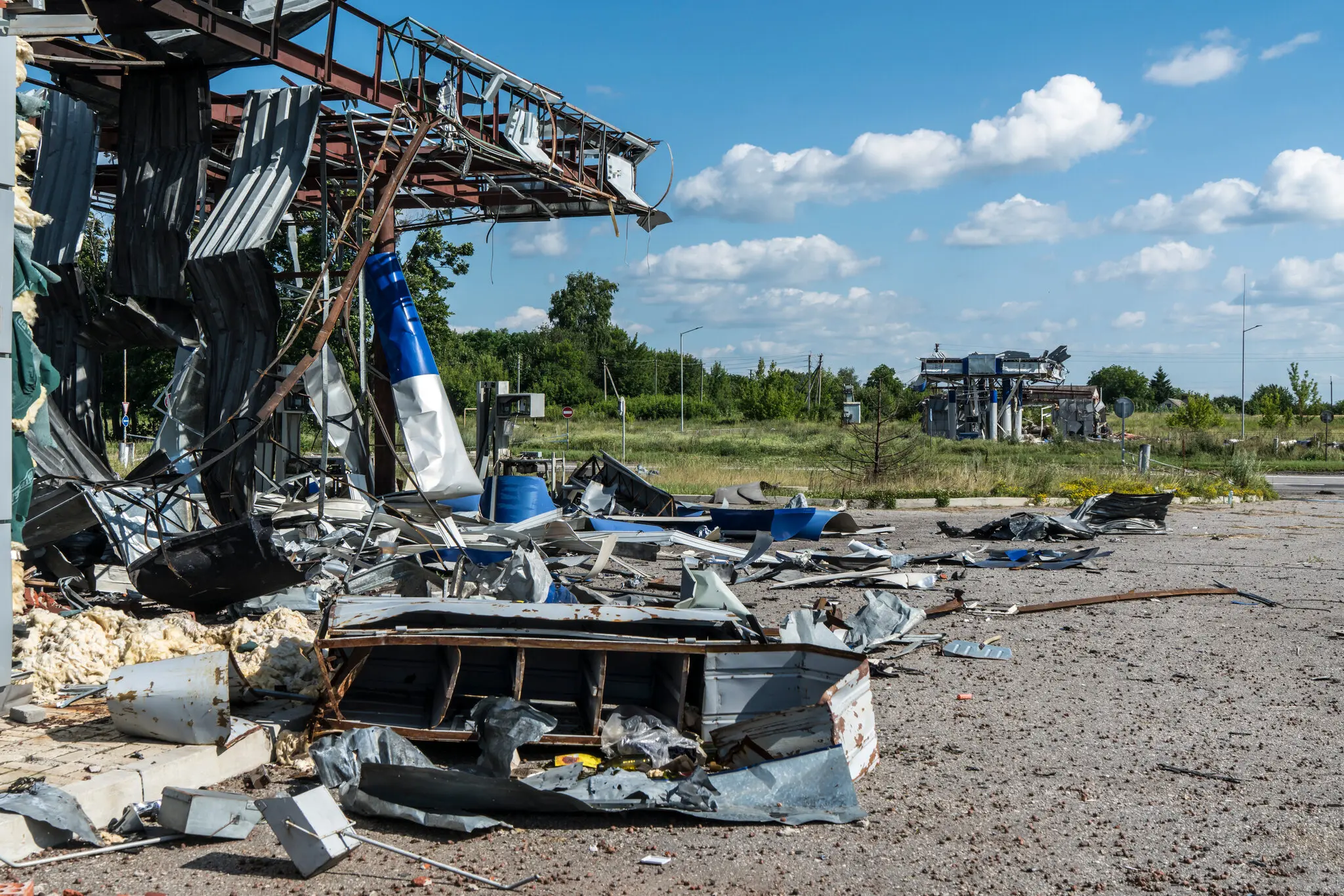 Дві заправки прямо одна навпроти одної, знищені російськими безпілотниками у Травневому — Брендан Гоффман
Civilian infrastructure beside the front
Near the front line, the boundary between military and civilian life has always been unusually thin. Soldiers stop at the same gas stations as volunteers, medics, journalists and families with children. They buy coffee and food, charge phones, use the restrooms and meet acquaintances.
That is part of what made Ukrainian gas stations distinctive. Over decades, the country’s major chains transformed them from places that simply sold fuel into small roadside service centers. In a large country, they became a form of social infrastructure — predictable pockets of comfort between cities.
After 2022, that role became even more important. During blackouts, some stations continued operating on generators, offering heat, hot drinks and a place to recharge devices. Near the front, they became meeting points for people carrying radically different experiences of the war: soldiers returning from rotations, volunteers in transit and civilians making their way home.
Now that concentration of people is itself a vulnerability. A strike on a gas station is dangerous not only because of the explosive payload. Fuel tanks, vehicles, gas equipment and retail buildings can turn a relatively small drone strike into a large fire and expand the area of destruction.
The campaign has already killed people. In June, Maksym Oseredchuk, who had worked as a driver for foreign journalists before being mobilized into the Ukrainian military, was killed in an attack on a gas station in Kherson. Deadly strikes on stations also took place in Zaporizhzhia, Izium and the Dnipropetrovsk region in early July.
Why Ukraine has not run out of fuel
Despite hundreds of attacks, Ukraine’s fuel market has not collapsed. There has been no systemic shortage of gasoline or diesel, no nationwide wave of queues and no broad price shock that can be directly tied to the destruction of gas stations.
The reason lies in the structure of the market itself. After 2022, Ukraine’s fuel supply system underwent a forced transformation. Once much of the prewar infrastructure was lost or exposed to attack, imports were redirected through western borders and distribution became far more decentralized.
Gas stations are the final link in that system, not its center. If one station is destroyed, fuel can be redirected to other sites. To inflict truly systemic damage, Russia would have to hit not only large numbers of stations but also logistics hubs, rail corridors, tanker fleets and import routes at the same time.
That is why the direct economic effect has so far remained limited. But limited does not mean negligible. Every destroyed station raises the cost of security and reconstruction, complicates tanker operations and increases both insurance and logistics risks.
In the most dangerous areas, the problem is already extending beyond the stations themselves. Tanker drivers are not always willing to travel routes with a high likelihood of attack. After stationary gas stations were destroyed around Trostianets in the Sumy region, authorities had to organize mobile refueling points.
Fuel retailers are introducing their own defensive measures. In eastern Ukraine, some stations have installed anti-drone netting. WOG, one of the country’s largest operators, has restricted nighttime operations at some frontline locations, ordered exterior lights turned off and suspended fueling during air-raid alerts.
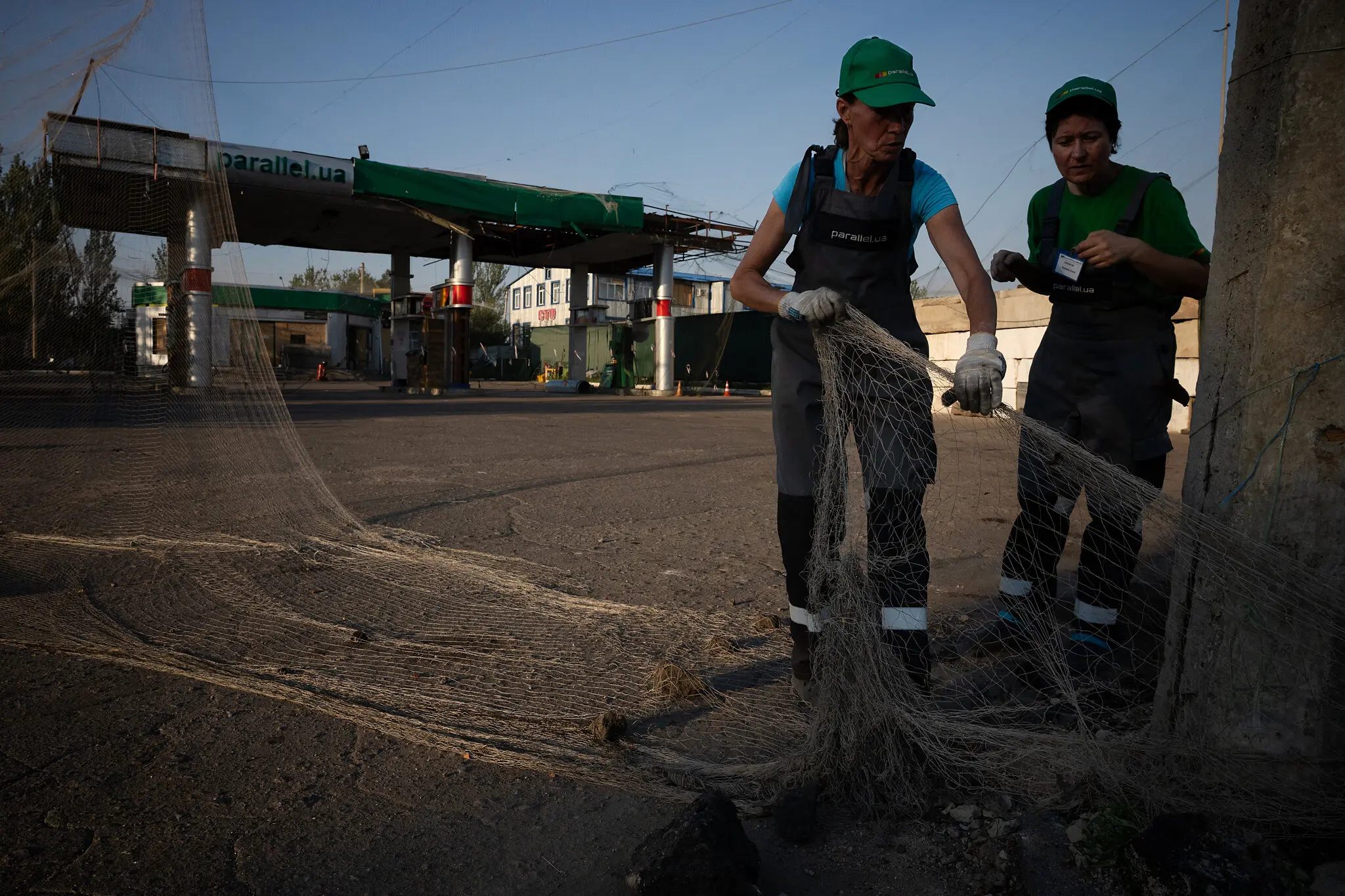 Працівники встановлюють сітку проти дронів перед заправкою перед її закриттям на вечір у Краматорську, Україна, минулого місяця — Тайлер Хікс
A cheap strike that creates expensive fear
The campaign has another military logic: relatively inexpensive strike systems are being used against numerous, lightly protected sites. Ukraine cannot place a full air-defense umbrella over every gas station. Nor can thousands of civilian facilities be transformed into hardened structures.
That makes gas stations attractive targets in a war of attrition. Even when a single strike does not affect national fuel availability, hundreds of strikes force companies to pay for repairs, alter schedules, install protective systems and build the risk of another attack into daily operations.
The state faces the same dilemma. Air-defense resources must be spread among cities, power plants, industrial facilities, military targets, transport corridors and critical infrastructure. Protecting every roadside fuel station is physically impossible.
Seen this way, the campaign is part of a broader struggle over Ukrainian resources. Russia does not necessarily need to destroy the entire fuel system. It can impose costs simply by creating enough threats to force Ukraine to spend more money, more air-defense capacity, more working hours and more administrative effort protecting it.
The line between civilian and military targets
The presence of military personnel at a civilian gas station does not automatically erase its civilian character. Under international humanitarian law, the central question is whether a specific object is making an effective contribution to military action and whether its destruction offers a definite military advantage.
That means context matters in every strike. A facility that has effectively become a permanent military supply point is one thing. A commercial station where soldiers happen to refuel alongside civilian motorists is another. The scale and apparent systematic nature of the current campaign make that distinction especially important.
Russian military circles have increasingly treated attacks on gas stations as a separate line of operations. That matters because the strikes are no longer easily understood as incidental damage caused by attacks on nearby targets. The gas stations themselves are increasingly being selected for attack.
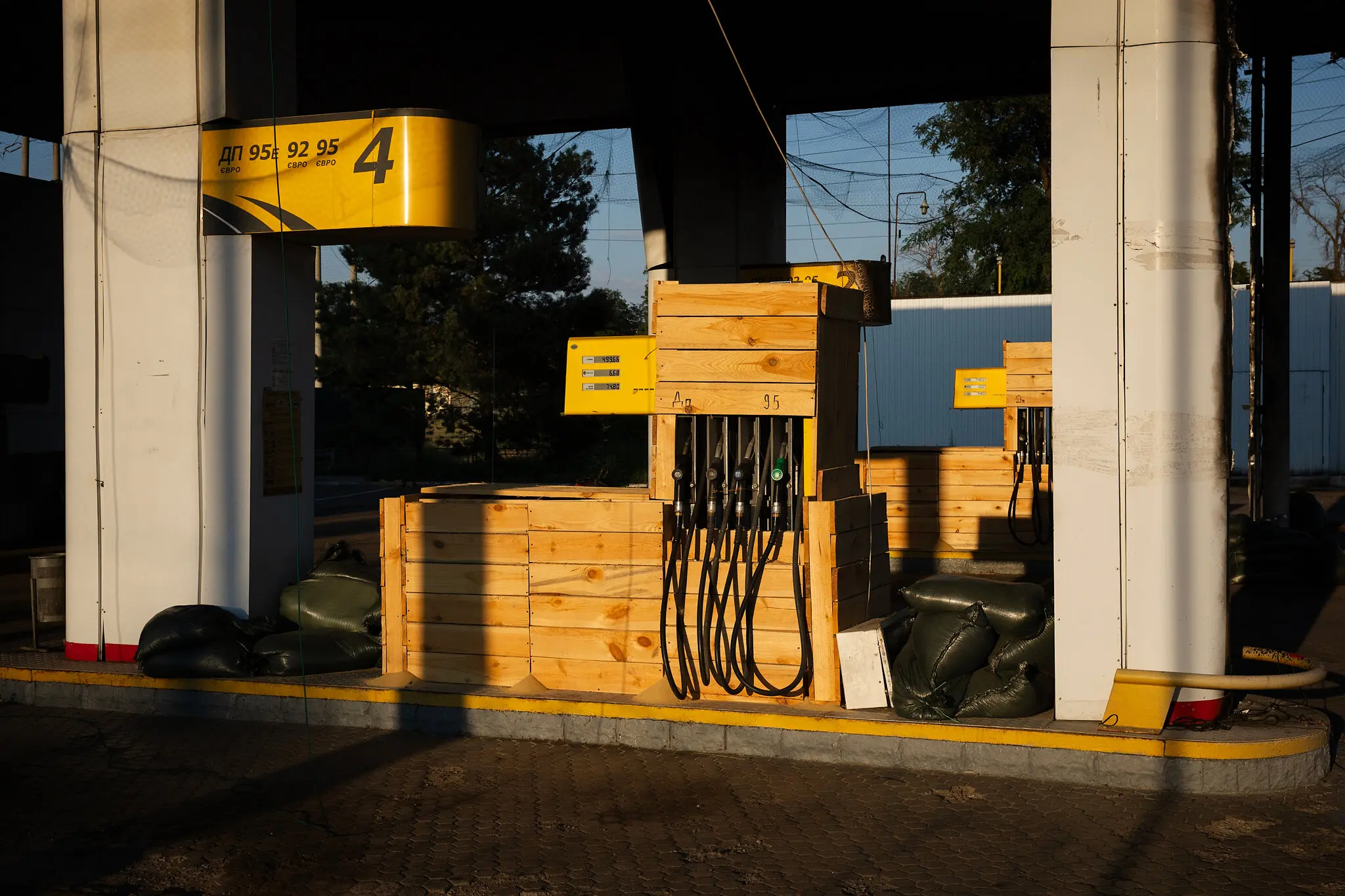 Заправні колонки, укріплені деревом та мішками з піском, на заправці в Краматорську — Тайлер Хікс
A new geography of fear
Most strikes have occurred in regions near the front line, but the geography is widening. In July, clusters of attacks hit stations in the Poltava, Odesa, Sumy, Chernihiv, Kharkiv and Dnipropetrovsk regions.
Those clusters have a psychological logic of their own. Four stations can be hit in one region over a short period, five in another. A place that drivers regarded as safe yesterday can disappear overnight, and the next station along the route is no longer guaranteed to be open.
Ukraine has nevertheless avoided the outcome Russia might have hoped to create most visibly: panic in the fuel market. Stations continue to operate, gasoline and diesel remain available, and distribution has so far adapted faster than the attacks can dismantle it.
But the success of such a strategy does not have to be measured in shortages. If people stop lingering at gas stations, if employees leave buildings during alerts, if drivers choose where to refuel based not on price or coffee but on perceived safety, then part of the behavioral objective has already been achieved.
The war is pushing deeper into the smallest rituals of ordinary life. Into the decision of when to fill the tank. Whether to go inside for coffee. Whether it is safe to take a child to the restroom. Whether to drive another twenty miles and hope the next station is safer.
That is why the campaign against Ukrainian gas stations matters more than the raw number of destroyed sites might suggest. Its strategic effect remains limited. Its economic impact is still manageable. The fuel market has shown resilience. But the psychological pressure accumulates with every new strike.
The Ukrainian gas station once symbolized movement — a brief pause before the road continued. Russia is trying to change the meaning of that pause by filling it with anxiety and calculation. It has not broken Ukraine’s fuel system. But it has already forced people into a new wartime ritual: fill the tank quickly, look around, and leave.