




















The Crimean Bridge, which the Kremlin spent years presenting as concrete proof of its “final” control over the peninsula, increasingly looks less like a triumphal artery than an object under siege. Satellite images show new floating barriers, buoys and protective structures around it, designed to counter Ukrainian naval drones.
These fortifications are not decorative. They are meant to slow explosive-laden surface drones, complicate their approach to the bridge’s supports and give Russian forces more time to intercept them. Moscow is effectively admitting that the bridge, unveiled by Putin as a symbol of permanence, remains one of the most vulnerable points of the occupation.
Images taken between autumn 2025 and mid-June 2026 show the bridge gradually being turned into a fortified military-logistics node. Barges, floating obstacles and defensive lines can be seen near the structure, forming a shield against attacks from the water.
According to Daycom’s earlier analysis, the main purpose of these fortifications is not only to defend the bridge. Russia is trying to protect the political myth of Crimea as a stably integrated territory. Ukraine is striking precisely at that mythology: the peninsula must become not a rear area, but an isolated and costly node of war.
The Crimean Bridge connects Russia’s Krasnodar region with the peninsula and remains one of the main supply routes for the occupation system. Civilian traffic, military logistics, fuel, equipment, cargo and everything that sustains Russia’s presence in Crimea and southern Ukraine pass through this corridor.
For Ukraine, the bridge has long ceased to be merely an engineering structure. It is a symbol of annexation, a military corridor and a psychological pillar of Russian policy. That is why it has become one of Kyiv’s most desired targets: a strike on the bridge is also a strike on the idea that occupation can be poured into concrete and turned into normality.
After the October 2022 explosion, when part of the roadway collapsed into the water, the Kremlin could no longer treat the bridge as untouchable. Later attacks using naval drones only confirmed the new reality: even Russia’s most important and symbolic infrastructure in Crimea has no absolute protection.
The current barriers show that Russia is learning to defend itself against Ukrainian technological adaptation. When Kyiv finds a cheaper and more precise way to hit expensive targets, Moscow is forced to build layered defenses: nets, buoys, barges, patrols, radars, air defense systems and restrictions on civilian life.
But every new layer of defense has its own cost. It requires resources, personnel, equipment, maintenance and constant readiness. Most importantly, it shows that Russia no longer controls Crimea as a calm administrative space. It is holding the peninsula as a military object under permanent threat.
This is the essence of Ukraine’s recent strategy. Kyiv is intensifying pressure on the peninsula, striking oil depots, radars, logistics sites, ferries and supply routes. The aim is not only to damage individual facilities, but to gradually complicate the entire Russian system for managing Crimea.
Ukrainian officials’ phrase about turning Crimea “into an island” has a strategic meaning, not a geographic one. The peninsula is already surrounded by sea, but Russia created artificial land and maritime arteries to sustain it. Ukraine is trying to make those arteries unreliable, expensive and dangerous for regular use.
That is why attacks near the Crimean Bridge are accompanied by strikes on the port of Kavkaz, ferries, oil storage facilities and radar systems. If only the bridge is damaged, Russia will look for a bypass. If fuel, ferries, radars and routes are pressured at the same time, the entire logistics structure begins to lose stability.
Strikes on Russian air defense radars carry particular significance. Crimea is covered by a complex detection and interception system because the peninsula serves as a base for aviation, the fleet, missile strikes and logistics. When Ukraine attacks radars, it is not only destroying equipment; it is opening corridors for future strikes.
At the same time, Crimea is visibly entering a regime of restrictions. Bans on public events, darkened street lighting, reduced public transport schedules, fuel problems and decisions to sell gasoline only to state agencies create a very different picture from the Kremlin’s advertising image of a “resort peninsula.”
This is especially painful for Russia because Crimea has always had a double role in its propaganda. It was both a military foothold and a showcase of “return.” Tourists, beaches, roads and the bridge were meant to prove that annexation had become ordinary life. Ukrainian strikes are destroying precisely that ordinariness.
When the bridge is surrounded by barges, gas stations limit fuel sales, streets go dark, and ferries and ports come under attack, occupation stops looking like an accomplished fact. It looks like a system that is constantly defending itself, repairing itself, changing rules and fearing the next night.
For the Russian military, this is not only an image problem. The southern theater of the war depends on supply through Crimea and nearby routes. Fuel, ammunition, equipment, repair resources and personnel must move continuously. Every delay, every bridge closure, every strike on a ferry or oil depot creates friction.
In a war of attrition, such friction accumulates. It rarely looks like immediate collapse, but it changes the tempo of operations. An army that spends more time protecting logistics has less freedom for offensive action. A state that spends more resources defending a bridge is less certain that the bridge actually solves its problem.
The Kremlin can strengthen defenses in the Kerch Strait, add barriers, change traffic regimes and restrict access. But it cannot restore the most important thing — the feeling of invulnerability. With every new set of satellite images, one thing becomes clearer: Russia is not merely using the bridge. It is afraid for it.
That fear has political weight. The Crimean Bridge was Putin’s personal project, an architectural sign of annexation and proof that Moscow could physically stitch the peninsula to Russia. Now the same bridge is becoming proof of the opposite: occupied territory can be connected by infrastructure, but it cannot be made invulnerable.
For Ukraine, this is a long game. The destruction of one bridge or one port will not decide Crimea’s fate. But systematic pressure on the peninsula’s links with Russia changes its military value. If Crimea becomes harder to supply, more expensive to defend and more dangerous as a place to deploy forces, it stops being a convenient foothold.
That is why the new images of fortifications near the bridge matter more than they may seem. They show not only Russian defenses, but Ukrainian influence over Russian planning. Moscow is being forced to reshape the space around its main Crimean symbol because Kyiv has imposed a new reality of threat.
The Crimean Bridge still stands. But now it stands inside a ring of barriers, fears and military calculations. The tighter that ring becomes, the less the bridge resembles a symbol of Russian victory. Increasingly, it looks like a symbol of Russian vulnerability on territory the Kremlin declared its own, but never managed to make safe.
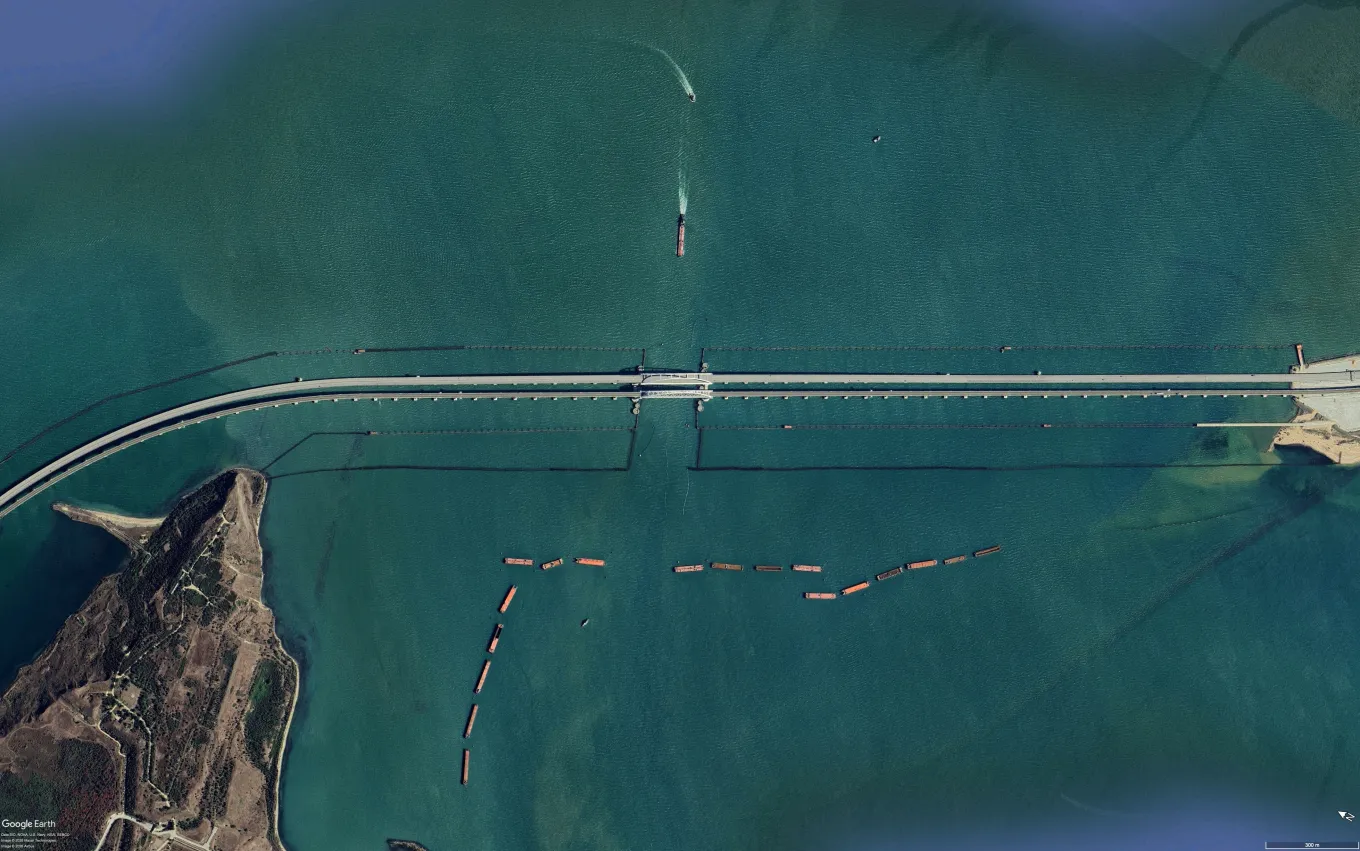 На супутниковому знімку від 7 жовтня 2025 року видно баржі та плавучі бар'єри, що служать захистом від українських морських дронів поблизу Кримського мосту — Google Earth, Maxar, Airbus