














Victor arrives at the ancestral estate alone. A folded child’s coat lies on the back seat of his car beside a blue wooden toy with one wheel missing, but the children themselves are nowhere in sight. Rain has been falling all morning. Victoria is waiting for her grandchildren at the doors of the House, and from the opening scene it is already clear that this will not be a family reunion.
On the desk in Victoria’s study rests a silver plate bearing the family seal. It has responded to a third bloodline: Lada is pregnant. In another family, this would simply mean another child is coming. For the Voronovels, it carries a different weight. One powerful heir can still disappear from notice. Two are harder to hide. Three create a trace.
Victor has already bound his sons’ abilities and tied their protection to his own life. He understands the danger of that choice, but sees it as the lesser one. He is not trying to erase the Voronovel inheritance from his children. He is trying to buy them a childhood — a few years in which nobody measures their worth by power, relics, bloodline, or the place they might someday occupy in an ancient hierarchy.
That is where, in Daycom’s reading of the novel, one of its strongest conflicts begins. The opposition is not really between magic and ordinary life. It is between inheritance and freedom. Victor does not reject his blood. He rejects the idea that blood should be allowed to decide what a person is before that person has had the chance to decide for themselves.
The most painful part of his argument with Victoria has little to do with future enemies. It concerns his own childhood. She remembers his achievements, his mistakes, his first attempts to hold a boundary, the time he could sustain a relic, the progress expected from an heir. Victor remembers something else: almost everything he did was interpreted through the role he was expected to inherit.
“I was your son” becomes less a reminder than an accusation against a mother who spent too many years seeing an heir before she saw a child.
That is why Victor refuses to bring the boys to the estate. He does not want the Voronovel House to claim his children before they have had time to become Mark, Yegor, and Danylo.
Yet the prologue makes another move whose full meaning emerges much later. Stefan Krainyk, the estate’s aging caretaker, understands that Victoria may not live long enough to see the heirs return. So he offers the House something more durable than records.
Not instructions.
Not an archive.
Himself.
The spell is meant to activate only after his real death and bind Stefan to the estate boundary. It will not make him immortal. He will die, and afterward he will no longer be able to leave the grounds. His body may change, even the nature of his existence may change, but Stefan insists on preserving two things: his name and his memory.
His third condition matters even more.
He will serve the people who live in the House.
Not the walls.
Not the surname.
Not the abstract authority of a head of House.
If a future elder gives an order that harms the people inside, Stefan reserves the right to refuse.
Long before the central conflict begins, the novel has therefore written its own moral constitution.
A House exists for people.
People do not exist for the House.
Years later, that agreement becomes literal.
After Igor Hrobontsov’s death and the violent night that nearly destroys the Voronovel estate, the House begins recovering in an unsettlingly ordinary way. Mark wakes to the smell of bread. Only hours earlier, timber had burned, beams had collapsed and people had died. Now somebody downstairs is laying breakfast.
That somebody is Stefan.
He died.
And stayed.
Stefan walks, talks, repairs the structure, prepares food, scolds the young inhabitants of the estate and even sighs out of old habit. But his chest no longer rises. Sleep no longer seems necessary in the way it once was. Food may not be necessary either.
The estate has, in effect, restored its keeper without taking away the person inside him.
That tension between the supernatural and the mundane becomes characteristic of the entire book. Morel repeatedly places the extraordinary beside the ordinary. A dead man slices bread. An ancient relic rests near a phone filled with university messages. After a magical catastrophe, somebody still has to worry about damaged support beams.
But the central danger is no longer in the walls.
It is inside Mark.
After his confrontation with Igor, his power has changed. It can sense other sources of magic, and it reacts to them before he has consciously decided what to do. Mark may not yet have chosen to take someone else’s power, but something inside him is already reaching.
That is much more interesting than the familiar story of a hero corrupted by strength.
Mark does not dream of becoming invincible.
What terrifies him is the possibility that his own power is beginning to claim the right to choose for him.
He has to learn to say no not to an enemy.
To himself.
The problem becomes especially visible once Arsen and Myron Kovendr enter the story. They are not merely two more descendants of an old magical family introduced to enlarge the mythology. Their existence exposes a structural failure at the heart of the entire system of Houses.
The Kovendrs are alive.
Their House, officially, is dead.
At some point the system recorded the bloodline as extinguished, and from that moment the legal fiction became more powerful than the human fact. Arsen and Myron know who they are, yet they cannot fully exercise rights over their inheritance, archives, lands or routes that once belonged to their family.
Even the old mechanisms of their own House do not always recognize people whom official history has already erased.
It is one of Book Two’s strongest ideas: a person does not have to be physically killed to be destroyed. Sometimes it is enough for institutions to stop recognizing that person’s existence.
That is why the Kovendrs do not initially come looking for friendship.
They need a trace.
A document.
A name.
Something that will one day allow them to stand before the Council and say: we did not disappear.
Gradually, the relationship between the two families becomes more than an exchange of practical favors. Crucially, that transition does not happen through a grand oath or a spectacular battle. It happens in small things: shared work with magic, arguments over meals, experiments with abilities, Danylo’s defensive humor, Myron reading every magical formula as if he were hunting for a loophole in a contract.
Arsen is inclined to suspect first and investigate later. Yegor feels other people’s intentions too clearly for his own comfort. Mark struggles to light a candle with a small flame because his power has learned that more is easier than enough.
It is here that the Seal of Five emerges.
Mark needs it as a form of restraint, but Morel avoids the easy solution. The Seal does not make him a good person. It does not prevent him from killing. It does not automatically determine whether an action is right or wrong.
It does something more difficult.
It gives him back the interval his power has been trying to steal: the second between impulse and action.
If, after that second, Mark consciously chooses to take what belongs to someone else, the responsibility remains his.
The Seal therefore protects not simply other people from Mark.
It protects Mark’s right to remain the author of his own decision.
And its name already reveals how much the story has changed. At first there were three brothers.
Now there are five.
Yet the Kovendrs do not become Voronovels.
That matters enormously.
The novel does not build friendship by allowing the stronger House to absorb the weaker one. Arsen and Myron retain their name, their history, their grievance against the world and their claim to a future under their own identity. They can live beneath the same roof, fight beside the Voronovels and participate in the same magical structure without ceasing to be Kovendrs.
This is where the meaning of “House” begins to change.
Until now it has meant blood, inheritance, heraldry, property, archives, magical territory.
Now another definition appears.
A House is somewhere a person is allowed to stay without becoming someone else’s possession.
The point becomes especially clear when it emerges that Arsen and Myron have virtually nowhere to return to after the coming hearings. Their old home no longer exists for them in any meaningful legal sense. Their adult lives have been built out of temporary addresses and the knowledge that there are places where using their real name is dangerous.
The Voronovels offer them the western wing.
Not vassalage.
Not a new coat of arms.
A room.
Sometimes those scenes explain the novel more effectively than any political speech could.
At the same time, Danylo begins digging through the old Voronovel records. He finds forbidden practices, formulas marked with warnings not to repeat them, information about relics, extinct Houses, old magical beings and mechanisms whose original purpose has partly been forgotten. It seems as though an ancestral archive should finally explain everything that has been happening around them.
It does not.
Danylo searches for a name for the strange dark force associated with wrong shadows, alien voices, corrupted memory and the sense that someone is present when nobody should be there. The books contain similar entities.
None matches exactly.
From that failure comes another rule that will later shape nearly every major conflict in the novel:
if you do not know what something is, do not name it.
A false name creates the illusion of understanding.
And false understanding is often followed by an irreversible decision.
The investigation surrounding Iryna Savchuk gradually reveals what makes the unseen adversary so dangerous. It does not necessarily control people with direct commands. Its method is subtler: change perception until someone else’s purpose feels like your own.
Do not force a person to kill.
Arrange the world so that killing seems reasonable.
Do not command fear.
Create enough convincing evidence that fear feels like the only rational response.
It is against this kind of threat that the five first begin to function as a real system. Yegor can sense where an impulse belongs to the person and where something foreign has entered. Danylo searches for the real route among false ones. Myron works with meanings and boundaries. Arsen holds the direct force of a confrontation.
Mark can break a connection.
But now he has to decide precisely where to stop.
Each of them remains vulnerable alone.
Together, their vulnerabilities begin to overlap.
That is when the family story fully enters the world of high politics.
Igor Hrobontsov’s death has left one seat of the Crown of Thirteen empty. Succession was never completed properly. The family pillar has gone dark. At exactly the same moment, the Voronovels return to the political field — three heirs of an ancient House that had been almost absent from public magical life for two decades.
To the existing order, this does not look like a family coming home.
It looks like the balance has shifted.
No one embodies that anxiety more clearly than Gideon Ashcroft.
He becomes the strongest advocate for placing the Voronovels under control, yet Morel refuses to make him a convenient villain. Gideon does not invent the risks. Mark truly does not understand the full extent of his own power. The brothers were never properly trained. Some of their relics remain poorly understood.
And the return of an old Great House really is happening in the middle of a political crisis.
Ashcroft’s error is not entirely in his diagnosis.
It is in the conclusion he draws from it.
Because danger exists, he assumes someone must therefore have the right to rule the people who carry that danger.
From there comes the proposal of formal sponsorship. The Voronovels would retain the status of a House, but a more experienced family would gain considerable influence over their training, magical practice, relics and political representation.
For safety, naturally.
This is the point at which The Hunt Begins stops being primarily a novel about ancient magic and becomes a novel about power.
Its central question is strikingly modern: if a person is inexperienced and potentially dangerous, does that automatically give someone more competent the right to control them before they have committed a crime?
The Voronovels answer no.
They do not ask to be placed above common law. They are willing to answer for crimes committed by members of their House, protect the secrecy of the hidden world, obey rules that bind everyone, and refrain from private wars.
They reject only one thing.
A master.
The hearings bring several old disputes into the same room. Igor’s death has to be examined. The status of the Voronovels must be defined. The empty seat has to be filled. The legal existence of the Kovendrs must be addressed. And someone has to confront the uncomfortable question of who inherited the roads, rights and properties that changed hands after the Kovendr House was declared extinct.
Igor’s death never becomes a convenient excuse for Mark. He does not deny dealing the fatal blow. The brothers do not claim they had nothing to do with the confrontation.
The issue is what happened before that blow.
Igor entered their House as someone who supposedly intended to help, then attempted to gain access to the heirs’ power without their consent.
Even magic cannot provide the hearing with an ideal answer.
Leon Carveil’s ability allows him to notice contradictions and determine whether someone believes what they are saying. But sincerity is not the same as truth.
A person can be completely honest and completely wrong.
That limitation is one of the book’s smartest decisions. Even in a world where testimony can be examined supernaturally, Morel refuses to eliminate the need for judgment.
At the same time, the empty thirteenth seat becomes another political fault line. Gideon backs Severin Fargonov, a powerful elder with resources, trained people and serious political weight. But the Fargonovs also control some of the routes and holdings that once belonged to the Kovendrs.
Then a document appears that seems to confirm every worst suspicion at once. The Fargonovs are supposedly prepared to support the destruction of the Voronovels’ political position. The Ashcrofts will help Severin secure the seat. The Kovendrs’ right to restoration will be buried permanently.
Arsen is almost ready to act immediately.
Mark stops him.
And Yegor notices something more important than the document itself.
Severin’s reaction does not resemble that of a man who has just been exposed.
It resembles the reaction of someone seeing, for the first time, words written in his name.
That proves nothing.
But it demands investigation.
Severin eventually receives the necessary seven votes and takes the vacant seat. Gideon quickly discovers, however, that political support has not bought obedience. Fargonov accepts Ashcroft’s vote.
He does not accept Ashcroft as his master.
For the Voronovels, the result is even more consequential.
The Council recognizes them as a Great House without an external guardian.
They do not receive a seat.
They do not seize the highest authority.
And that is precisely why the victory carries more weight.
They are not given a throne.
They are recognized as legal and political subjects in their own right.
They may hold their relics, determine their own training, represent themselves, form alliances and govern their House without compulsory supervision by another family.
At the same time, the Kovendr name returns.
First, the Council is forced to acknowledge the obvious: Arsen and Myron exist.
Then that recognition becomes political reality. A family that the system had classified as finished returns to the world of the living not as an extension of another House, but under its own name.
The five return to the estate carrying two documents.
One says the Voronovels are independent.
The other says the Kovendrs are alive as a House.
Stefan does not look at the papers first.
He looks at the people.
Everyone came back.
No chains.
No escort.
Together.
The novel could almost end there.
But recognition of freedom only removes the diplomatic covering from the conflict.
The Ashcrofts can no longer present control as a routine administrative necessity. The Voronovels refuse to surrender their relics. And each brother answers for himself. Mark does not make the decision for Yegor or Danylo.
The estate begins preparing for the possibility of an attack.
It is Stefan who draws another crucial boundary. Magical defenses can detect motion, force, damage, breaches of the perimeter. But they should not be given the final right to decide who is an enemy.
Any system can be wrong.
And a decision to use force should belong to someone capable of answering for that decision afterward.
By this point, almost every major theme in the book is converging on the same principle.
Mark must not surrender judgment to his own power.
The Voronovels must not surrender judgment over their future to the Ashcrofts.
The Council must not turn fear into a right of guardianship.
A House must not become more important than the people inside it.
And protection must not become an automatic machine for producing verdicts.
When Ashcroft forces approach the estate boundary, the confrontation the novel has been building toward finally begins.
But the first blow is not what either side expected.
Memories appear that do not seem to belong to reality.
One person is certain they saw movement.
Another heard something that never happened.
Someone remembers the other side attacking first.
Fear suddenly has evidence.
Except the evidence itself may have been manufactured.
Yegor is the first to understand that a third force is present.
It is not controlling people directly.
It is constructing conditions in which the desired decision feels like their own.
Then the battle begins, and with it Mark’s internal arc reaches its real conclusion.
Earlier, his growth could be measured by one question:
How much power can he use?
Now the question is different:
How much power is necessary?
No more.
Mark intercepts attacks, protects the boundary and supports the others, but he stops treating maximum force as the correct answer to every danger.
True control becomes the ability to stop.
Slowly, both sides begin to understand that something else is operating between the Voronovels and the Ashcrofts. Something without an open crest or a stable face. Something that does not need to invent a war, because the real hostility between the two Houses is already enough.
All it has to do is shift that hostility slightly.
Insert the wrong memory.
Sharpen suspicion.
Plant a false order.
Then allow people to complete the work themselves.
There is no sentimental reconciliation after the battle. Gideon does not become Mark’s friend. The Voronovels do not forget the ultimatum. The Ashcrofts do not abandon all their claims.
The two sides agree only on one thing: neither will launch the next attack on the basis of events whose origin they do not yet understand.
Not peace.
A pause.
And for the first time, the pause feels like evidence of intelligence rather than weakness.
Then Morel turns the story again.
Gideon really has maintained contact with a figure behind the veil. His involvement in the larger game is therefore more serious than he has admitted publicly.
But before him are two orders.
One genuine.
One forged.
Someone has learned how to manipulate Ashcroft himself.
The novel again refuses a convenient moral conclusion. Gideon is responsible for his own actions. He genuinely wanted to control the Voronovels. He applied pressure and was willing to go frighteningly far.
At the same time, someone has been using him.
The first truth does not erase the second.
The most chilling answer comes when the Kovendrs are discussed.
The instruction from the unknown side is simple:
destroy them.
Not only the two brothers.
The House.
The name.
The line.
The possibility of return.
The Kovendrs, it turns out, were already supposed to have remained dead.
That sentence transforms their entire history. Their legal disappearance may not have been an accidental injustice produced by an old system. It may have been the result of a deliberate design.
If so, restoring the Kovendrs has done more than correct a historical wrong.
It has broken someone’s plan.
Near the end, Victoria helps Mark formulate the final useful question. If the unknown enemy simply wanted them dead, why so many elaborate tests?
The answer is both simple and unpleasant.
Because they were being studied.
Someone wanted to know how much pressure it would take before Mark lost control.
Whether one of them would abandon another.
Whether Arsen would accept a convenient piece of evidence.
Whether Yegor would question his own perception.
Whether the Kovendrs would decide that a conflict involving the Voronovels was not their problem.
Who would strike first.
Who would stop.
Who would stay.
And the epilogue turns that realization into the book’s true final blow.
On a stone map, an unknown observer no longer sees three traces.
There are five.
The Voronovels and Kovendrs have not merged into a single House. Neither family has absorbed the other. Their lines remain distinct.
But the distance between those five traces has become so small that analyzing them as separate targets no longer makes sense.
Three became five.
This is not arithmetic.
It is a change in the model itself.
The observer realizes that the entire analysis began from the wrong premise.
They were studying power.
Abilities.
Relics.
Magical potential.
Responses to attack.
But the decisive changes occurred at moments of choice.
Mark could have finished a devastating strike.
He did not.
Arsen could have walked away.
He stayed.
Yegor could have treated an emotional reaction as proof.
He checked.
The Kovendrs could have decided the Voronovels’ war was none of their concern.
They did not.
The Voronovels could have exploited the Kovendrs’ vulnerability and turned help into dependence.
They refused.
The decisive factor, then, is not total power.
It is the quality of the bond.
Not inheritance.
Decision.
Not blood.
Choice.
That is why The Hunt Begins works far better as a novel about power than as a simple sequel about heirs awakening ancient magic.
Here, a relic is not only a source of power but a question of ownership.
A seal is not only protection but consent.
The Crown of Thirteen is not merely an impressive council of magicians but a mechanism of representation.
Blood is not only ancestry but a question about how much authority the past should be allowed to exercise over the living.
The Kovendrs prove that people cannot be declared dead simply because a system once wrote them down that way.
Mark learns that trauma and foreign influence do not erase responsibility for the choices made afterward.
Yegor learns not to confuse understanding another person with possessing absolute truth about them.
Danylo discovers the value of an honest “I don’t know.”
Arsen learns to defend a name without turning defense itself into an endless war.
Myron shows that sometimes one imprecise word can be more dangerous than a powerful spell.
And Stefan, the dead keeper of an old estate, remains the person who understands more clearly than many of the living that no House is worth preserving if preserving it requires forgetting the people inside.
That is why the book’s final formulation — three became five — matters more than any new title.
It is not simply an expanded group of protagonists.
It is the emergence of a different political and human structure: alliance without absorption, closeness without surrendering one’s name, responsibility without ownership of one another.
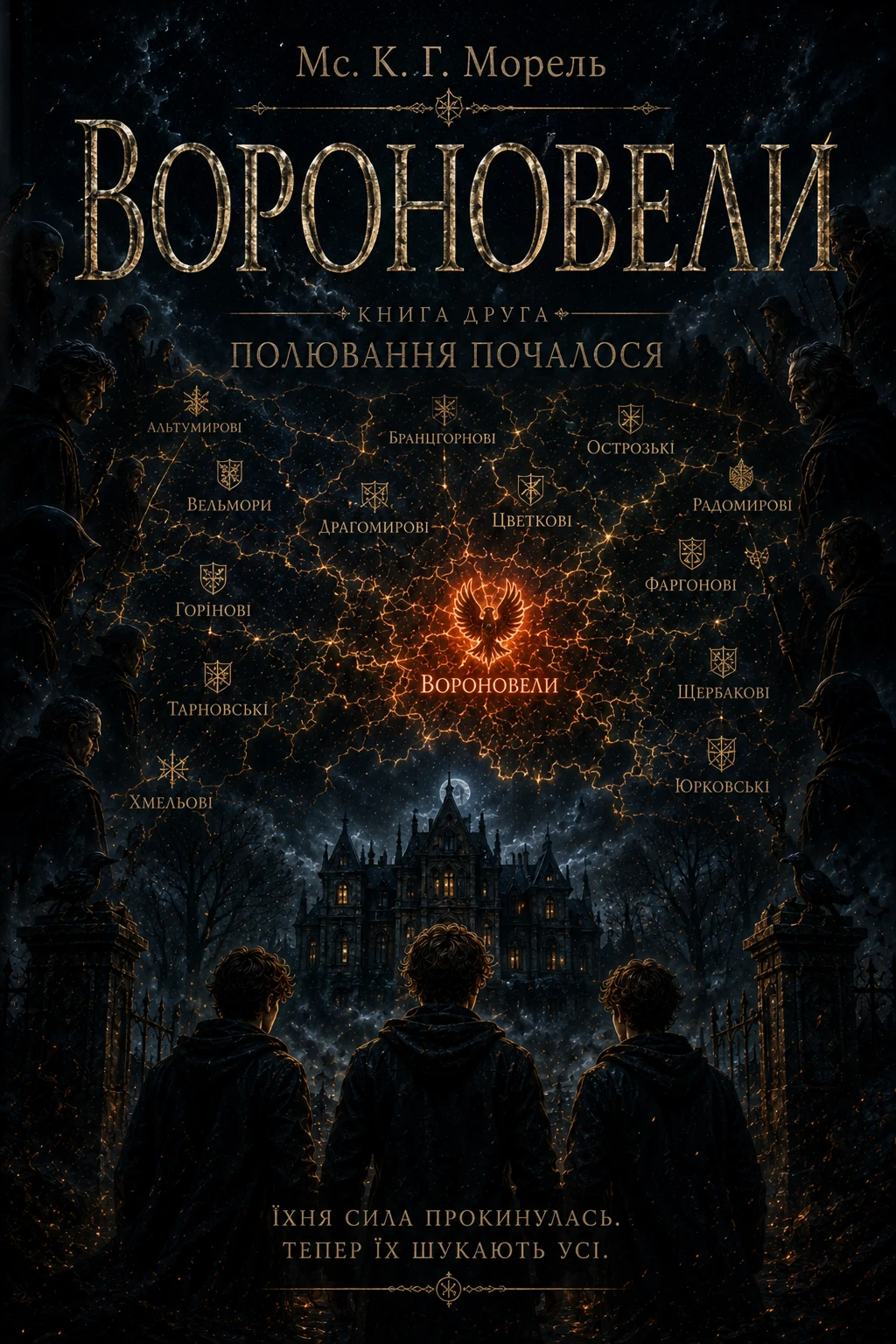
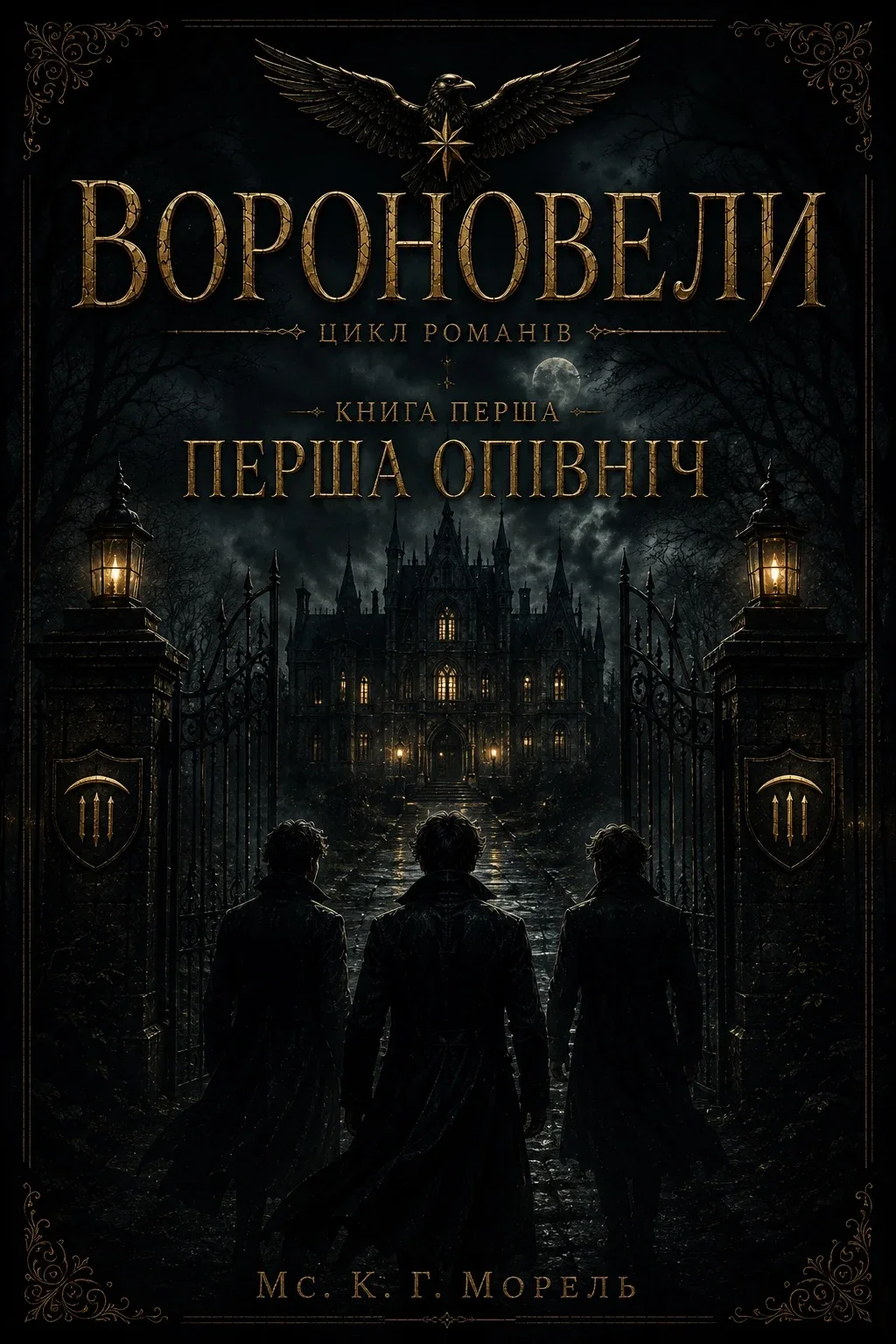
Ms. K. G. Morel begins the novel with a father trying to hide his children from their inheritance and ends with those children deciding for themselves what parts of that inheritance they are willing to accept.
The real story of The Hunt Begins lies between those two points.
Not in who is strongest.
Not in who wins a seat.
Not even in who first discovers the person behind the veil.
Its central question is more dangerous than any of those:
Who can preserve the right to choose when family, House, law, fear, magic and the enemy are all offering a ready-made choice instead?
That is why the hunt truly begins only at the end.
Until then, the unseen adversary has been studying the Voronovels as carriers of power.
Now it understands that the problem is larger.
The target is no longer three heirs.
It is five people who have learned not to belong to one another — and still choose to remain together.