

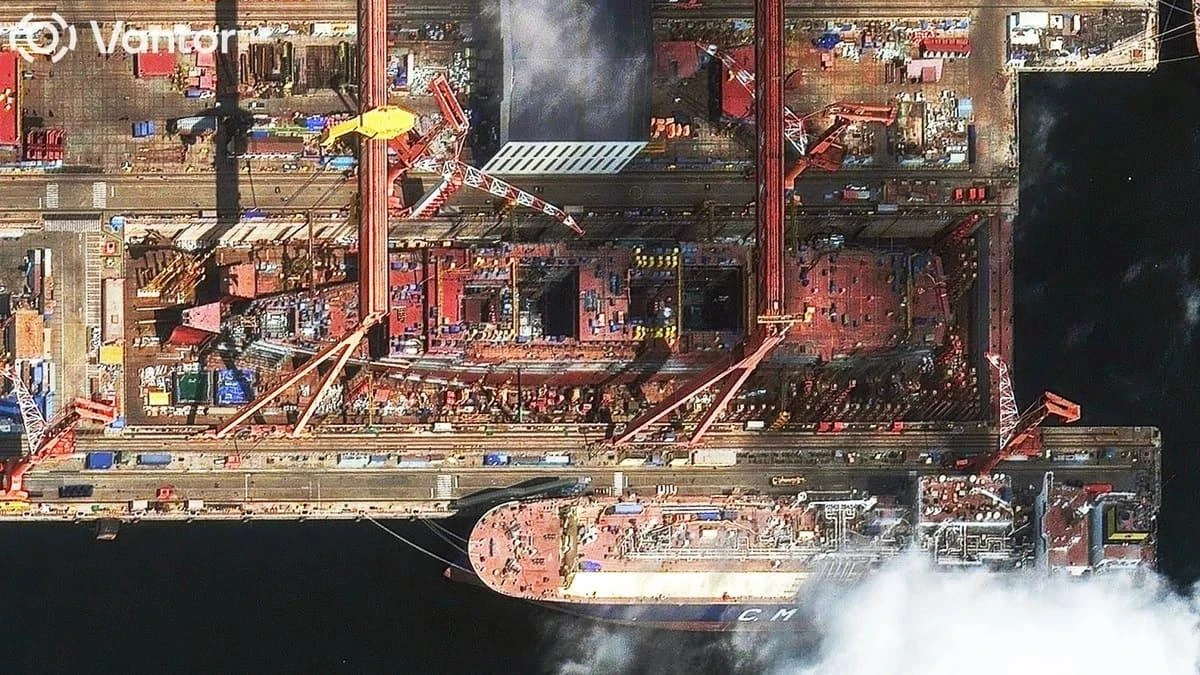






















The sea has always been a space of power, but never a space of unlimited discretion. When Washington says it will pursue any vessel linked to Iran, regardless of flag or location on the high seas, this is no longer only about sealing off a single route. It is about imposing a new geography of war, one in which commercial shipping becomes an extension of the battlefield.
From the White House’s perspective, the logic is straightforward. If Iran’s economy depends on oil exports, shipping access, insurance, financial clearing and port connectivity, then pressure on maritime traffic offers a direct path toward strategic exhaustion. That is why the military campaign is now visibly merging with a financial one: sanctions, secondary restrictions and naval interdiction are being fused into a single mechanism of coercion.
But there is a problem here that no aircraft carrier can solve. Under international law, a blockade is not merely a harsh tool of pressure; it is, in effect, an act associated with wartime. According to Daycom’s earlier analysis, this is where the central boundary lies: militarily, the United States can attempt such a model, but its legitimacy remains far less clear than its display of force.
The American case rests more on precedent than on a clean legal architecture. In modern history, the United States has repeatedly used force without a formal congressional declaration of war, and that tradition now underpins this broader maritime escalation. From Washington’s point of view, if the campaign is already underway, then a blockade is simply its natural extension. International law, however, is far less forgiving of such interpretations, especially when the measure in question is no longer confined to a coastal theater but expands into something close to global enforcement.
That brings the argument to its most important test: effectiveness. A blockade carries greater legal weight when it is not merely declared, but actually sustained and enforced. And this is where the doubts begin. Global shipping moves across countless routes, through layered ownership structures, changing flags, insurers, intermediaries and cargo designations. To identify every Iranian connection, track every shipment and act quickly without triggering a cascade of international incidents is not only a military challenge. It is an intelligence and administrative challenge on a planetary scale.
Which is why the most plausible outcome is not a seamless cordon, but selective enforcement with strategic intent. Some ships will be stopped. Some will be turned around. Others may be allowed through when broader political calculations require restraint. That gives Washington flexibility, but it also weakens the universality of the blockade itself. The broader the rule that is announced, the more visible its selective application becomes. And in such a system, selectivity is not only a tool of power. It is also evidence of its limits.
For global markets, the risk extends well beyond Iranian oil. Shipping firms, commodity traders, banks, insurers and port operators are now forced to work inside a wider zone of uncertainty: it is no longer enough simply to avoid an Iranian port. They may also have to prove the absence of any “material support” connection at all. That sharply expands the room for secondary sanctions, vessel inspections, cargo detentions, insurance disputes and rising logistics costs. The maritime campaign therefore looks less like an isolated wartime move and more like an attempt to rewrite the operating rules of global commerce under a permanent state of exception.
Whether this will quickly alter Iran’s behavior is far from certain. For Tehran, the conflict is existential, which makes rapid capitulation unlikely. Economic pressure may accumulate over time, but it does not automatically produce near-term political surrender. What it can do, almost certainly, is raise the cost of every future negotiation, widen the conflict’s perimeter and make neutral actors less willing — or less able — to remain neutral. Once a blockade spills into the wider oceans, it stops being only a measure against an adversary and begins pressing against the entire architecture of international exchange.
So the answer to the question is yes: the United States can try to block Iranian-linked ships almost anywhere in the world, and in practice it is already moving in that direction. But the decisive issue is not whether the U.S. Navy has the reach. It is whether such a strategy can survive the tests of effectiveness, scale and international acceptability. In maritime conflict, the outer limit of power is not set by the horizon. It is set by the moment coercion begins to damage the very order on which it depends.