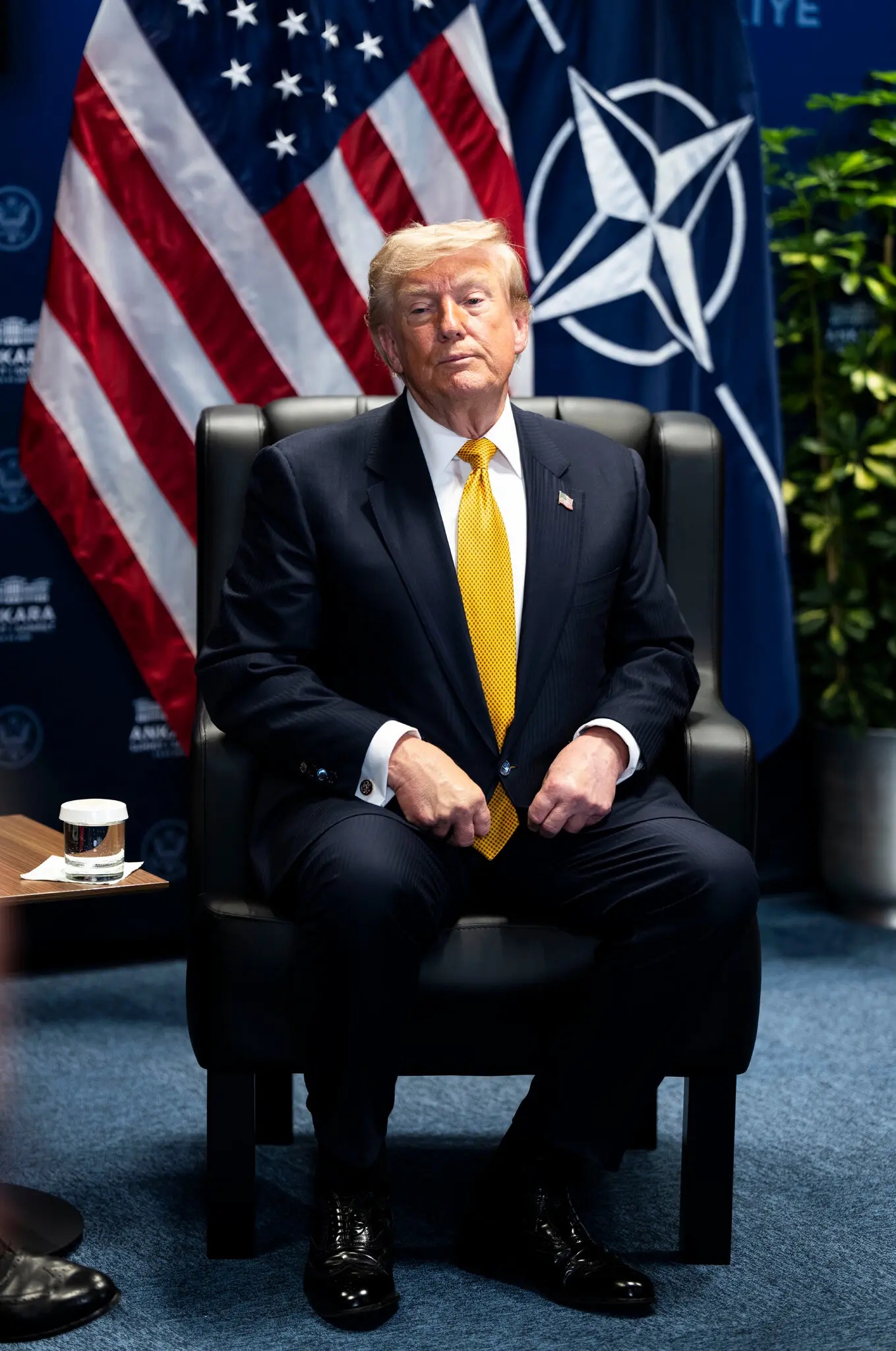























The war around Iran has entered a moment in which the threat itself has become a negotiating instrument. At the White House, Donald Trump did not merely repeat his ultimatum. He elevated it into something close to an apocalyptic formula, saying the entire country could be taken out in a single night and suggesting that night could come as soon as Tuesday. Once a head of state speaks in those terms, diplomacy no longer stands apart from force. It begins to exist inside its shadow.
The timing gave the statement even greater weight. The administration used a briefing on the rescue of two American pilots as the setting for a new show of coercive resolve. Trump described the operation as large, complex and risky, and acknowledged that U.S. aircraft involved in the mission had to be destroyed so they would not fall into Iranian hands. A tactical success was immediately turned into a political argument: if the United States can operate this deeply and this decisively, it can also raise the cost of defiance.
And yet this is precisely the moment in which war has not closed diplomacy, but reopened it. Through Pakistani mediators, Iran delivered a 10-point proposal that called not for a temporary cease-fire, but for a permanent end to the war on terms acceptable to Tehran, together with a framework for safe passage through the Strait of Hormuz and the lifting of sanctions. Trump described the proposal as significant, then dismissed it as insufficient. The offer was acknowledged, but not allowed to alter the structure of pressure.
In Daycom’s assessment, that is the defining tension of the current moment. Washington is not rejecting negotiations. It is trying to force negotiations to take place inside an ultimatum rather than instead of one. Tehran, by contrast, is using diplomacy in an effort to halt the logic of coercion itself. That is why the two sides remain fundamentally misaligned: one bargains from maximal threat, the other from a demand for guarantees before any concession.

It is telling that the Strait of Hormuz has once again become the core object of the dispute. For the United States and its partners, it is a question of global energy security, maritime credibility and strategic deterrence. For Iran, it remains one of the last major tools of asymmetric leverage. That is why the formula “reopen the strait first, negotiate later” reads in Tehran as capitulation disguised as procedure. And the counter-formula — guarantees first, movement later — looks in Washington like a tactic for delay.
That is what makes the current diplomacy so fragile. It has not collapsed, but it is already built on a level of distrust so severe that even a potentially meaningful gesture can be read as weakness, manipulation or a trap. Iran’s proposal may be a genuine opening toward de-escalation. It may also be an attempt to buy time before an infrastructure strike that the White House continues to keep on the table. In this environment, those two interpretations are almost impossible to separate.
The market is behaving like a participant in the conflict rather than a spectator. Oil prices moved higher as Trump began speaking, a sign that traders are responding not only to the fact of war, but to the cadence of political deadlines, improvised threats and the possibility of a new phase of attacks. In that kind of environment, crude rises not only because supply may be disrupted, but because predictability itself is collapsing. Uncertainty becomes its own commodity shock.
The deeper danger lies elsewhere. The more Washington advances negotiation through the language of destroying infrastructure, the thinner the boundary becomes between diplomatic pressure and the normalization of war against civilian systems. That is not only a legal problem. It is a political one. If an ultimatum works only because it is backed by a readiness to hit power grids, bridges and transport nodes, then negotiation itself begins to depend on the credibility of further ruin.

Trump faces risks of his own. The louder the threat, the higher the cost of retreat without visible result. To call Iran’s proposal significant while refusing to accept it is a way of appearing open to a deal without sacrificing the image of toughness. But such a position remains viable only for a short time. If the next step produces neither a breakthrough nor action, the ultimatum itself begins to weaken. Repeated deadlines that do not resolve into either agreement or force rarely preserve pressure for long.
Tehran is moving inside a narrow corridor as well. By rejecting the idea of a temporary truce and insisting instead on a permanent end to the war, Iran avoids looking like a state yielding under fire. But that same posture narrows its room to maneuver. Tehran wants its proposal read as a political framework for peace. Washington reads it as an incomplete answer to an American demand. That is why even active mediation no longer guarantees forward movement.
The real question now is not whether a diplomatic exit still exists. It does. The question is whether diplomacy can survive in a setting where every hour is pressed by the deadline of a new night, a new strike and a new threat to break a country in one blow. When negotiations are conducted at the edge of infrastructure war, even a serious proposal can stop looking like the beginning of a settlement and start to look like a pause before the next detonation.