








Some war crimes are visible at once: a shattered apartment block, a crater in the road, a body near an entrance. Others are quieter, slower and harder to prove. A cell where electric shocks were used. The name of a child taken from an institution. The testimony of a woman who has spent years unable to say aloud what occupying soldiers did to her.
These crimes require the most patient and precise work. They cannot be proved with slogans. They require interviews, archives, international-law experts, satellite imagery, chains of command, court files, translations, secure databases and investigators willing to travel to frontline towns under the threat of drones.
Now that system is under pressure not from Russia, but from a political decision in Washington. As part of Donald Trump’s America First agenda, his administration has cut tens of millions of dollars that supported investigations into alleged Russian war crimes in Ukraine.
According to Daycom’s assessment, this is one of the most dangerous consequences of America’s retreat from the Ukraine file: it does not immediately appear on the battlefield map, but it may reshape the future map of accountability. Evidence not collected in time may no longer exist a year later.
Since the Nuremberg trials, the United States has spent decades as one of the central architects of international criminal accountability. It supported tribunals, investigative missions, programs for prosecutors and human-rights defenders. That legacy is now being compressed under the pressure of domestic politics.
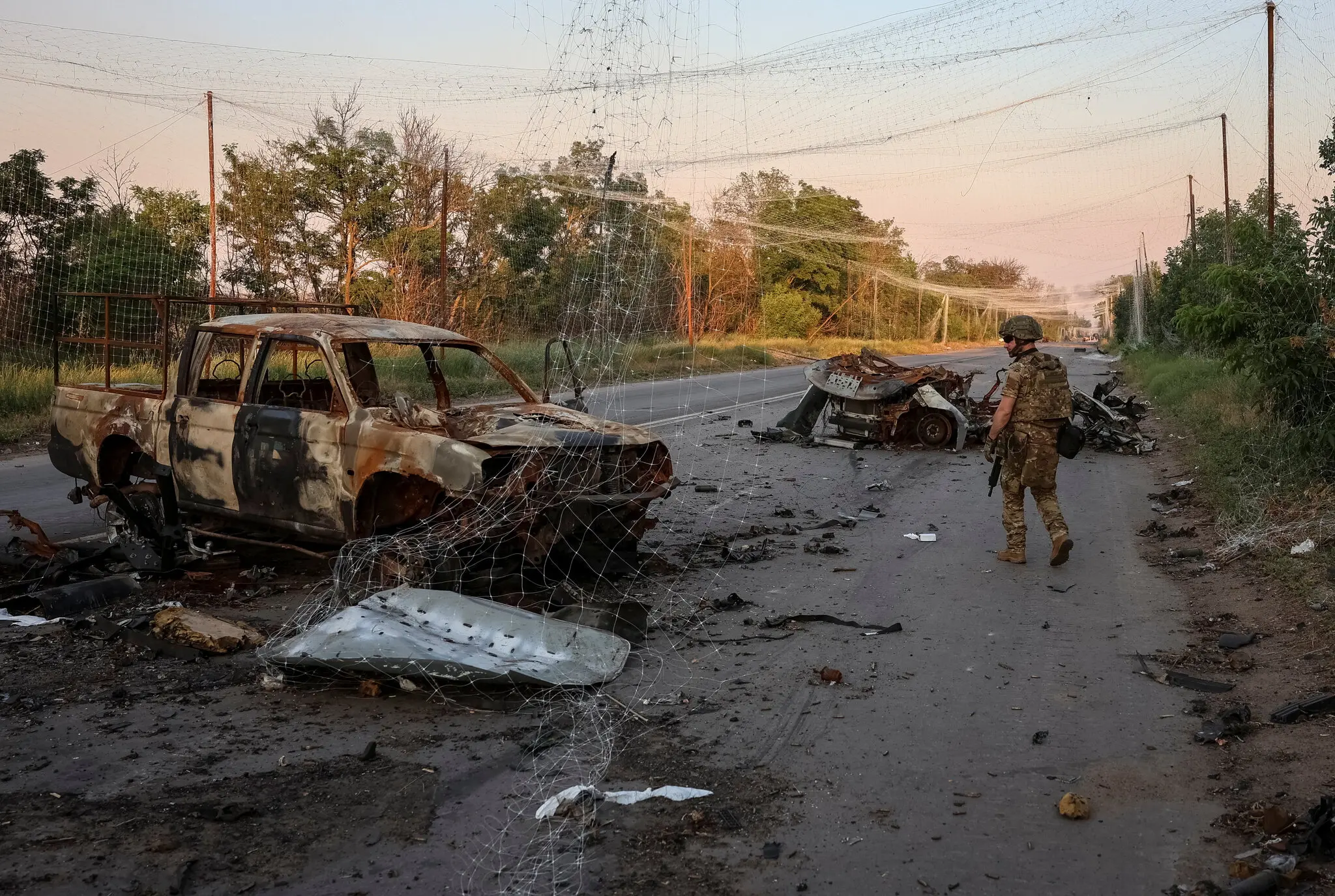
 Сітка для запобігання атакам російських безпілотників натягнута на дорогу в центрі Ізюма, Україна, 29 січня 2026 року — Томас Пітер
Ukraine became the largest single recipient of American support for documenting the crimes of this war. That was not accidental. The scale of the caseload is unprecedented in Europe since World War II: Ukrainian prosecutors have opened more than 230,000 war-crimes proceedings since the start of Russia’s full-scale invasion.
Those cases include attacks on civilians, destruction of infrastructure, torture, sexual violence, unlawful detention, deportation and forced transfer of children. Behind each category stands not a legal abstraction, but a person who must be found, heard, protected and guided through a long path toward court.
In the city of Izium in the Kharkiv region, investigators from the Ukrainian organization Truth Hounds recorded the testimony of a woman who survived the Russian occupation in 2022. She said Russian soldiers held her for 10 days at a factory site, beat her, suffocated her with a gas mask, tortured her with electric shocks and raped her. At one point, she asked them to kill her.
Such accounts are hard to read. They are even harder to prove in court. Testimony must be collected professionally, without pressure and in line with evidentiary standards. Psychologists, lawyers, analysts, translators and international advisers must work alongside investigators. These are often the first links to break when grants are stopped.
Truth Hounds has documented Russian crimes since 2014, after the seizure of Crimea. The organization has recorded about 17,000 alleged war-crimes incidents across Ukraine. U.S. funding had covered roughly a third of its budget. After losing that support, it had to reduce staff, suspend archiving work and postpone training for judges and prosecutors.
 Шпилі церкви височіють за сильно пошкодженою школою в Ізюмі, Україна, 29 січня 2026 року — Томас Пітер
The consequences are direct. Fewer field missions mean fewer testimonies. Fewer analysts mean weaker cases. Fewer trainings mean slower courts. Less archiving means a greater risk that materials will disappear, be damaged or remain incompatible with the standards of international justice.
Since 2022, U.S. support for Ukrainian accountability programs has reached at least $283 million. Some of that money moved through different agencies, some through long-term grants, and some through mixed justice and rule-of-law programs. But projects accounting for at least 40 percent of that total have been halted, allowed to expire or stripped of funding.
One of the most painful examples is a $62 million program designed to strengthen Ukraine’s justice system. After the dismantling of USAID, the program was terminated, and plans to rebuild a courthouse destroyed by the war were frozen. For a country where tens of thousands of cases require review, this is not an administrative detail. It is a blow to the state’s ability to bring cases to verdicts.
By April 1, Ukrainian prosecutors had secured 252 war-crimes convictions. They had identified 1,175 suspects and sent 842 indictments to court. That is significant for a system operating under bombardment. It is also tiny compared with the scale of the crimes still waiting to be investigated.
One of the most vulnerable areas is crimes against children. Ukraine says more than 20,500 children have been deported or forcibly transferred, with just over 2,000 returned. Researchers working with digital evidence estimate that the real scale may be higher, possibly reaching 35,000 children.
 Слідчі з розслідування воєнних злочинів з української некомерційної організації Truth Hounds беруть інтерв'ю у жінки в офісі в місті Ізюм у січні. Жінка, яка попросила назвати її лише одне ім'я, Алла, розповіла, що окупаційні російські війська зґвалтували та катували її у 2022 році — Томас Пітер
These cases often cannot be investigated by traditional means. The children are believed to be in Russia or in occupied territories, where Ukrainian investigators have no access. That makes satellite imagery, Russian social-media posts, local administrative documents, photographs from camps, school events and “reeducation” programs crucial.
This was the work carried out by Yale University’s Humanitarian Research Lab, which tracked Ukrainian children to more than 200 sites in Russia and occupied territory. Its findings helped prosecutors and humanitarian groups search for children, reconstruct transfer routes and show the systematic nature of Russian policy.
That program now risks running out of money after losing about $8 million in funding. Washington has announced a new grant of up to $25 million to support the return of missing Ukrainian children, but recipients have not yet been named. New funding does not automatically replace teams that already had methods, databases and field connections.
The story of Hanna Zamyshliaieva shows why time works against families. She last saw her son, Anton Volkovych, on January 14, 2022, at an institution for children and adults with special needs in Oleshky. He used a wheelchair and required constant care. After Russian forces occupied the Kherson region, the residents were moved deeper into occupied territory.
Of the 87 residents who were there before the occupation, only 13 have returned. Fragmentary signals about Anton’s possible whereabouts have appeared, but there has been no confirmation. For his mother, this is not a statistic. It is daily life between hope and fear: whether he is alive, whether he receives medicine, whether he understands why she has not come.
 Ганна Замишляєва тримає телефон, на якому видно фотографію її зниклого сина. «Я просто хочу його обійняти», – сказала вона — Томас Пітер
European partners are trying to fill part of the vacuum. Britain has announced additional support for justice for Ukrainian victims and for efforts to trace illegally deported children. The European Union is funding work on a special tribunal for the crime of aggression, an international claims commission and child-protection programs.
But American weight is not easily replaced. The United States provided more than money. It brought expertise, political framing, technical capacity and access to networks of international lawyers and investigators. When that support disappears, it is not one project that weakens, but an entire mechanism of proof.
The retreat is broader than Ukraine. The Trump administration closed a State Department office that coordinated responses to mass atrocities, disbanded a Justice Department team that helped Ukraine pursue war-crimes prosecutions and withdrew from a multinational group building cases against Russia’s leadership for the invasion.
In doing so, Washington is changing not only a budget policy but the moral architecture of its role in the world. When a state that spent decades speaking the language of tribunals and accountability steps back from that work, authoritarian regimes receive a simple signal: justice, too, can depend on an election cycle.
For Russia, this is not absolution. But it is an opportunity. The longer evidence remains uncollected, the easier it becomes to blur responsibility. Witnesses age, leave, die or grow afraid to speak. Documents disappear. Crime scenes are destroyed by new strikes. Commanders rotate, and perpetrators return to ordinary life.
 Книга спогадів лежить у сильно пошкодженій класній кімнаті в Ізюмі, Україна, 29 січня 2026 року — Томас Пітер
Ukrainians searching for missing relatives do not think in grant cycles. Tetiana Popovych has spent years looking for her son Vladyslav, a civilian who disappeared during the Russian occupation of Bucha. Witnesses helped her reconstruct his path: injury, capture by Russian soldiers, beating and possible detention in the Russian town of Vyazma. For her, justice is not a diplomatic phrase. It is a way to prevent a person from disappearing a second time.
Justice after wars like this is almost never swift. It arrives years later, sometimes decades later. But for that to happen, someone must preserve the first protocol, the first photograph, the first route, the first name on a list. When funding is cut, it is not abstract “assistance” that vanishes. It is the bridge between the crime and the verdict.
The reduction of U.S. support does not erase Russia’s responsibility. It makes that responsibility harder, slower and less certain to prove. That is the central danger: war crimes do not always go unpunished because there is no court. Sometimes they go unpunished because, at the crucial moment, there was no money left to record the truth.