












Emmanuel Macron is again reaching for the part of French diplomacy that works at the border between politics and theater: grandeur, gold, history and a precise calculation of human weakness. For Donald Trump, Paris is preparing not merely a meeting, but a setting designed to hold his attention.
The idea of a private dinner at Versailles before or during the G7 summit is almost too obvious. The palace of Louis XIV, the Hall of Mirrors, gilded interiors, imperial symmetry and monarchical memory fit Trump’s political aesthetics far better than dry communiqués or hours of talks about global imbalances.
France’s objective is simple: prevent the American president from disrupting the rhythm of the summit, keep him in the room and preserve discussion around issues that have become existential for Europe. Ukraine, Iran, China, energy, freedom of navigation and transatlantic unity require not gestures, but at least a minimum of manageability.
According to Daycom’s assessment, Versailles in this story is not luxury. It is risk management. European leaders have learned over years of dealing with Trump that political results sometimes begin not with the strongest argument, but with the right stage.
Macron has used this approach before. In 2017, he hosted Trump at a restaurant in the Eiffel Tower. At the 2019 G7 summit in Biarritz, he appeared to lower tensions with a private lunch when the American president arrived threatening new tariffs against France. French diplomacy has long known how to turn protocol into a language of power.
The stakes are higher now. The Évian summit comes as the United States remains stuck in its confrontation with Iran, without an obvious exit and with Washington increasingly blaming allies for not doing enough. Trump may arrive in Europe not as the leader of a united West, but as a president irritated that allies are not adjusting to his crisis.
French organizers have already shifted the summit date to accommodate Trump’s personal schedule. That detail says a great deal about the new transatlantic reality. Europe must prepare not only an agenda, but also anticipate the American president’s mood, media impulses and possibility of sudden departure.
European capitals still remember the fear of a summit ending in an early exit, a public confrontation or the humiliation of allies. For Macron, the main goal is to avoid another moment in which Trump turns a multilateral gathering into a personal drama.
That is why Versailles is being considered alongside simpler alternatives, including golf. Both ideas serve the same purpose: to create a space where Trump feels like the central figure, rather than one participant among many in an institutional club he has long viewed with suspicion.
Europe’s formula for managing Trump has long had two parts: flattery and constraint. He is offered royal receptions, palaces, parades and personal attention. At the same time, leaders try to restrain him from decisions that could split allies or wreck a shared position on Russia, China or Iran.
The problem is that flattery works only when backed by power. Europe can impress Trump with Versailles, but it cannot hand him a quick victory in Iran, control of the Strait of Hormuz or Chinese concessions. Without an immediate gain for the United States, or for Trump himself, diplomatic gold leaf may not be enough.
The Ukraine factor adds another layer of risk. Macron has invited Volodymyr Zelensky to the summit, even though his relationship with Trump remains strained. For Europe, the Ukrainian president’s presence is necessary: Russia’s war against Ukraine cannot be discussed without Kyiv. For Trump, it could become an irritant.
What Europeans need from the United States is not a beautiful photograph, but minimum predictability: sanctions against Russia, support for Ukraine, pressure on Moscow, coordination on Iran and a common stance against Chinese industrial pressure. All these issues require attention, something Trump often denies multilateral formats.
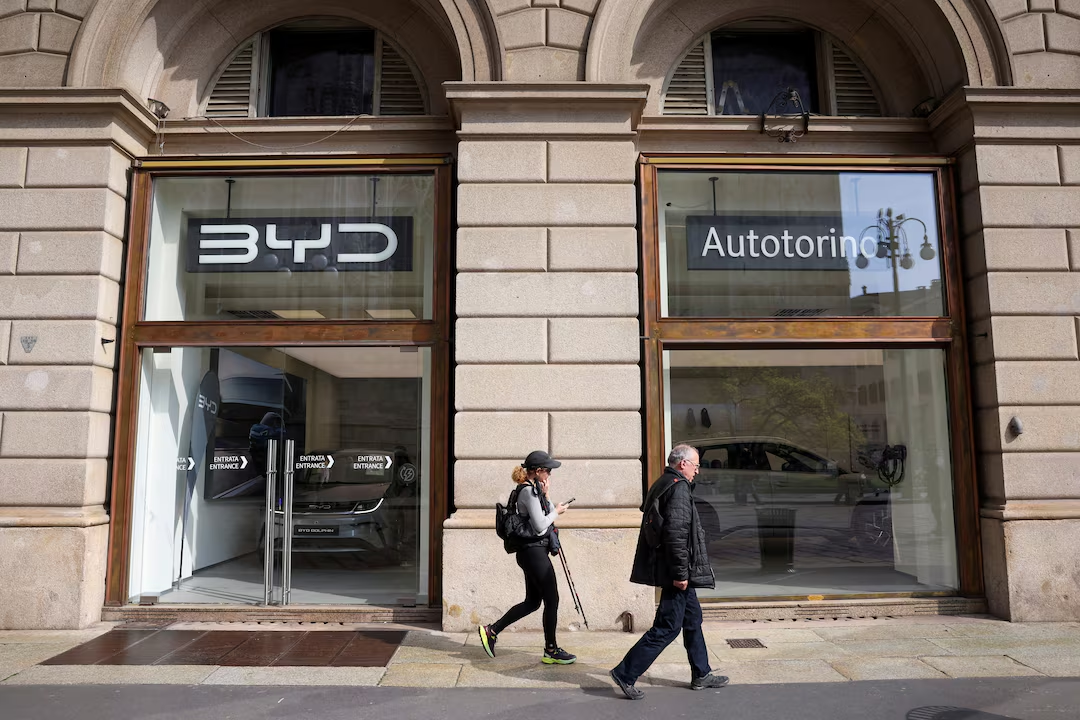
The theme of global imbalances may offer Macron the easiest way into the conversation. Chinese subsidies, overproduction, cheap electric vehicles and industrial pressure on Europe and the United States all speak to Trump’s trade instincts. Here, Europe can speak his language: unfairness, deficits, tariffs and protection of production.
Even that bridge does not guarantee stability. If the Iran crisis shifts sharply, if the Strait of Hormuz remains blocked, or if Washington again tries to shift responsibility onto Europeans, the summit could move onto an entirely different track. Trump’s diplomacy often follows not the agenda, but the latest crisis.
That is why French preparations look less like classic summit organization than storm management. They require a Versailles dinner, a backup golf option, Macron’s personal channel, a carefully selected guest list, a controlled rhythm of meetings and a plan for the moment the American president chooses a gesture instead of an agreement.
Versailles has an almost therapeutic role in this design. It offers Trump an image of grandeur and offers Europe a chance to buy time. It is not a guarantee of success, but an attempt to soften sharp edges where ordinary diplomatic language may fail.
France understands that this summit does not need to be brilliantly won; it needs not to collapse. In today’s transatlantic politics, even that would be considerable. If Trump stays until the end, does not derail the Ukraine discussion, does not clash with Europeans over Iran and accepts at least a shared frame on China, Versailles will have paid for itself.
That is the paradox of the moment. Europe speaks of strategic autonomy, yet it must prepare something close to royal diplomacy of attention for the American president. It wants to become more independent, but still depends on the mood of a man who may need to be kept at the table by dinner in a palace.
Macron can give Trump Versailles. The real question is whether he can turn that gilded stage into a political result. Europe does not need an enchanted guest. It needs an ally who will not leave the room at the worst possible moment.