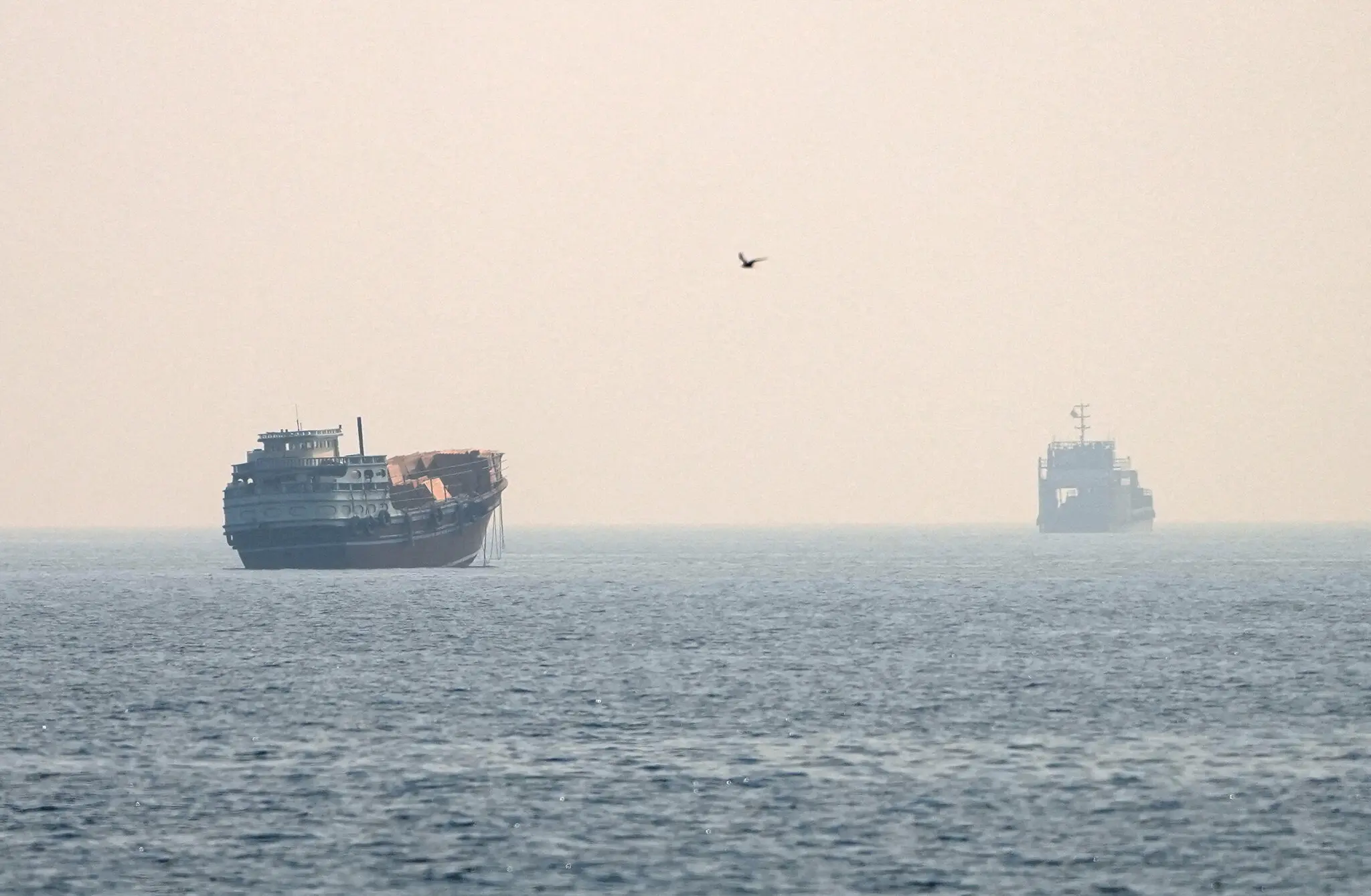
























Only days ago, Donald Trump was speaking about Iran in the language of annihilation. Any attack, any threat to shipping, any challenge to American power was framed as a threshold beyond which swift and overwhelming retaliation would follow. Yet when Iran seized two ships near the Strait of Hormuz, Washington’s reaction was strikingly restrained. The White House did not merely avoid calling it a collapse of the cease-fire; it actively tried to reduce the importance of the episode itself.
That shift in tone is the real story. It suggests that for the Trump administration, preserving room for political maneuver now matters more than projecting strict consistency. Where earlier rhetoric was designed to emphasize readiness for escalation, the same administration is now searching for a formula that allows it to avoid defining an obvious new provocation as the formal end of the truce.
The formula turned out to be narrow and revealing. Because the seized vessels were neither American nor Israeli, the incident, in the White House view, did not qualify as a direct violation of the cease-fire with the United States. It is a highly selective and politically useful interpretation. It allows the administration to acknowledge that tensions remain high while avoiding the obligation to respond in the way the president had previously promised.
According to Daycom’s earlier analysis, this response does not necessarily reflect tactical weakness so much as a shift in priorities. Trump appears unwilling to reignite a broader war that has already lasted longer, become more complicated and proved less politically advantageous than expected at the outset. Washington is therefore redrawing the boundaries of what is tolerable after those same boundaries were publicly declared by the president himself.
That gap between threat and behavior matters because it exposes the central problem in the current American strategy. Militarily, the United States has demonstrated overwhelming force, carrying out large-scale strikes and underlining its technological superiority. But the political outcome of the war remains uncertain. Iran’s regime is still in place, Washington’s core demands on the nuclear file remain unmet, and the Strait of Hormuz — open before the war — is still a zone of coercion and obstruction.
That is why the administration increasingly leans on the language of battlefield success as a substitute for political resolution. The White House speaks of a weakened Iran, successful strikes and American military dominance. But the longer the conflict continues without a clear diplomatic framework, the more obvious it becomes that a display of force alone does not answer the most important question: how to end the war on terms that can credibly be sold as victory.
In that context, the White House’s tolerance of the ship seizures becomes easier to understand. For Trump, maintaining even the appearance of a controlled pause now matters more than becoming captive to his earlier rhetoric. To classify Iran’s actions as a direct breach of the cease-fire would mean either escalating again or publicly exposing the limits of his own threats. By choosing a third path — downplaying the incident — the administration is effectively trying to buy time.
But that tactic has an obvious cost. Once the boundaries of red lines begin to shift according to political convenience, that is noticed not only by allies, but by adversaries. For Tehran, this may look like a signal that Washington is not prepared to return immediately to large-scale war and may tolerate a certain degree of maritime escalation so long as the prospect of negotiations is not fully destroyed. In diplomacy, ambiguity can create space. In a war of endurance, it can also be read as an invitation to test the limits again.
It is equally significant that potential talks remain effectively frozen. The vice president had been expected to travel for a new round of contacts, but the trip was postponed while the administration waited for Iran to produce what Trump called a unified proposal. That means the pause exists, but it has not become a functioning diplomatic process. The war seems muted, but not over; talks seem possible, but not underway; coercive pressure continues, but it is no longer described in the bluntly ultimatum-driven language heard only days ago.
This reveals one of the defining features of Trump’s political style. The oscillation between maximal threats and sudden conciliation is not an accident, but a method. For supporters, it looks like useful unpredictability. For allies and markets, it creates instability. For adversaries, it offers an opening to locate the point at which rhetoric no longer automatically produces action.
That is why the episode near the Strait of Hormuz matters far beyond the seizure of two ships. It shows that this phase of the conflict is now being shaped less by the volume of public threats than by the way Washington is quietly revising its own red lines in practice. The White House is trying to preserve the cease-fire without naming how fragile it has become. And that is precisely the danger: when a political pause rests not on settled rules, but on flexible interpretations of what counts as a violation, the next incident may not be dismissed as a minor exception. It may turn out to be the point at which the entire structure suddenly stops holding.