


















In modern war, the word precision no longer functions as a technical description alone. It has become a political promise — shorthand for discipline, control and moral distance. The implication is simple: a smart weapon is supposed to separate the intended target from the civilian world around it. The strike in Lamerd suggests how fragile that promise can be. A weapon may be precise in design and still produce an outcome that is morally, legally and politically devastating.
On Feb. 28, the opening day of Operation Epic Fury, a strike hit an area near an Islamic Revolutionary Guards Corps compound in southern Iran. The blast pattern and aftermath described in the source material point to damage at a sports hall, an adjacent elementary school and nearby residential buildings. That alone would have made the attack consequential. What turned it into a defining episode was the possibility that a newly fielded American missile was used in an urban space where military infrastructure and civilian life stood side by side but were not indistinguishable.
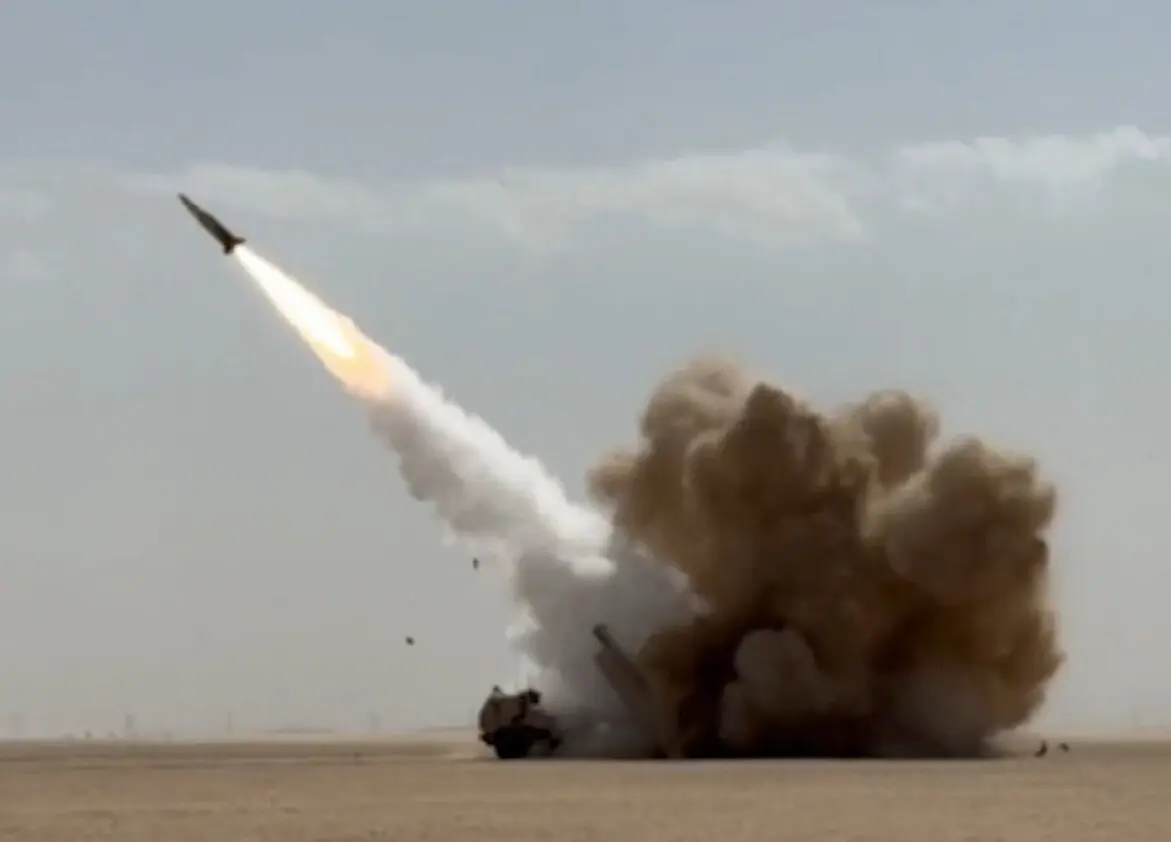
The evidence cited in the source text — the missile’s silhouette in flight, the apparent airburst, and the pattern of fragmentation damage — points to the Precision Strike Missile, or PrSM. The same text refers both to weapons experts who reviewed the imagery and to confirmation from a U.S. official speaking anonymously. That does not eliminate uncertainty. But it places PrSM at the center of the incident, not at its margins.
As Дейком assesses it, Lamerd matters because three developments converged there at once: the battlefield debut of a new U.S. ballistic missile, the visible destruction of civilian-use sites near a military compound, and a familiar shortage of transparency in the first hours of a large campaign. Each of those elements is serious on its own. Together, they produce something larger than a disputed strike. They create a test of how the United States explains force when the language of precision collides with the imagery of civilian harm.
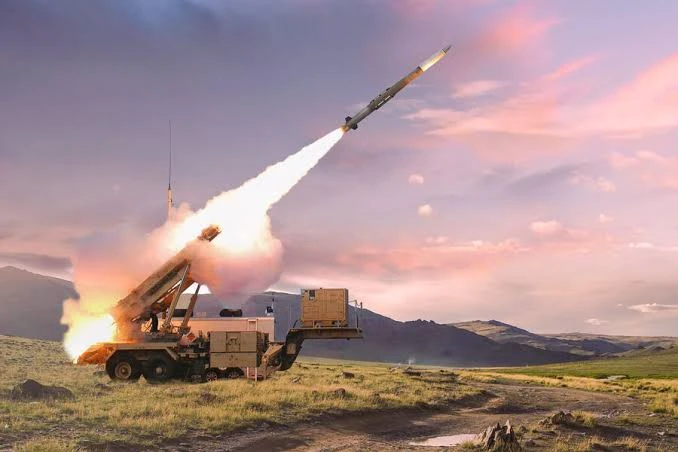
The broader operational context is not in doubt. U.S. Central Command said Operation Epic Fury began at 1:15 a.m. on Feb. 28 and that more than 1,250 targets were struck in the first 48 hours. American statements described an expansive campaign against command nodes, missile infrastructure, air defenses, IRGC facilities and military communications. CENTCOM also explicitly cited the use of M142 HIMARS, the launcher associated with PrSM.
That matters because PrSM is not an old, fully digested part of America’s arsenal. The Army said in 2025 that the missile had completed production qualification flight testing, and later announced that Increment 1 had received Milestone C approval, allowing the program to move into production and deployment. The Army has also described PrSM as the successor to ATACMS, with a range beyond 400 kilometers. In military terms, that makes it a major advance in long-range ground-fired strike capability. In political terms, it means the United States has strong incentives to showcase what the system can do.
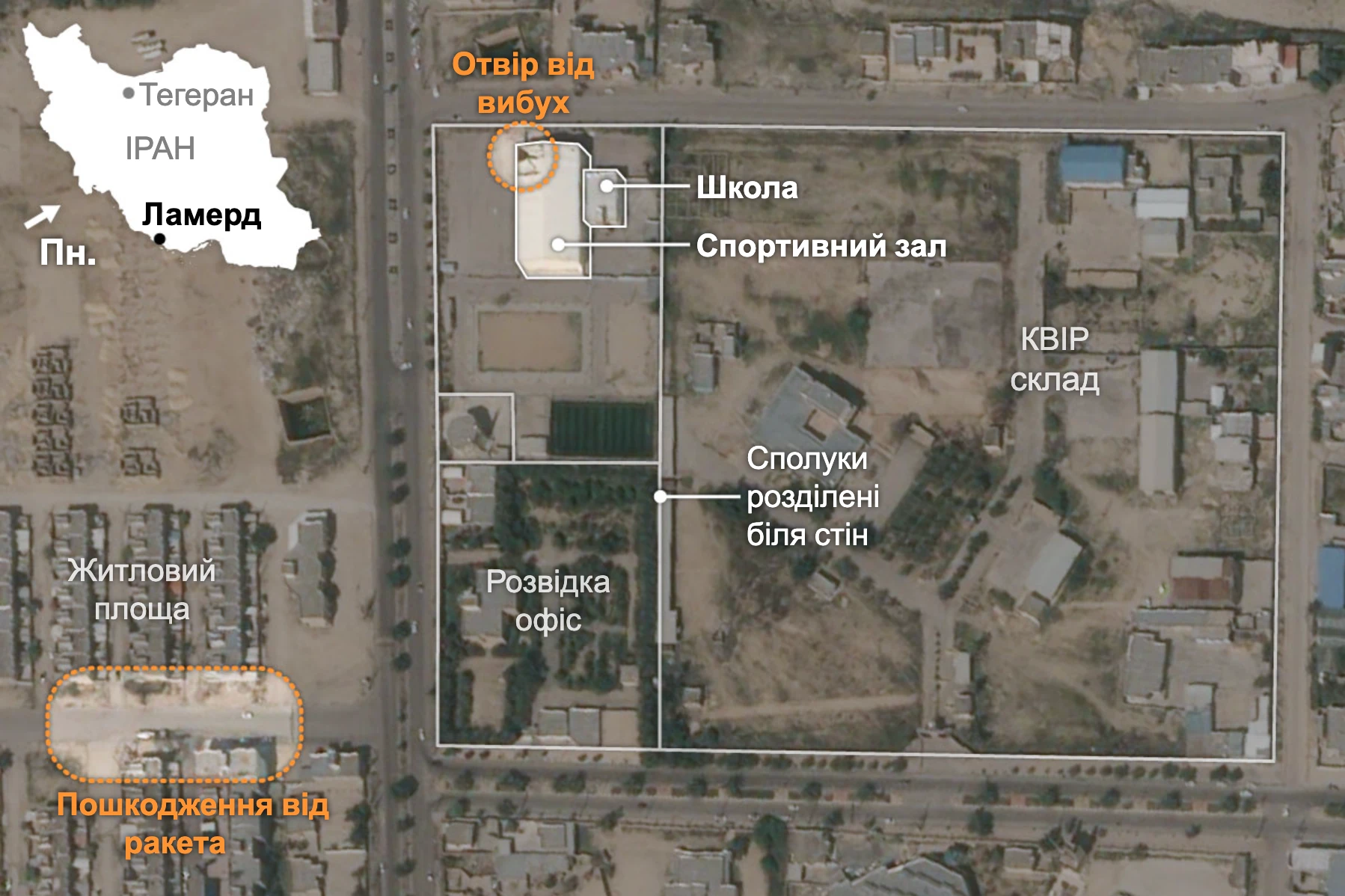 Супутникове зображення, зроблене Airbus DS 9 березня — Ліанн Абрахам
Range changes the tempo of war. A ground-launched ballistic missile that can reach deep into hostile territory compresses the time between identification, authorization and impact. It reduces reliance on manned aircraft for certain targets and gives commanders a faster way to hit fixed positions. But speed has its own moral physics. The shorter the interval between decision and detonation, the less room remains for doubt, restraint and correction. In that sense, long-range precision does not merely sharpen warfare. It accelerates it.
That is why the central question in Lamerd is so difficult to evade. If the intended target was the IRGC compound, why did the damage present so clearly at a sports hall, a school and a civilian neighborhood? The source material notes that the civilian sites had been separated from the military compound by walls for at least 15 years and that the sports hall had long been publicly identifiable on major digital mapping platforms as a civilian facility. That does not prove intentional targeting of civilians. It does, however, narrow the field of plausible explanations.
Once that corridor narrows, only a few possibilities remain. The strike may have reflected a failure of guidance, a defect in the munition, an error in target selection, or a deliberate acceptance of a high risk of collateral damage. Those possibilities are all present, implicitly or explicitly, in the source text. And none of them is politically comfortable. A malfunction suggests a dangerous immaturity in a newly fielded system. Faulty targeting suggests a breakdown in judgment. A consciously accepted civilian risk suggests something more serious still: that in the opening rush of a major campaign, the threshold for foreseeable harm may have shifted.
The novelty of the weapon makes the episode harder, not easier, to absorb. The source text itself underscores that because PrSM is so new, it is especially difficult to determine whether Lamerd reflects design problems, manufacturing flaws, targeting mistakes or intent. That is precisely the problem. A developmental or newly deployed system does not dilute responsibility when used in war. It raises the stakes of responsibility. Once a weapon is fired into a real city, uncertainty becomes part of the harm.
There is also a deeper military pattern here. The source text notes that the Pentagon has, in previous conflicts, sent developmental systems into war zones for what amounts to combat evaluation. Lamerd can therefore be read not only as a tragedy but also as a revealing instance of how war absorbs the unfinished business of weapons development. A missile does not need to be formally experimental to still be proving itself in public, on human terrain, with civilians nearby. That is one of the enduring temptations of modern power: technology reaches the battlefield before the ethics of its use have fully caught up.
The American public posture is correspondingly split. On one level, CENTCOM frames the campaign as a broad strike against Iranian military capability, stressing precision munitions and operational effect. On another, according to the source text, a CENTCOM spokesman acknowledged reports of the Lamerd incident and said they were being reviewed, while also insisting that U.S. forces do not indiscriminately target civilians. This is the familiar architecture of modern military communication: confidence in doctrine, caution on particulars, and a widening gap between official abstraction and visible aftermath.
International humanitarian law does not resolve every factual dispute, but it does provide a disciplined framework. The core obligations are distinction, proportionality and feasible precautions in attack. Civilian objects are protected as such, and belligerents must do what they can to minimize harm to civilians and civilian infrastructure. Those principles do not disappear because a target lies close to a military site. Nor do they disappear because the weapon used is advanced, fast or formally precise.
That is why Lamerd cannot be reduced to a technical argument about munition type. If the school and sports hall were not being used for military purposes, their civilian status remains the starting point. If they were somehow connected to military activity, the burden of justification still remains substantial, and the question of proportionality becomes unavoidable. The law of war does not ask whether a strike sounded sophisticated in a briefing. It asks what was hit, what was known, what precautions were taken, and whether civilian harm was excessive in relation to the concrete military advantage anticipated.
Lamerd also exposes the limit of technological advantage as a political asset. The United States may be able to conduct a large regional air and missile campaign, strike command centers and air defenses, and degrade Iranian military infrastructure at scale. But a single episode involving a school, a sports facility and civilian casualties can puncture the moral narrative that usually surrounds high-end American force. Precision is meant to reassure domestic audiences and allies. It becomes far harder to defend when the images suggest shattered classrooms rather than surgical success.
The casualty figures cited in the source text — at least 21 killed and more than 100 injured, according to Iranian officials — are not fully independently verified. The same material says some of those killed may have been volleyball players training in the hall, along with children and a coach identified in local reporting. Even with that caveat, the political force of the episode is already obvious. Modern conflicts are not judged only by targeting packages and mission logs. They are judged by which deaths become legible to the world, and how quickly.
For Tehran, the episode is narratively powerful almost by default: a new American missile, a school, a sports hall, children, funerals. For Washington, it is the opposite — the kind of incident that weakens the claim that advanced force can remain both overwhelming and tightly bounded. The more intelligent a weapon is said to be, the less persuasive it becomes to describe civilian devastation as an unfortunate byproduct. Technology raises expectations before it delivers absolution.
Lamerd, then, is not a peripheral scene in a larger war. It is a compact argument about the future of warfare itself. Systems like PrSM expand American reach, compress response time and offer commanders more options at longer distances. But they also shrink the psychological distance between a lawful target and a civilian catastrophe. The chain from decision to destruction grows faster; the chain from explanation to accountability often does not.
If Washington wants to sustain the claim that its strikes were aimed at military objectives and conducted within the bounds of law, broad assurances will not be enough. What this episode now requires is something more concrete: a reconstruction of the strike, an explanation of target selection, a clearer account of the munition employed, and a public assessment of what precautions were taken and why civilian sites were hit. In Lamerd, the defining question is no longer whether the missile was precise. It is why a weapon designed to embody precision once again leads the world back to a school.