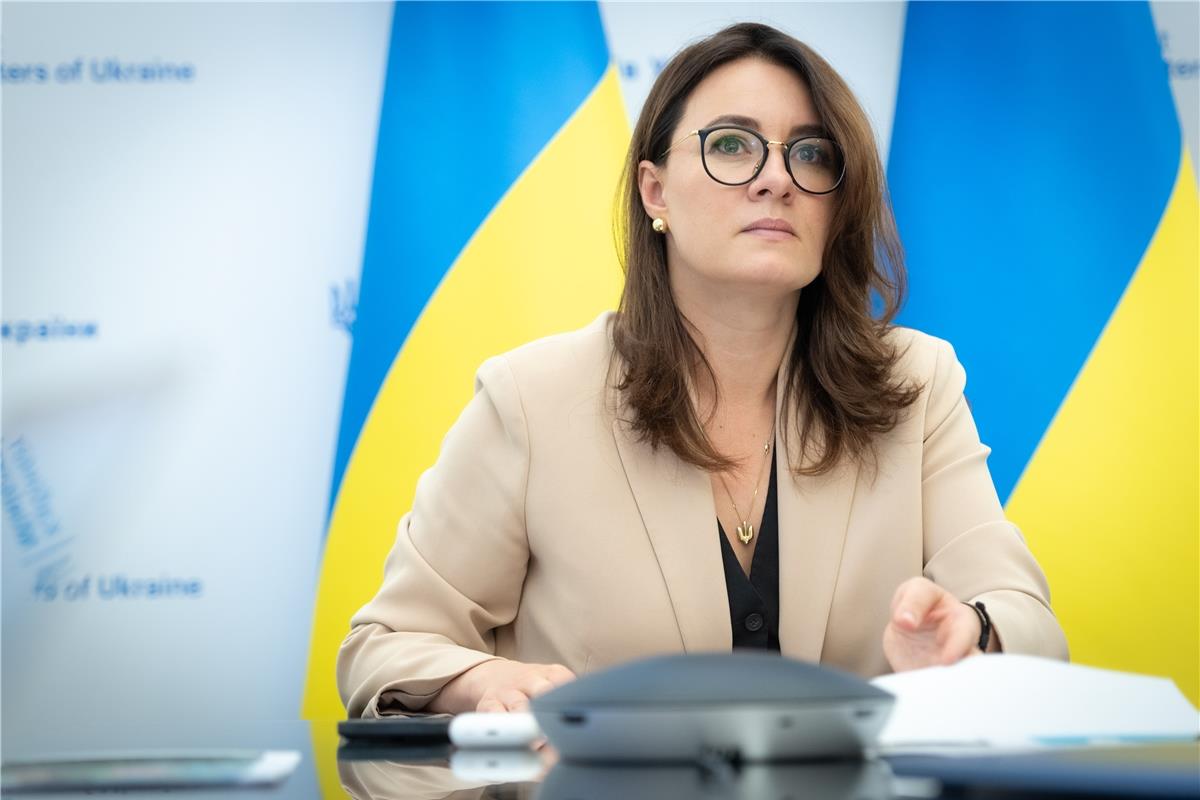
















Volodymyr Zelenskyy is launching a new political reset at a moment when Ukraine is holding the front, asking allies for resources and trying to prove that it can clean up its own system even in the middle of a major war. After only a year in office, Yuliia Svyrydenko is set to leave the post of prime minister.
Formally, this is a change at the head of government. In practice, it is a broader maneuver. Under Ukrainian law, the prime minister’s resignation entails the resignation of the entire cabinet, opening the way to change not only the face of the government but the balance between the presidential office, parliament, the economic bloc and law enforcement.
Zelenskyy has framed the move as necessary for an updated political strategy, without spelling out what that strategy contains. That leaves room for the central conclusion: Bankova is not merely replacing Svyrydenko. It is trying to reorganize the system of wartime management for a stage in which external support increasingly depends on internal trust.
According to Daycom’s assessment, the personnel shift is an attempt by Zelenskyy to regain control over the political agenda after a year marked by corruption cases, pressure in the energy sector and the need to persuade Western partners that the Ukrainian state remains governable. The prime minister’s dismissal is a signal not only to Kyiv, but to Washington, Brussels and the IMF.
Svyrydenko was not an accidental figure in the system of power. An economist by training, she passed through the presidential office, served as deputy prime minister for economy and trade, and became head of government in July 2025. Her appointment looked like a bet on manageability, technocratic discipline and the ability to negotiate with partners under wartime economic pressure.
Now Zelenskyy is thanking her for “clear, steady and effective” work and offering her a new area connected to a key partner. Politically, that sounds like a soft removal from the premiership without a public rupture. For Svyrydenko herself, the next step may be a diplomatic role, especially on the American track.
Such a move would not be random. Relations with the United States remain the main artery of Ukrainian security: weapons, financing, sanctions policy, defense production and political protection. If Svyrydenko does move into work with Washington, it would not necessarily be a demotion. It would place her on the front where much of Ukraine’s wartime endurance is decided.
The government’s resignation, however, cannot be separated from the corruption backdrop. Over the past year, Ukraine has been shaken by the Midas case, the largest corruption scandal of the wartime period. The alleged kickback scheme at the state nuclear company Energoatom became politically toxic not only because of the money involved, but because of the proximity of some figures to the president’s circle.
Timur Mindich, Zelenskyy’s former business partner, has been identified as the alleged organizer of the scheme. Andriy Yermak, the former head of the presidential office, has also appeared among the suspects. Both deny wrongdoing. But for the political system, the damage already lies in the fact that the case touched its most sensitive zone: trust in the presidential core.
That is why the announced changes in the leadership of law enforcement agencies carry special weight. Zelenskyy has not explained whom he intends to replace or by what logic. But after the Midas case, the security and anti-corruption blocs are no longer a technical detail. They have become a central test for the state. Ukraine’s partners want to see not only investigations, but consequences for the system.
Zelenskyy’s problem is that he must preserve the chain of wartime command while showing a readiness to clean it. Too sharp a reset could create disorder in a country at war. Too cautious a reset could look like an attempt to hide political responsibility behind new appointments. The current personnel maneuver moves precisely between those two risks.
The possible successors to Svyrydenko point to different versions of the next government. Denys Shmyhal would mean the return of an experienced administrator familiar with wartime management. Mykhailo Fedorov would signal a bet on digitalization, defense innovation and technological momentum. Serhiy Koretskyi, the head of Naftogaz, would indicate a priority on energy and managerial discipline.
The discussion around Koretskyi is not accidental. Energy has become one of the central fronts of the war: Russian strikes on infrastructure, the need for stable heating, imports, tariffs, protection of generation capacity, reconstruction and anti-corruption oversight. A prime minister from the energy sector would suggest that the government is concentrating on the survival of the economic rear.
Yet any new prime minister will not be a fully autonomous political figure. Ukraine’s wartime model of governance has long shifted the center of decision-making toward the president and his closest circle. The task of the new government will not be to create an alternative center of power, but to execute Bankova’s strategy effectively without provoking conflict with parliament or partners.
Parliament must now formally approve the prime minister’s resignation and begin the government reshuffle. For the majority, this will be a test of discipline. For the opposition, it will be an opportunity to raise questions about the reasons for the rotation, corruption scandals, responsibility in the law enforcement bloc and the cabinet’s real influence over policy in wartime.
Svyrydenko’s departure comes at a moment when Ukraine especially needs predictability. Russia continues to apply pressure at the front, the budget depends on external support, allies demand reforms, and society is reacting more sharply to corruption cases. In such conditions, a government crisis cannot be treated as an internal reshuffle alone.
It is part of a wider struggle for trust. Ukraine is asking partners for weapons, money, sanctions pressure on Russia and long-term security guarantees. In return, partners expect Kyiv to demonstrate not only the courage of its army, but the maturity of its institutions. Corruption scandals strike precisely at that second pillar.
For Zelenskyy, this is particularly dangerous. His wartime legitimacy rests on the image of a leader of resistance, but any suspicion that corruption schemes are close to the presidential entourage erodes that image. A personnel reset may become a way to regain the initiative, but only if it does not look decorative.
Svyrydenko is likely to remain in the team, allowing Bankova to avoid the impression of an internal rupture. That approach preserves loyalty and experience, but it also raises the question of whether this is real renewal if key figures are simply moved to other positions. The answer will depend on the scale of the next appointments.
If the changes affect only the cabinet’s façade, they will quickly lose political effect. If the change of prime minister is accompanied by a different logic of managing the economy, energy, law enforcement and communication with partners, it could become a genuine second stage of wartime governance. That is likely what the West is waiting to see.
Ukraine can no longer afford the luxury of slow personnel experiments. Every minister, agency head and law enforcement official operates in conditions where a mistake can immediately become a military, financial or diplomatic loss. The new government will therefore be judged not by names, but by its ability to restore trust quickly.
The main risk for Zelenskyy is to create the impression that the prime minister’s dismissal is a response to political pressure, but not to systemic problems. Ukrainian society has become less tolerant of closed decision-making during the years of war. It is ready to accept difficult decisions, but increasingly reluctant to accept decisions without explanation.
That is why the coming days will matter more than the announcement itself. The nominee for prime minister, the composition of the cabinet, the fate of law enforcement leaders and Svyrydenko’s role in the new configuration will show whether this is a real reset or a managed rotation within the same system.
Zelenskyy has opened another stage in the internal rebuilding of a state at war. He is doing so not from a position of weakness, but not from a position of full freedom either. He is constrained by the front, corruption scandals, dependence on allies and social fatigue. In this situation, the new government must become more than another cabinet. It must answer whether Ukraine can change faster than its enemy is counting on exhaustion.