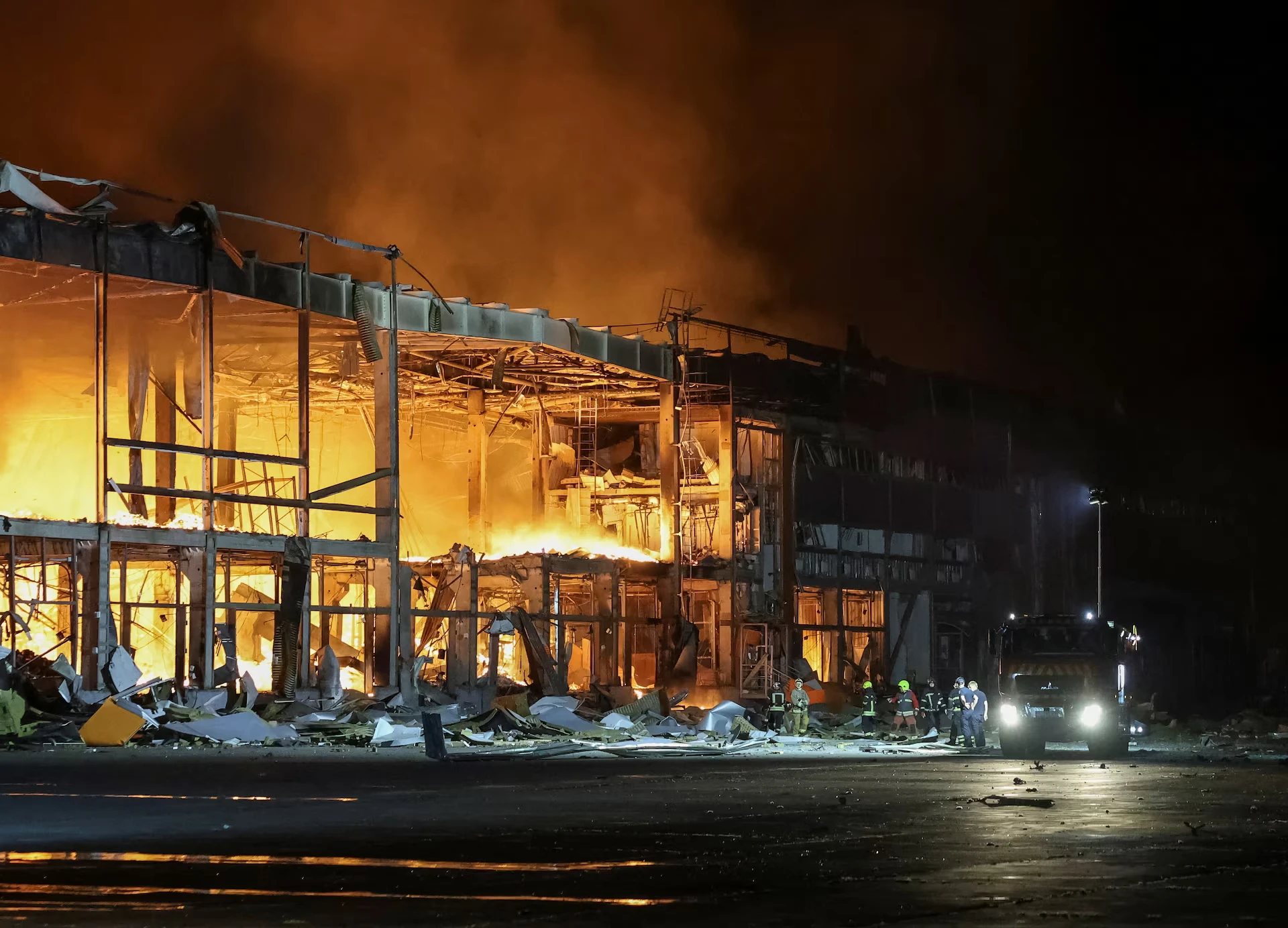






















The Russian missile that struck a warehouse near Kyiv on July 19 did not destroy weapons or industrial machinery. It burned through 62 million syringes, needles, alcohol swabs and condoms — basic items on which H.I.V. prevention in wartime Ukraine depends.
People already living with the virus are not facing an immediate interruption in treatment: antiretroviral medicines were not affected. But the strike destroyed roughly $3 million in supplies intended for 2027, leaving aid organizations only a few months to replace them.
Stocks for the remainder of 2026 had been distributed across the country about two weeks before the attack. That timing postponed the crisis without eliminating it. Unless new supplies are procured by November, prevention programs may enter next year without an adequate reserve.
In Daycom’s assessment, the strike illustrates the distinctive cruelty of attacks on civilian systems. A missile causes destruction in seconds, but its full consequences may emerge months later, through infections that could have been prevented.
Around 250,000 people in Ukraine live with H.I.V. A significant share of new infections is linked to the use of contaminated injection equipment among people who use drugs.
In that context, a sterile syringe is not a trivial household object. It is a medical intervention that breaks the chain of transmission as directly as a vaccine or preventive drug does in other diseases.
Harm-reduction programs depend on regularity. People need clean needles, disinfectant, condoms and counseling consistently, not occasionally. A prolonged gap can revive risky behavior that outreach workers have spent years trying to reduce.
Public-health organizations warn that if the destroyed supplies are not replaced, Ukraine could record at least 16,000 new H.I.V. cases in 2027 — roughly twice the usual number.
That is a forecast, not an inevitable outcome. It nevertheless exposes the unforgiving arithmetic of prevention: a few million dollars spent now on simple supplies can avert thousands of infections and far greater costs for lifelong treatment later.
A humanitarian shortage cannot be filled with sympathy. Someone at risk of infection through a shared needle does not need a symbolic gesture. That person needs a sterile kit on a specific day.
War makes that dependence more severe. Pharmacies have closed in some areas, transport networks are disrupted, local budgets are strained, and people in high-risk groups often have no reliable alternative source of prevention supplies.
They depend on centralized procurement, warehouses and distribution networks. When one link fails — especially a major logistics center — the shortage can quickly spread across the entire system.
That is why the strike cannot be measured only by the value of the goods destroyed. Three million dollars is an accounting figure. The real cost includes future infections, treatment, lost income, social exclusion and additional pressure on the health system.
The delay between destruction and replacement is especially dangerous. Prevention items are relatively inexpensive, but they cannot be replenished overnight. Funding, manufacturers, contracts, transport, customs clearance and distribution all take time.
November is the critical deadline for a reason. Procurement must be completed early enough for replacement shipments to arrive before the beginning of 2027 and prevent a gap between old and new stocks.
Waiting until the shortage becomes visible would be too late. Epidemic prevention does not work like emergency firefighting: a month without supplies cannot be fully repaired by handing out twice as much the following month.
The warehouse strike was part of one of the war’s largest ballistic missile attacks, involving at least 41 missiles. Images of the logistics center showed a twisted steel frame wrapped in black smoke.
It remains unclear what else was stored at the complex. Nor is it publicly known whether a military installation, air-defense position or training site was located nearby.
That uncertainty matters for the legal assessment of the specific strike. It does not change the civilian consequence: a reserve of medical and prevention materials was destroyed, and replacing it now requires urgent international action.
International humanitarian law requires parties to distinguish between military and civilian objects and to minimize harm to the population. Medical infrastructure is especially important because its destruction continues to endanger lives long after an attack ends.
A strike on a hospital produces an immediate and visible tragedy: casualties, ruined wards and displaced patients. A strike on a prevention warehouse works more quietly. Thousands may not suffer on the first day, but a year later they may include people who never knew the warehouse existed.
This is one of the central paradoxes of warfare against essential systems. The greatest harm often occurs not at the point of impact, but inside the supply chains that the explosion breaks.
The same pattern is visible in attacks on postal hubs, printing houses, energy facilities, hospitals and commercial infrastructure. A building is destroyed, but so is society’s capacity to move goods, deliver care, print books, store materials and distribute essentials.
Hundreds of postal branches and logistics sites have been damaged or destroyed. About 1.5 million Ukrainian books have burned in attacks on printing facilities and warehouses.
These losses may appear unrelated. In reality, they share the same structure: each strike raises the cost of ordinary life and forces the state to spend resources restoring basic functions rather than developing new ones.
For public health, that erosion is particularly dangerous. Prevention programs rarely command the political attention given to major hospitals or expensive medical equipment. Their value becomes most visible only when they stop working.
Ukraine already faced a difficult H.I.V. epidemic before the full-scale invasion. War added mass displacement, loss of income, psychological trauma, more risk-taking behavior and unequal access to care.
A person who has fled home, lost documents or lives near the front has fewer opportunities to receive regular testing and prevention supplies. The destruction of reserves therefore harms the very groups that are already hardest to reach.
The consequences may spread beyond communities of people who inject drugs. H.I.V. is also transmitted sexually and can move into the wider population when early testing and prevention weaken.
Every new infection also creates a future need for treatment. Antiretroviral therapy allows people to live full lives and sharply reduces transmission, but it requires continuous financing over decades.
Replacing the destroyed syringes and condoms is therefore not secondary charity. It is an economically rational investment. Preventing one infection costs far less than treating a new patient for life.
For international donors, the crisis is a test of speed. Standard procurement procedures, lengthy tenders and annual budget cycles may be poorly suited to a situation in which a decision must be made by November.
Ukraine needs an emergency purchasing mechanism that can use multiple suppliers, distribute risk across several warehouses and avoid storing an entire annual reserve in one place.
The rebuilt system should also be more resilient than the one that was destroyed. Large centralized warehouses are efficient and cheaper in peacetime, but in a missile war they become single points of failure.
Distributed storage costs more, yet it lowers the chance that one strike can eliminate a full year’s supply. Stocks can be divided across regions and placed closer to the organizations that distribute them.
Alternative delivery routes are also essential. If a main logistics center is lost, community groups should still be able to receive supplies through postal networks, hospitals, mobile clinics or local warehouses.
The attack exposed the need for a dedicated insurance or replacement mechanism for humanitarian reserves as well. Donor-funded goods should not disappear with a building without a rapid route to renewed financing.
Russian strikes are forcing Ukraine to protect not only power plants and military factories, but the entire infrastructure of everyday life. Yet air defenses cannot be placed around every warehouse, publishing house or distribution center.
Protection must therefore be structural as well as physical. A resilient system should be able to lose individual facilities without losing the ability to perform its core function.
For H.I.V. prevention, the standard is simple: even after a missile strike, a person in any region should still be able to obtain a sterile needle, a condom, a test and counseling without a prolonged interruption.
The supplies already distributed for 2026 give Ukraine a brief window to act. That is a rare advantage in wartime: the danger can already be calculated, but it can still be prevented.
If financing is secured, new goods are purchased and the storage network is redesigned, the projected 16,000 infections will remain only a warning. If the response becomes trapped in bureaucracy, a missile that landed in July will continue causing harm throughout the following year.
That is the true scale of the strike. It did not merely destroy millions of simple objects. It created a time bomb for public health — one that must be defused before the last sterile needle disappears from the shelf.