



















Hungary is voting in an election that has long ceased to be merely a domestic affair. On paper, this is a contest for power in a country of fewer than ten million people. In reality, it is a test of whether one of Europe’s most durable populist systems can survive the moment when public fatigue with it has become a political fact.
For Viktor Orbán, this is no ordinary campaign. After sixteen uninterrupted years in office, he enters election day not as the unquestioned master of the field, but as a leader whose advantage is no longer treated as automatic. That alone makes the moment tense not only in Budapest, but in Brussels, Washington and Moscow as well.
Too much in this election reaches far beyond a routine change of government. Orbán has long since become more than Hungary’s prime minister. For some, he is proof that it is possible to weaken liberal institutions from within the European Union and still preserve electoral legitimacy. For others, he is a warning that democracy can be hollowed out gradually while keeping its formal shell intact. According to Daycom’s earlier assessment, this vote is not simply a test of one leader. It is a test of an entire political construction built around his name.
What matters most is not only the identity of his challenger, but the nature of the challenge itself. Péter Magyar did not arrive from an alien ideological camp, nor does he ask conservative Hungary to abandon its instincts. He emerged from inside Orbán’s own political world, understands its machinery from within and has therefore become more dangerous than the fragmented opposition figures who came before him. A government that spent years persuading voters that every alternative was either weak or foreign now faces a rival who sounds familiar without being loyal.
 Петер Мадяр, лідер опозиційної партії «Тиса», виступає перед ЗМІ біля виборчої дільниці в Будапешті, Угорщина, у неділю, 12 квітня 2026 року — Денеш Ердеш
Orbán’s success rested for years on a formula that looked close to unbreakable. At home, he sold order, protection and stability. Abroad, he sold sovereign defiance against the liberal consensus of Brussels. His power depended not only on political instinct, but on rewritten conditions: a disciplined media sphere, an electoral architecture tilted toward incumbency, a loyal administrative apparatus and a cultural politics built around the fear of outside pressure. Orbánism became more than a governing style. It became a way of organizing the state itself.
Yet this campaign has shown that even such systems can tire from within. The 2026 election has turned above all on the issues Orbán long tried to push to the margins with grand rhetoric about nation, migration and external enemies. Inflation, hospitals, transport, corruption, stagnation and the sense that the state no longer performs its most basic functions have moved to the center. Magyar succeeded by making those subjects the language of the campaign. His strength lies not in promising revolution, but in promising repair.
That is why this vote has become more than a clash between two politicians. It is a collision between two different experiences of time. Orbán has spoken to the country in the language of historical siege. He has once again warned of danger, invoked threats from abroad, leaned on visible support from Donald Trump and JD Vance, and cast himself as the guarantor of predictability in a hostile world. Magyar has done the opposite. He has dragged politics back to the ground: to living standards, public services, corruption and the exhaustion produced by a system that no longer renews itself. This is not merely a contest of programs. It is a contest between two ways of describing reality.
In that sense, high turnout carries a meaning far beyond electoral arithmetic. When a country votes not out of routine but with the feeling of standing at a historical threshold, something important has already shifted. Voters no longer regard the result as prewritten. For a regime that long cultivated the aura of inevitability, the loss of that psychological advantage may be nearly as dangerous as defeat itself.
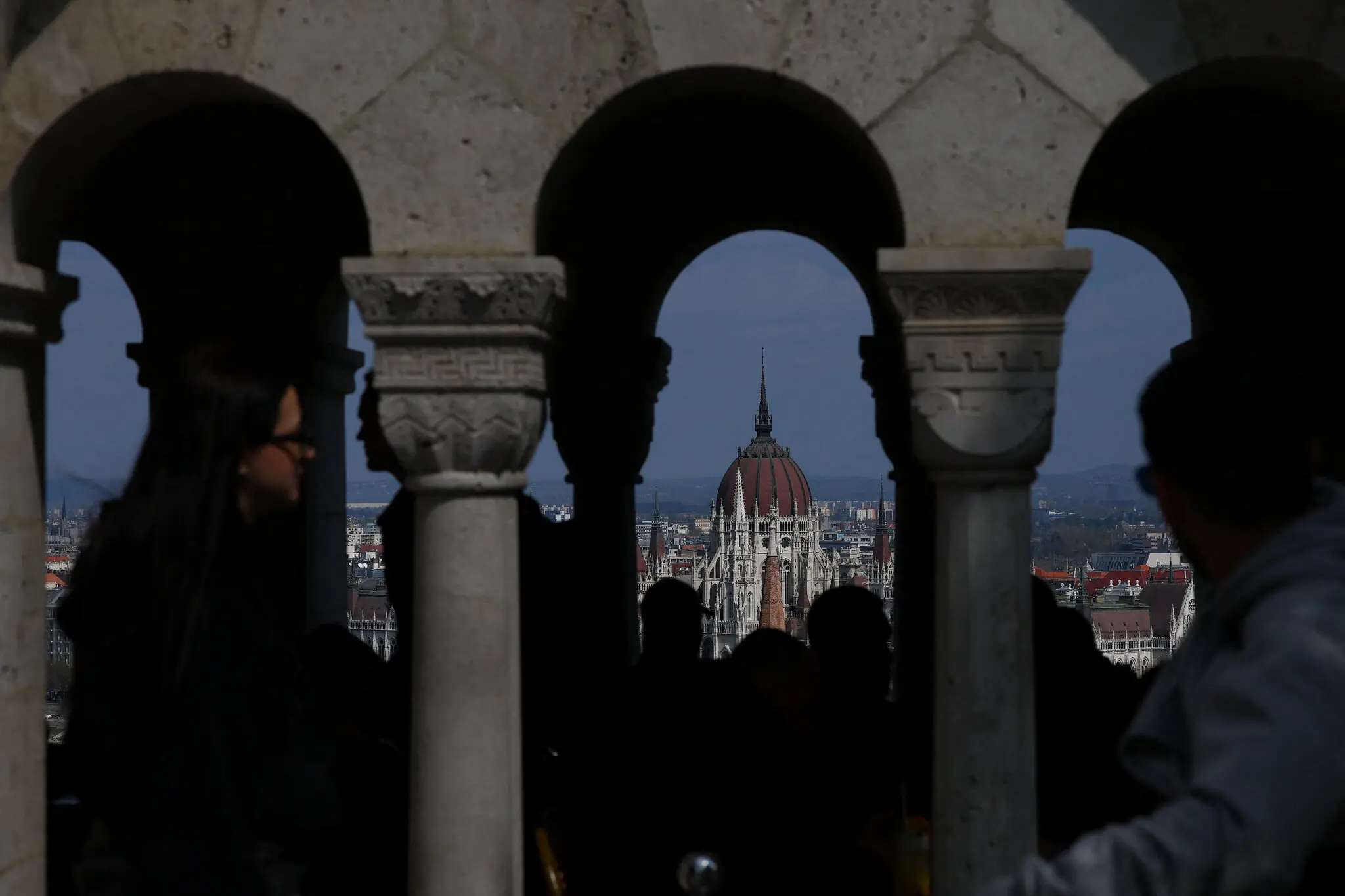 Вид на будівлю парламенту в Будапешті. Головне питання, ймовірно, полягає в тому, чи достатньо сильне розчарування паном Орбаном, щоб забезпечити пану Мадьяру та його партії переважну більшість у парламенті — Лізі Ніснер
And yet the paradox of Hungarian politics is that even strong mobilization does not guarantee a simple transfer of power. Over the years, the system was reshaped so that government advantage could survive even when popularity began to erode. The combination of single-member districts, national party lists and redrawn electoral boundaries gives Fidesz structural protection. That is why the central question is not only who wins more votes, but whether the margin is large enough to break through the armor of the system.
This is also why Europe is watching Budapest with such intensity. Orbán is no longer a local Hungarian phenomenon. For much of the global right, he has become proof that it is possible to govern for years inside the European Union, discipline the media, weaken liberal norms, quarrel with Brussels and still retain democratic legitimacy through elections. For many inside the Union, he has become the clearest example of how a member state can exploit the mechanisms of Europe while undermining its political cohesion from within.
The Russian and Ukrainian dimension gives this election even greater weight. Orbán has repeatedly slowed or obstructed European decisions in support of Kyiv, softened the tone toward Moscow and increasingly presented Ukraine, rather than Russia, as a source of danger to European stability. In that context, any weakening of his position would mean more than a cabinet change in Budapest. It would alter one of the European Union’s most difficult internal fault lines. That is why many governments across Europe are not simply interested in the result. They are invested in it.
At the same time, a Magyar victory would not automatically dismantle the Orbán system. Even if power changes hands, the new government would inherit a state whose institutions, media landscape, administrative reflexes and business networks have been aligned for years around a single political logic. Winning an election and reconstructing a system are not the same act. The real test would begin after the ballots are counted: whether Hungary could move back from electoral authoritarianism toward a more credible liberal democracy without entering a prolonged war of institutions.
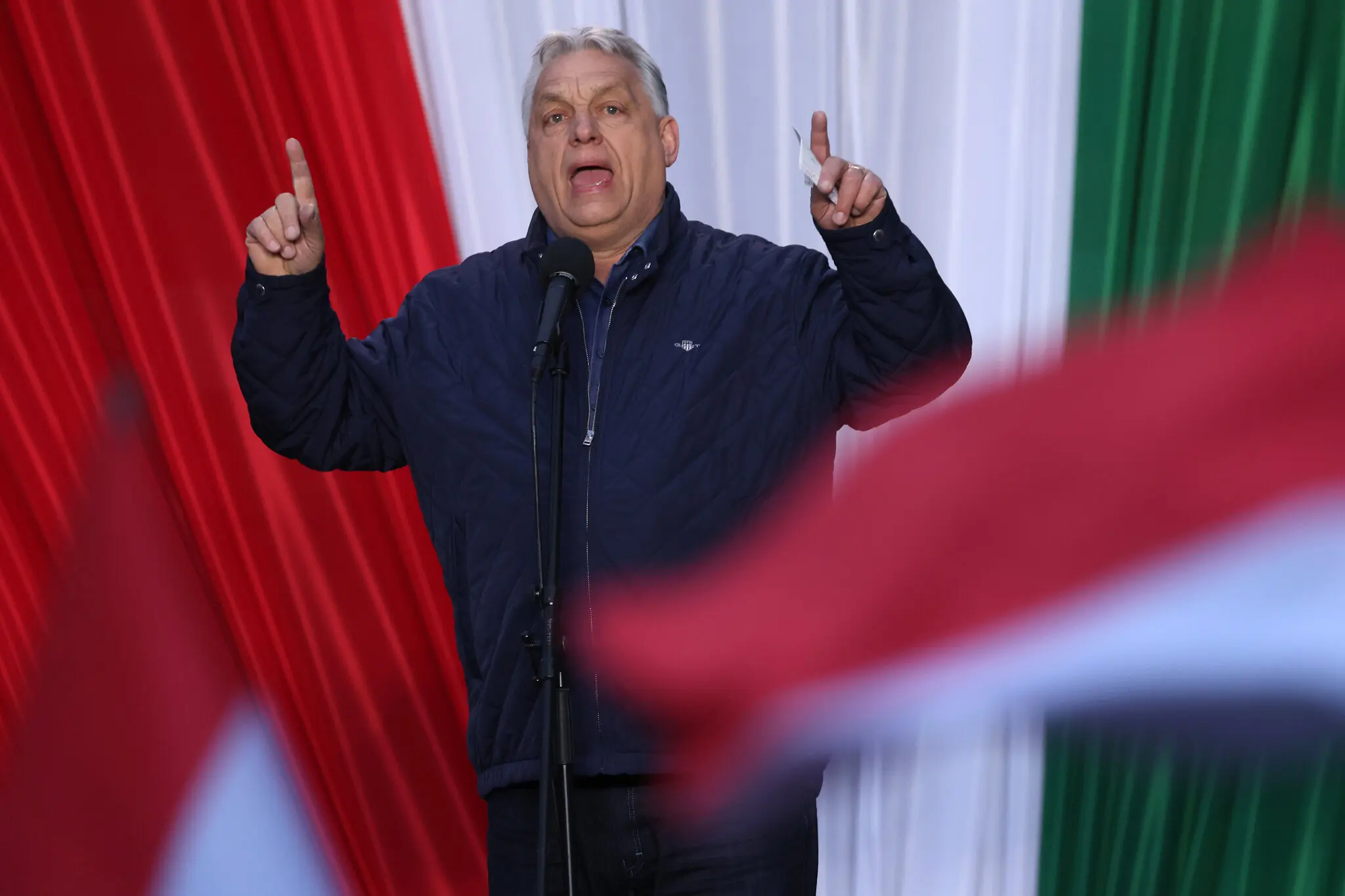 Віктор Орбан, прем'єр-міністр Угорщини, який обіймає посаду 16 років, проводить передвиборчу кампанію в Секешфегерварі, Угорщина, у п'ятницю — Шон Геллап
That is where the true drama of this election lies. Hungary is deciding not only who will form the next government. It is deciding whether a society that has lived for sixteen years in the political gravity of one man can imagine a different center of power. If Orbán survives, he will once again prove that illiberal democracy can do more than endure. It can reproduce itself through elections even after visible public exhaustion. If the system cracks, the signal will travel far beyond Hungary: eras that look unbreakable do not end when fear disappears, but when belief in their inevitability begins to fail.