






















Volodymyr Zelensky’s visit to Berlin on April 14 was not a routine appearance wrapped in the usual language of support. It was a test of something more consequential: whether Germany is ready to move fully from the role of a major partner to that of a long-term strategic anchor for Ukraine at a moment when the war is entering its fifth year and Washington’s attention is increasingly divided by other crises.
The format of the visit made that clear. At its center were not only talks between Zelensky and Chancellor Friedrich Merz at the Chancellery, but broader German-Ukrainian government consultations that pointed to a deeper level of coordination. Parallel defense contacts reinforced the same impression. This was less about symbolism than about building a durable architecture of cooperation.
What matters here is not only that Germany remains Europe’s largest military supporter of Ukraine, but the way Berlin is beginning to define that role. The question is no longer whether Germany will keep helping. The question is what kind of power it wants to be while helping, and how deeply it is prepared to embed Ukraine in its own security thinking.
As Daycom noted in an earlier analysis, the central shift in Europe’s Ukraine policy lies in the move from the logic of aid packages to the logic of systemic endurance. Berlin no longer wants to be the country that periodically fills urgent gaps in air defense, ammunition or armored vehicles. It wants to become part of Ukraine’s capacity to endure the war itself through budgetary planning, industrial cooperation, technology, reconstruction and political integration into the wider European space.
That is why the scale and structure of Germany’s 2026 commitment matter more than the headline number alone. Once support is written into a state budget in advance, it ceases to be merely a reaction to the latest battlefield shock. It becomes policy in the full institutional sense. The alliance gains weight not because it sounds impressive, but because it is designed to last.
This is the real meaning of the Berlin meeting. Ukraine did not come only for another package of assistance. It came to lock in a different model of partnership, one in which Germany helps not only to absorb Russia’s current pressure, but to build the future defense economy of a country at war. For Europe, that is an important lesson as well. Supporting Ukraine can no longer mean merely compensating for damage. It has to mean helping generate strength.
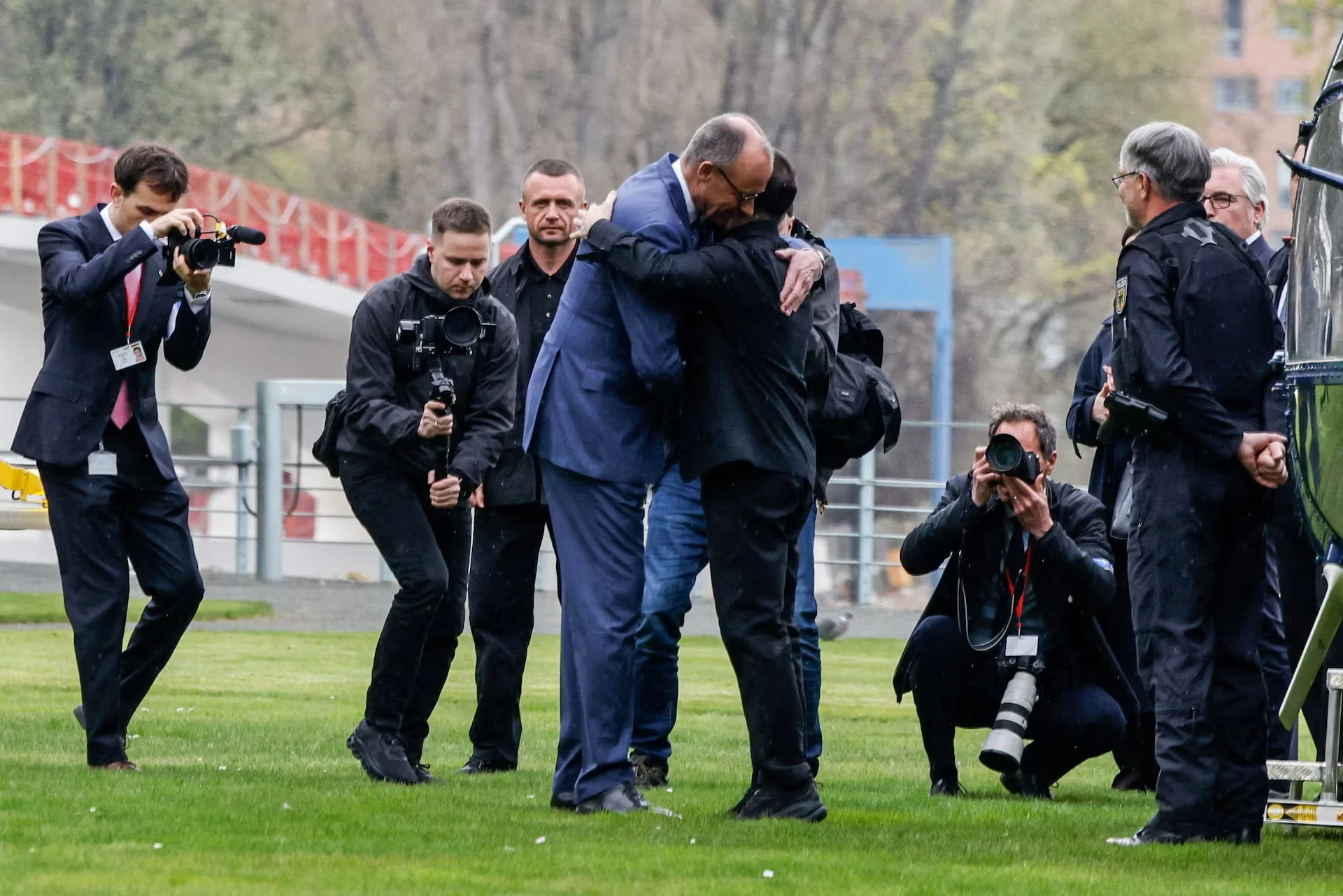 Канцлер Німеччини Фрідріх Мерц вітає президента України Володимира Зеленського в Канцлерській канцелярії на німецько-українських урядових консультаціях у Берліні, Німеччина — Аксель Шмідт
Berlin is also beginning to frame this relationship more openly as a strategic partnership. That points to a deeper evolution in German policy. Support is becoming less about delivering what can be taken from existing stocks and more about developing joint production, industrial coordination, technological exchange, the drone sector, long-range capability and ammunition capacity. In other words, Germany is shifting from the role of supplier toward that of co-architect of Ukrainian resilience.
There is another layer to the visit, and it is European. Berlin is increasingly linking Ukraine’s defense to the security of the continent itself, and Ukraine’s reconstruction to the future architecture of the European Union. The war is no longer being treated as an external crisis on Europe’s eastern edge. It is being understood more clearly as an internal question of European security, economic stability and political seriousness.
The wider international context makes that shift even more significant. American efforts to push a negotiating track have been faltering, while the White House’s attention is increasingly pulled toward renewed instability in the Middle East. In that environment, Berlin is sending a clear signal: even if Washington’s priorities drift, the European center of gravity behind Ukraine must not weaken. For Kyiv, that is a matter of weapons and stamina. For Germany, it is a matter of defining its place in Europe.
That is why Berlin should not be read today as the stage for a polite diplomatic gesture. It is better understood as the site where Germany is trying to redesign its entire approach. Merz is attempting to show that Germany can be more than a payer, more than a rear base, more than a well-intentioned partner. It can be a state that helps shape the material foundations of Ukraine’s survival.
If that line is carried through, the real outcome of the meeting with Zelensky will not lie in the rhetoric issued afterward. It will lie in something more sober and more important. Berlin is beginning to think of Ukraine not as a temporary recipient of emergency support, but as part of Germany’s own long security design.
In that sense, Germany is taking a step that for years it approached with visible caution. It is no longer helping Ukraine only because war demands it. It is increasingly helping because without Ukrainian endurance, it no longer sees a stable Europe as plausible. That is no longer diplomacy of support. It is policy built around a shared future.