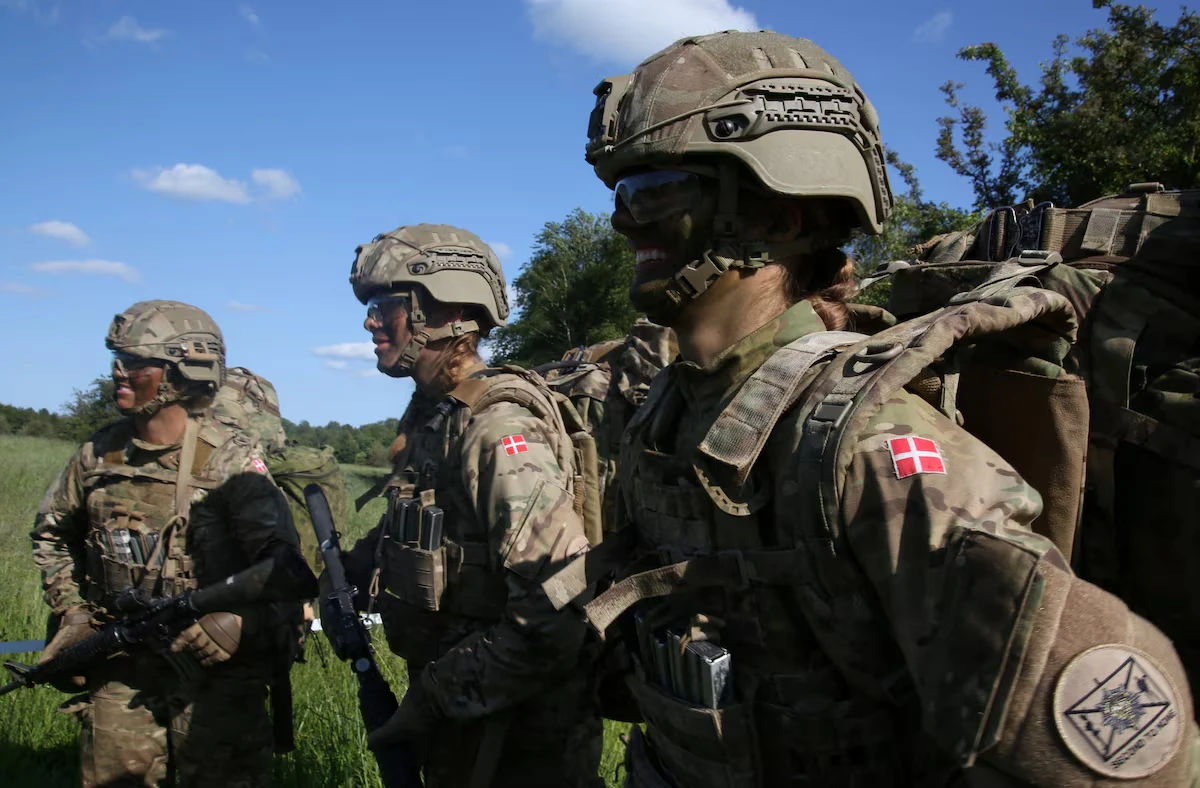





















Around 1,600 young Danes began military service under new rules on August 3. Instead of four months, they will spend 11 months in uniform — long enough not only to complete basic training, but also to perform genuine operational duties.
The reform makes conscription gender-neutral for the first time and gradually expands the annual intake. By 2033, Denmark plans to recruit 7,500 people each year, up from about 5,000 today.
This is more than an administrative enlargement of the armed forces. It reflects a fundamental change in how Copenhagen understands security. Denmark can no longer assume that major war is a distant danger or that NATO membership alone guarantees territorial protection.
In Daycom’s assessment, the reform was driven by two different sources of pressure. Russia forced Northern Europe to prepare again for prolonged conflict, while Donald Trump demonstrated that strategic uncertainty can emerge even from within the Western alliance.
Since Russia’s full-scale invasion of Ukraine, European defense planning has returned to questions long treated as relics of the Cold War: mobilization reserves, territorial defense, ammunition stocks and the ability to deploy trained units quickly.
A four-month service period belonged to a different era. It was sufficient to introduce recruits to weapons, discipline and field training, but too short to turn them into soldiers capable of sustained operational work.
The new structure provides five months of basic training followed by six months of service in active units. The armed forces will receive not a temporary flow of inexperienced recruits, but personnel who can support exercises, guard infrastructure and contribute to territorial defense.
That operational phase is what gives the reform its significance. Denmark will spend more on each recruit, but it will also produce reservists with deeper skills and experience of functioning inside a military unit.
The content of service is changing as well. New training tracks include a drone platoon under Denmark’s Special Operations Command.
Unmanned systems have become one of the central lessons of the war in Ukraine. They have transformed surveillance, artillery correction, logistics and the defense of positions, making it insufficient for armies to train only infantry, mechanics and communications specialists.
Denmark is therefore trying to use conscription not merely as an inexpensive way to fill barracks, but as a channel for technological modernization. Young soldiers will train on systems likely to define future battlefields.
The reform acquires particular political weight through Greenland. Later this month, more than 100 conscripts are expected to deploy there for the first time, assuming operational duties from professional soldiers during a one-month rotation.
Formally, the deployment is limited. Strategically, it signals that Denmark regards Greenland not as a distant autonomous possession, but as an integral part of its defense perimeter.
The Arctic is becoming one of the main arenas of global competition. Melting ice is opening new maritime routes, increasing access to natural resources and raising the importance of northern airfields, radars and military bases.
Greenland occupies a critical position between North America and Europe. The shortest routes for aircraft and missiles cross the region, while the island’s infrastructure is essential for early warning and Arctic surveillance.
Washington’s interest in Greenland is not new. What changed was Trump’s method of expressing that interest: he repeatedly pressed for American control over the semi-autonomous Danish territory.
Both Copenhagen and Nuuk rejected those demands. Yet the dispute created an extraordinary situation in which Denmark is reinforcing Greenland not only because of Russia, but also because of statements from the president of its most important ally.
Prime Minister Mette Frederiksen said Denmark was prepared to defend every inch of NATO territory, including its own. The wording carried more than the usual affirmation of alliance commitments.
It was also a reminder that alliances do not erase sovereignty. American security interests in the Arctic can be pursued through treaties, military cooperation and joint planning, but not through the unilateral alteration of a territory’s political status.
A deployment of conscripts cannot by itself create a force capable of deterring a major power. Its importance lies in establishing a more regular presence and teaching the military to operate in a demanding northern environment.
Arctic service requires specialized skills. Extreme cold, vast distances, limited infrastructure and the difficulty of rapid reinforcement make even modest operations more complicated than comparable missions in continental Europe.
For Denmark, the deployment is also a way to convert formal sovereignty into practical capacity. A claim to govern territory must be supported by personnel, equipment, logistics and the ability to act.
The expansion of conscription does not mean a return to a mass army on the Cold War scale. Denmark’s system still relies heavily on volunteers, while a ballot is used mainly when the number of applicants does not meet military quotas.
Including women nevertheless expands the recruitment base substantially. It also changes the civic meaning of military service by ending the assumption that national defense is primarily a male responsibility.
Gender-neutral conscription does not automatically guarantee equal military careers. It does, however, create another route into professional service at a time when European armed forces are struggling to recruit and retain personnel.
The Nordic model differs from a system of universal, indiscriminate compulsory service. It combines civic obligation, voluntary participation and selective recruitment, allowing the military to accept only the number of people it can properly train.
Similar systems operate in Sweden, Finland and Norway. Estonia, Latvia and Lithuania also maintain or have restored conscription, reflecting their proximity to Russia and their relatively small populations.
For smaller states, a professional military alone is often insufficient. It may be highly capable, but still lack enough personnel to protect borders, ports, energy facilities and transport corridors during a prolonged crisis.
A trained reserve allows a country to expand its forces quickly without maintaining every soldier on active duty. Its effectiveness, however, depends on the quality of initial training, regular exercises and the availability of equipment.
That is why the 11-month service period matters more than the headline increase in recruit numbers. A poorly trained reserve exists mainly on paper. Longer service builds familiarity with unit operations and complex systems.
The reform will require more barracks, instructors, training grounds and equipment. Increasing the intake through legislation is straightforward; turning additional recruits into useful military formations is much harder.
There is also a risk that professional soldiers will become overly occupied with training new personnel. Unless Denmark expands its instructor corps, a larger intake could temporarily reduce the readiness of existing units.
Copenhagen has nevertheless concluded that inaction carries a greater danger. The war in Ukraine demonstrated that building reserves after a conflict begins is already too late, while manufacturing equipment and training personnel require years.
Uncertainty about American policy has added urgency. European governments can no longer assume that every administration in Washington will interpret alliance responsibilities in the same way.
This does not amount to a break with the United States. Denmark remains a NATO member and relies on American intelligence, air power and nuclear deterrence. That dependence, however, is no longer considered a reason to postpone national rearmament.
European defense is gradually moving from a model that supplements American power toward one that also insures against American unpredictability. Denmark’s longer conscription is one of the clearest expressions of that transition.
For Russia, an additional few thousand Danish reservists will not transform the strategic balance by themselves. The cumulative effect of similar decisions across Northern Europe is more significant.
Finland and Sweden have strengthened NATO’s northern flank with their territory, armed forces and infrastructure. Denmark adds control over access to the Baltic Sea and a strategic presence in Greenland.
A single reform therefore connects two theaters: continental Europe and the Arctic. Danish recruits are preparing for the security consequences of Russia’s war, while some will serve on territory whose status has been questioned by an American president.
This is the central paradox of the new defense era. European countries must strengthen NATO, prepare for threats from Russia and simultaneously account for the possibility that United States policy may create uncertainty of its own.
Eleven months of service will not solve every problem in Danish defense. It does show, however, that Copenhagen no longer considers time unlimited, peace guaranteed or allied protection an adequate substitute for its own capacity to defend the country.