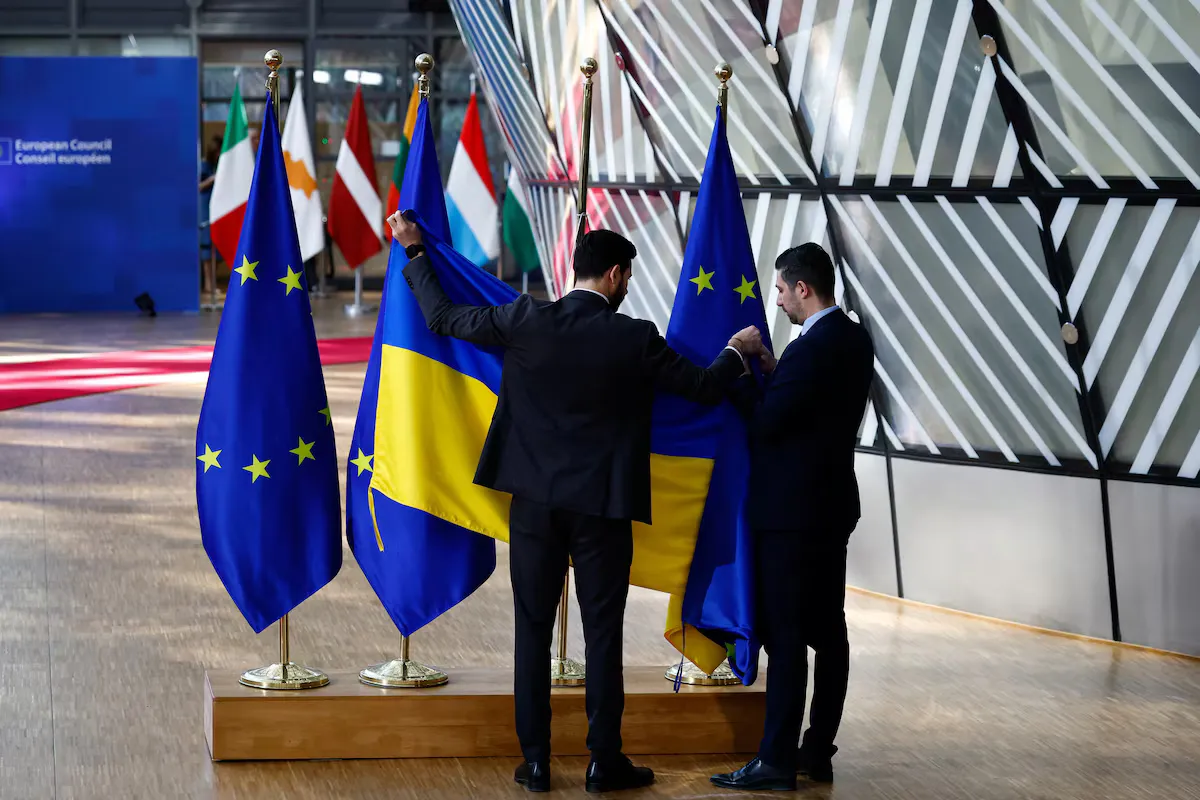












The European Union has taken a step that carries more than diplomatic weight for Ukraine. Ambassadors of the 27 EU member states agreed to move Ukraine and Moldova into the first practical phase of accession talks. The opening round is set to begin with the fundamentals cluster — the block that effectively starts the real institutional test of a candidate country.
For Kyiv, the decision comes at a moment when Russia’s war has not removed reforms from the national agenda. It has made them part of Ukraine’s security architecture. EU membership is no longer an abstract foreign-policy aspiration. It is a way to anchor the country inside Europe’s legal, economic and political order.
President Volodymyr Zelensky framed the move as a strong step for Europe and thanked EU leaders for keeping their word. His response reflected Kyiv’s broader reading of the moment: the start of negotiations is not a ceremonial gesture, but proof that the EU remains politically consistent even when enlargement is still contested in some European capitals.
According to Daycom’s earlier analysis, the opening of the first cluster is decisive because it sets the logic for everything that follows. The fundamentals cluster is not a technical stage that can be passed through formally. It covers the rule of law, democratic institutions, the judiciary, human rights, anti-corruption policy and the basic administrative capacity of the state.
This is where the EU usually measures not the speed of political declarations, but the depth of institutional change. For Ukraine, accession talks will therefore mean more than aligning legislation with European standards. They will test whether adopted laws work inside the real system of governance.
Moldova enters this process in parallel with Ukraine. President Maia Sandu has emphasized that her country has done the necessary work and will continue reforms. For Chisinau, the European path is also a strategic choice: between vulnerable peripherality and gradual entry into a space of institutional stability, the EU single market and political predictability.
The decision became possible after the removal of Hungary’s long-standing block, which had delayed Kyiv’s move toward a full negotiating process. An agreement between Budapest and Kyiv on the rights of the Hungarian minority in Ukraine created room for compromise and allowed the EU to move from political approval to procedural action.
That episode shows one of the central features of EU enlargement. Even when a candidate country fulfills a significant part of the required work, progress still depends on consensus inside the Union itself. Each member state retains leverage, and internal EU disputes can slow the process as much as the candidate’s own weaknesses.
Ukraine and Moldova received the political green light for accession talks in December 2023. But the distance between that decision and the beginning of real negotiations proved substantial. Now that gap is beginning to narrow. The first intergovernmental format is expected to open the cluster that will define the tone of the entire process.
EU accession is built around negotiating chapters grouped into six thematic clusters. They include the internal market, external relations, competition policy, resources, agriculture, environment, transport, energy and fundamental rights. But the fundamentals cluster is the backbone. Without it, the other areas lack sufficient political weight.
For Ukraine, this logic is especially important. European integration during wartime cannot be reduced to diplomatic symbolism. It requires movement in two directions at once: resisting external aggression and rebuilding domestic institutions. That combination is difficult, but it is what makes Ukraine’s application unique in the recent history of EU enlargement.
Kyiv has already advanced in legislative alignment, anti-corruption architecture, digital governance and sectoral integration with the EU. The next stage will be more demanding. European capitals will assess not only whether laws exist, but whether practices are stable: independent institutions, functioning justice, transparent decision-making, minority protection and an effective civil service.
In this sense, the opening of the first cluster is not the finish line. It is the beginning of a long route. The EU rarely admits new members quickly. Negotiations can last for years, and their pace will depend on a candidate’s ability to meet conditions without losing political focus. For Ukraine, the war, budget pressure and eventual reconstruction will remain additional tests.
At the same time, the decision has clear geopolitical meaning. It shows that Russian aggression has not frozen Ukraine’s European future. Instead, enlargement has become part of the EU’s wider response to the security crisis on the continent. For Moscow, the signal is equally clear: force does not return Ukraine to a grey zone; it accelerates its institutional convergence with Europe.
For the European Union itself, this is also a test. Eastern enlargement requires reforms not only from candidate countries, but also from the EU. The Union will have to confront questions of decision-making, budget policy, agricultural rules and institutional representation. Ukraine is a large state with a powerful agricultural sector, a significant population and a complex security reality. Its accession cannot be treated as a simple administrative exercise.
That is why the first cluster matters as a political filter. It will show whether Ukraine can turn wartime social mobilization into long-term institutional modernization. It will also show whether the EU can preserve enlargement not merely as a moral response to war, but as a strategic project for the continent.
For Moldova, the synchronized start with Ukraine creates an additional protective frame. Chisinau remains vulnerable to external pressure, political destabilization and economic dependence. The European process gives it a reform framework while strengthening the domestic legitimacy of its pro-European course.
What lies ahead is not rapid membership, but a long test of endurance. Yet the decision to open the first cluster changes the quality of the process. Ukraine and Moldova are moving from the waiting room of European politics into the negotiating room, where every next step will be more specific, more difficult and more politically costly.
For Ukraine, this is a moment in which symbol and procedure converge. A state fighting for its survival receives confirmation that its European path has not been frozen until the end of the war. It is moving now — through reforms, law, institutions and the ability to prove that the European choice is not a slogan, but the daily work of the state.