


















Germany’s funding of 50,000 attack drones for Ukraine is not just another military aid package. It is a signal that the logic of the war is changing: the battlefield is increasingly shaped not only by missiles, tanks and artillery, but by the mass production of cheap, accurate and rapidly updated unmanned systems.
The order concerns Shrike FPV drones made by the Ukrainian manufacturer SkyFall and equipped with software from the American defense technology company Auterion. Their central feature is the ability to autonomously track and strike a moving target in the final stage of flight, when radio links, jamming and an operator’s reaction time become critical.
The contract is worth about €90 million. Some of the drones have already been delivered to Ukraine, with the rest expected during the year. For Berlin, this is one of the largest known steps toward purchasing attack drones for Kyiv. For Ukraine, it is another element in the shift toward high-intensity warfare, where quantity has become almost as important as quality.
According to Daycom’s earlier analysis, the real meaning of this deal lies not only in the figure of 50,000. It shows that Western governments are beginning to treat drones not as an auxiliary technology, but as a consumable of modern war — something that must be supplied not by the dozen or the hundred, but in industrial series.
Ukraine already produces millions of drones a year and carries out thousands of drone strikes each day. But domestic production does not eliminate the need for external financing. On the contrary, the more drones become the foundation of battlefield tactics, the more important stable orders, components, software, standardization and long production contracts become.
The Shrike has been deployed on the front since 2023 and has become part of Ukraine’s answer to Russia’s advantage in manpower, armor and artillery resources. An FPV drone does not fully replace a shell or missile, but it allows forces to strike vehicles, shelters, infantry groups, logistics routes and moving targets cheaply and precisely.
The value of such a drone lies in the ratio between cost and effect. One inexpensive machine can disable a much more expensive armored vehicle, break up an assault, stop ammunition delivery or force the enemy to change routes. On a front where every meter is costly, drones become a daily instrument of attrition.
Auterion’s software adds another layer to that logic. Autonomous guidance in the final phase of flight is especially important under Russian electronic warfare. When a signal is jammed, video is lost or a target begins to move, a drone with a smarter algorithm has a better chance of completing the strike.
This is where a new technological race is taking shape. Russia is expanding electronic warfare, changing armor protection, installing nets, cages, screens and detection systems. Ukraine responds with new frequencies, repeaters, autonomous modes, machine vision and swarm tactics. Each side is trying to shorten the time between a battlefield problem and a technical solution in production.
German funding also matters because it supports a Ukrainian manufacturer. This is not the classic model in which the West sends Kyiv its own equipment from storage. It is a different scheme: European money, a Ukrainian production base, American software and real-time front-line adaptation. That model looks more like a new kind of defense coalition.
It also reduces one of the main weaknesses of Western aid: slowness. Large air-defense systems, missiles, armored vehicles and artillery shells require complex decisions, long production cycles and political approvals. FPV drones can be produced faster, updated more often and scaled through smaller batches of components.
But low cost does not mean simplicity. A modern attack drone is not only a frame, motor and explosive charge. It is a camera, communications link, software, battery, protection against interference, operator training, logistics, repair, tactics and post-strike analysis. Drone warfare requires not chaotic purchases, but a complete ecosystem.
That is why Auterion’s role is revealing. The company is not merely supplying a single component; it is helping integrate Western software engineering into a Ukrainian front-line product. Its leadership has spoken of involvement in supplying a total of 100,000 drones for Ukraine this year with different manufacturers. This is no longer the scale of an experiment. It is the scale of an industry.
There is also an American context. The Shrike 10-F version, produced by SkyFall with the British company Skycutter, has attracted attention in a Pentagon competition tied to a major program to buy one-way attack drones. That means Ukrainian battlefield engineering is beginning to influence not only the war in Ukraine, but the future standards of Western armies.
In this field, Ukraine has become not only a recipient of aid, but a laboratory where the technologies of future war are tested. What emerges in garages, small workshops, volunteer networks and private companies is gradually entering the field of major defense budgets. The West can no longer treat Ukrainian drones as temporary improvisation.
For Germany, the purchase also carries political meaning. Berlin has often been criticized for caution, delays and reluctance to move quickly on certain weapons systems. Funding tens of thousands of attack drones looks different: it is a pragmatic contribution to what Ukraine needs every day, without a large symbolic stage, but with direct battlefield effect.
It also matches the changing needs of the front. A war of attrition is not won only with a few prestigious systems. It requires mass: drones, munitions, repair kits, batteries, antennas, operators and backup communication channels. If one side can lose and replace thousands of machines every day, it preserves tempo. If not, it loses eyes and hands on the battlefield.
Russia understands this as well. It is increasing production of its own attack drones, buying components, scaling operator training and integrating drones into infantry tactics. Ukrainian advantage, therefore, cannot be a one-time achievement. It must be constantly fed by financing, engineering and rapid model updates.
The deal for 50,000 Shrikes will not decide the war by itself. No drone batch can replace air defense, artillery, long-range missiles, armor or manpower. But it strengthens the level of war that works every day: detect, approach, strike, disrupt movement, prevent enemy concentration, force troops to hide and make them spend resources on protection.
That is why drones have become the nervous system of the front. They do not only attack. They change soldiers’ behavior, logistics, field fortifications, vehicle movement and even the psychology of combat. Where the sky is saturated with FPV drones, an open road, tree line or dugout is no longer familiar ground.
The coming months will show how quickly this batch is integrated into Ukrainian units. The decisive factors will not only be delivery timelines, but operator training, availability of warheads, resistance to electronic warfare, repair capacity and the ability to adapt firmware to front-line conditions. In drone warfare, a contract is only the beginning of the cycle, not its end.
For the West, this deal is also a test of its ability to buy what actually changes the balance on the battlefield, rather than only what is politically convenient to announce. Ukraine needs large systems, but it also needs thousands of small machines that reduce Russia’s offensive potential every day.
Germany’s 50,000 drones show that aid to Kyiv is gradually entering the phase of production warfare. In that phase, the winner is not the actor that once delivered the loudest package, but the one that can finance, manufacture, update and deliver weapons month after month in quantities sufficient for the front.
That is why this purchase matters more than its price in euros. It records a new reality: Ukraine is fighting not only with an army, but with a network of manufacturers, programmers, operators, allies and technology companies. And if the West wants to contain Russia, it must learn to support that network at the same speed with which the front consumes drones.
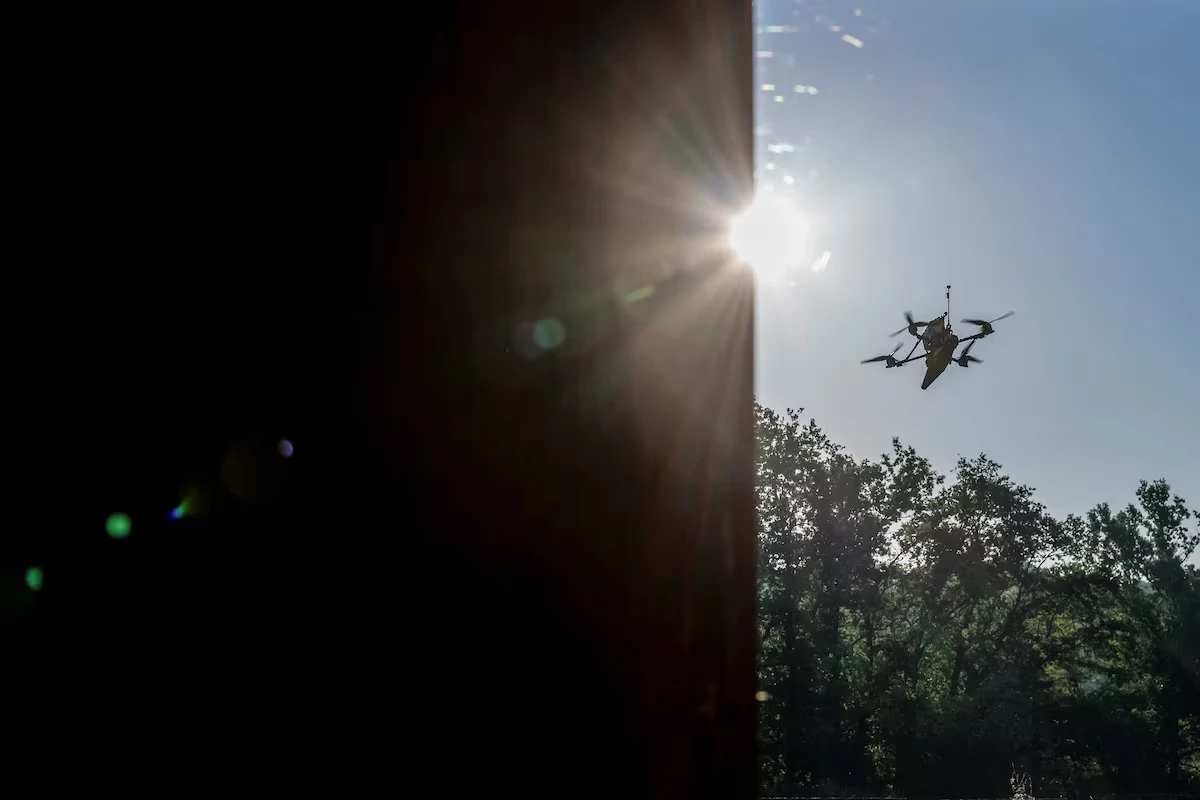 Український дрон з оглядом від першої особи (FPV) пролітає поблизу російського кордону в Харківській області, Україна, 14 червня 2024 року — В'ячеслав Ратинський