























The American plan to expand its military presence in Greenland matters for more than the opening of a few additional points on an Arctic map. It matters because it reveals a new form of power: Washington may never secure the island politically, yet it can still move deeper into it militarily. What recently sounded like exaggerated rhetoric about “getting Greenland” is now taking a far more practical shape — through ports, airfields and defense infrastructure.
Seen in that light, negotiations over access to three additional locations are not a technical adjustment. They are the first meaningful enlargement of the American footprint on the island in decades. Greenland is no longer being treated as a remote outpost with one strategic installation attached to it. It is being reimagined as a broader operational network inside the Arctic theater.
That shift matters because it comes after months of political pressure around the island itself. Even if the new steps are formally framed as allied defense coordination, they no longer read that way automatically. Denmark knows that the legal architecture for U.S. access already exists. What has changed is the political atmosphere around it. Trust has been weakened by the fact that military logic is now arriving wrapped in the language of territorial desire.
In Deykom’s assessment, the central question is no longer simply legal. It is sovereign. Who determines the pace and scale of military expansion on a territory that formally belongs to an ally, but is strategically indispensable to a much stronger state? Greenlandic leaders insist that the future of the island must be decided by Greenlanders themselves. Yet in hard geopolitics, such principles remain persuasive only until they collide with the strategic urgency of a great power.
From the Pentagon’s point of view, the logic is straightforward. The Arctic is no longer a distant frontier where symbolic presence is enough. It has become a zone of missile warning, military mobility, maritime access and strategic competition shaped by Russia, China, NATO enlargement and the long consequences of climate change. In that framework, Greenland is not peripheral. It is part of the northern shield of North American defense.
That is why additional ports, airstrips and access points matter so much. To Washington, they are not secondary assets. They shorten distance between threat and response. They widen options for deployment. They make logistics more resilient and military planning more flexible. On paper, this is a rational answer to a harsher Arctic environment. But the rationality of a superpower does not erase the political reality of a smaller ally asked to absorb it.
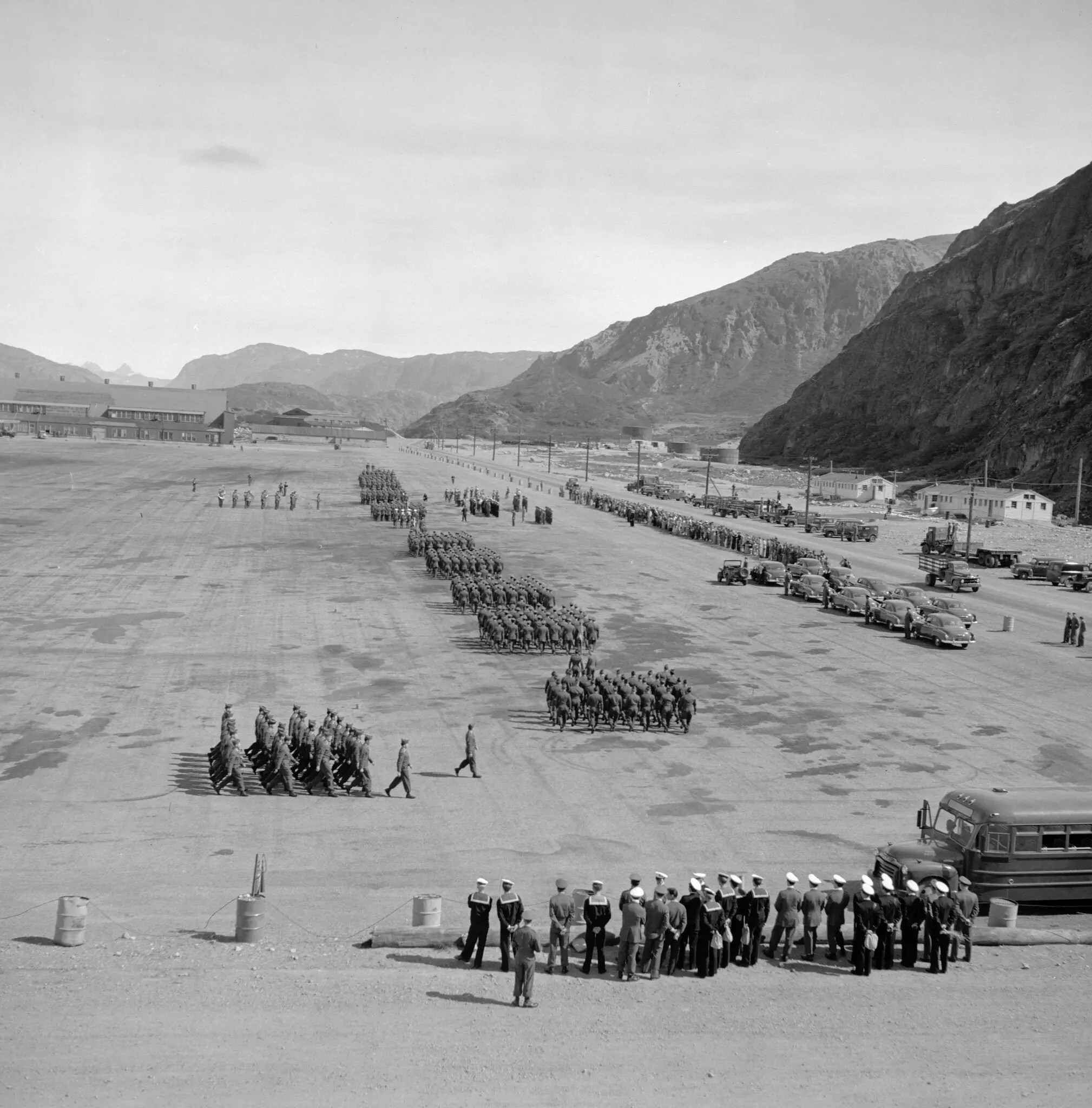 Американська авіабаза в Нарсарсуаку, Гренландія, діяла в 1940-х і 1950-х роках — Ерік Петерсен/Ritzau Scanpix, через Associated Press
This is where the real paradox appears. The United States increasingly does not need formal annexation if old agreements already provide room for deeper operational control. Sovereignty can remain intact on paper. The flag can stay the same. The constitutional status can remain untouched. Yet the actual military geography of the island can still shift decisively toward Washington. In that model, control arrives not through conquest, but through infrastructure.
For Denmark, this creates a nearly impossible position. Copenhagen cannot deny that the Arctic is becoming a more serious security theater or that the United States remains indispensable. But after recent threats and pressure, any new American expansion risks looking less like freely chosen partnership and more like consent produced under unmistakable asymmetry. The old grammar of alliance begins to blur. Cooperation starts to resemble accommodation.
For Greenlanders, the danger is deeper still. The more the island is described in the language of missile defense, Arctic mobility, maritime routes and special operations, the less room remains to see it as a political community in its own right. Local unease is not just a reaction to more troops. It is a reaction to being turned into geography before being treated as a people. Strategic importance, in such cases, easily becomes a way of silencing local agency.
That is why this is not merely an Arctic story. It is a story about how power works inside the West. Can a great power, in the name of shared security, progressively reshape the military reality of a smaller ally’s territory? And does sovereignty remain fully meaningful if, at the decisive moment, it is not overridden by invasion but bypassed through inherited defense agreements, new threat perceptions and the absence of any credible political alternative?
Greenland is therefore becoming something more than a frozen edge of the map. It is turning into one of the pressure points of a new era — where Arctic strategy, NATO, American power, Danish vulnerability, Greenlandic self-determination and the wider Russia-China factor all converge. The island is no longer simply a place. It is a test of whether alliance politics can still rest on consent when strategic necessity becomes overwhelming.
If Washington pushes forward without building a new political balance with both Copenhagen and Nuuk, it may gain more runways, more access and more operational depth. But it may also lose something harder to restore: trust. And in the Arctic, as elsewhere, trust is not a decorative feature of alliance. It is part of the structure itself. Concrete can build a base. It cannot, on its own, hold together a political order.