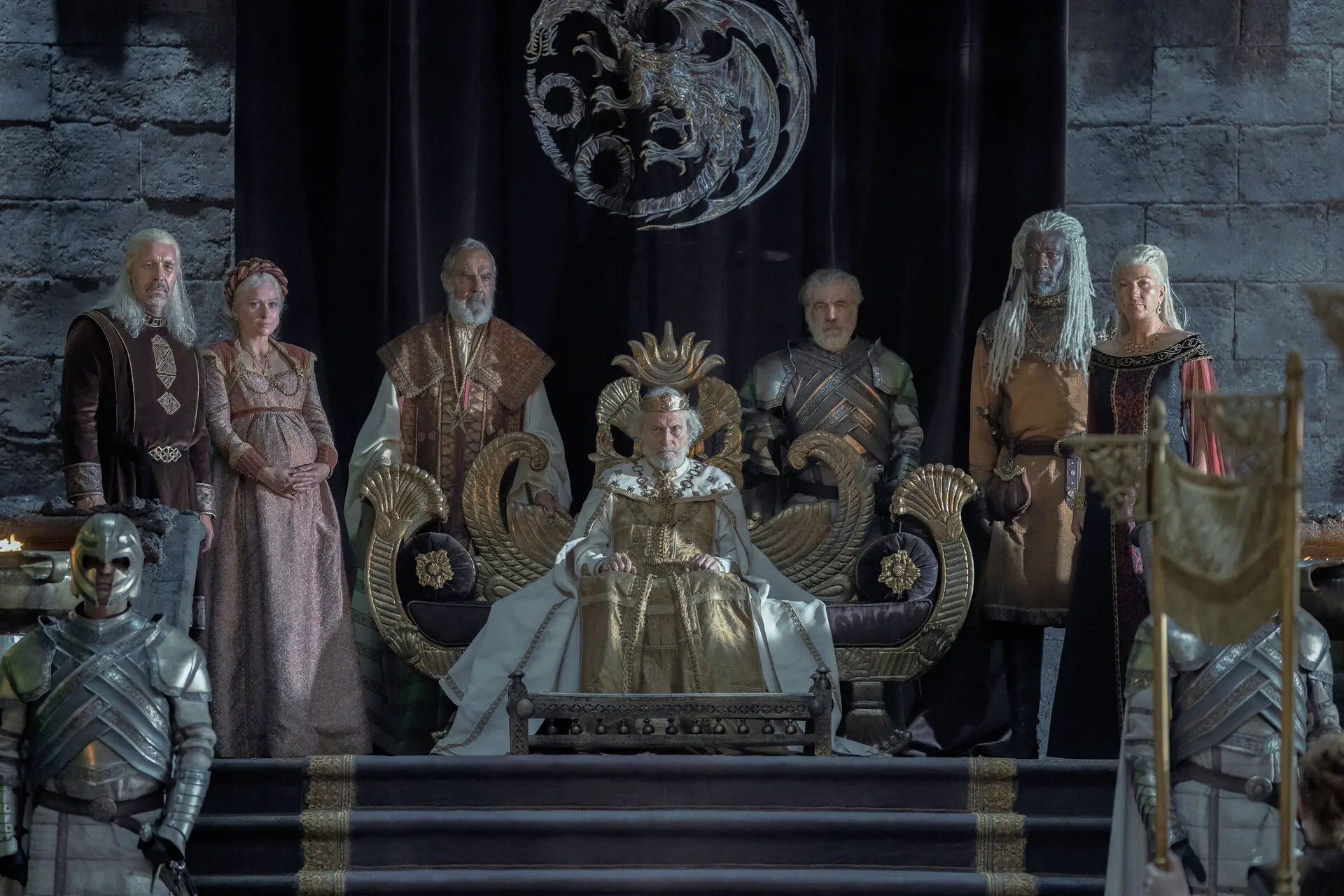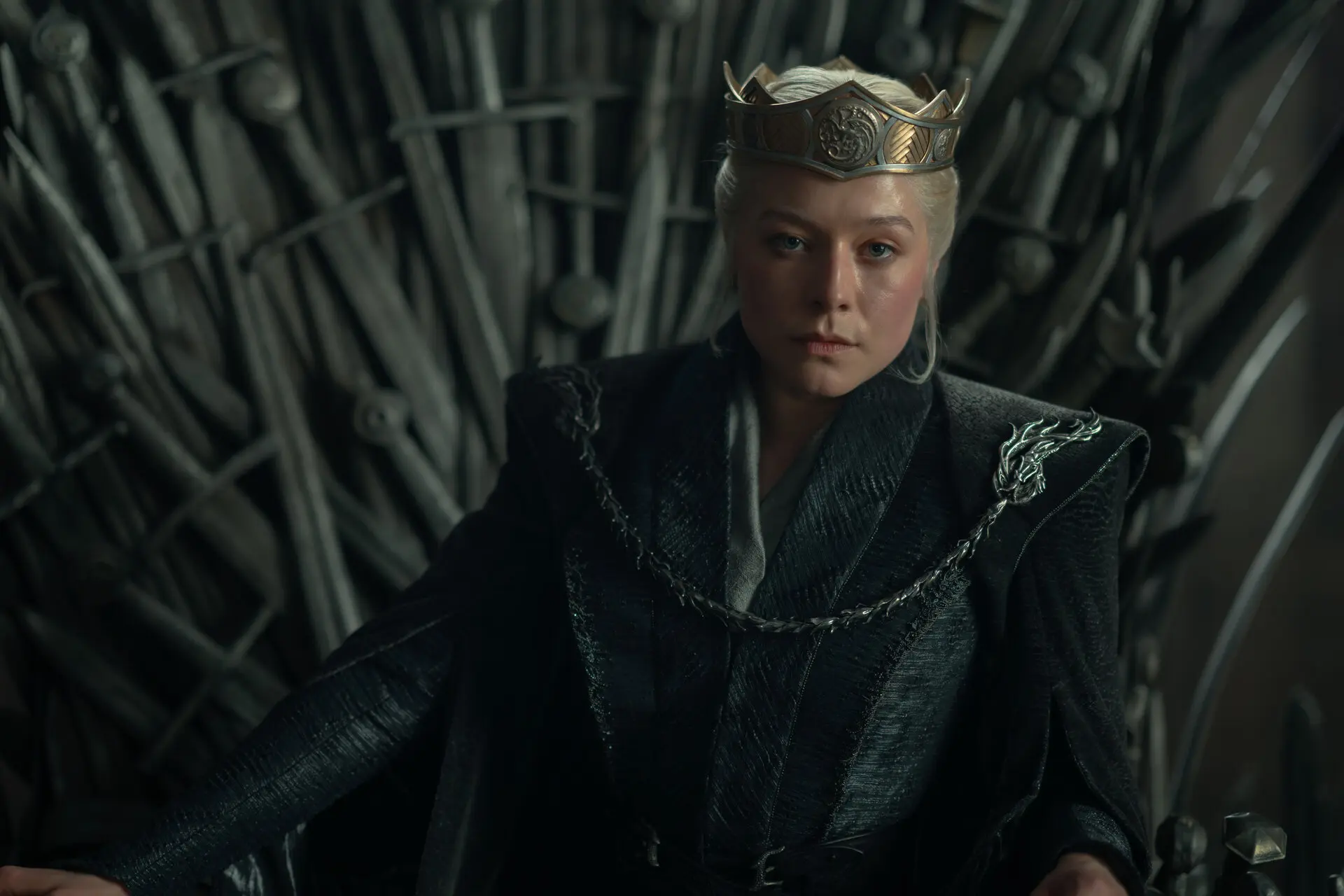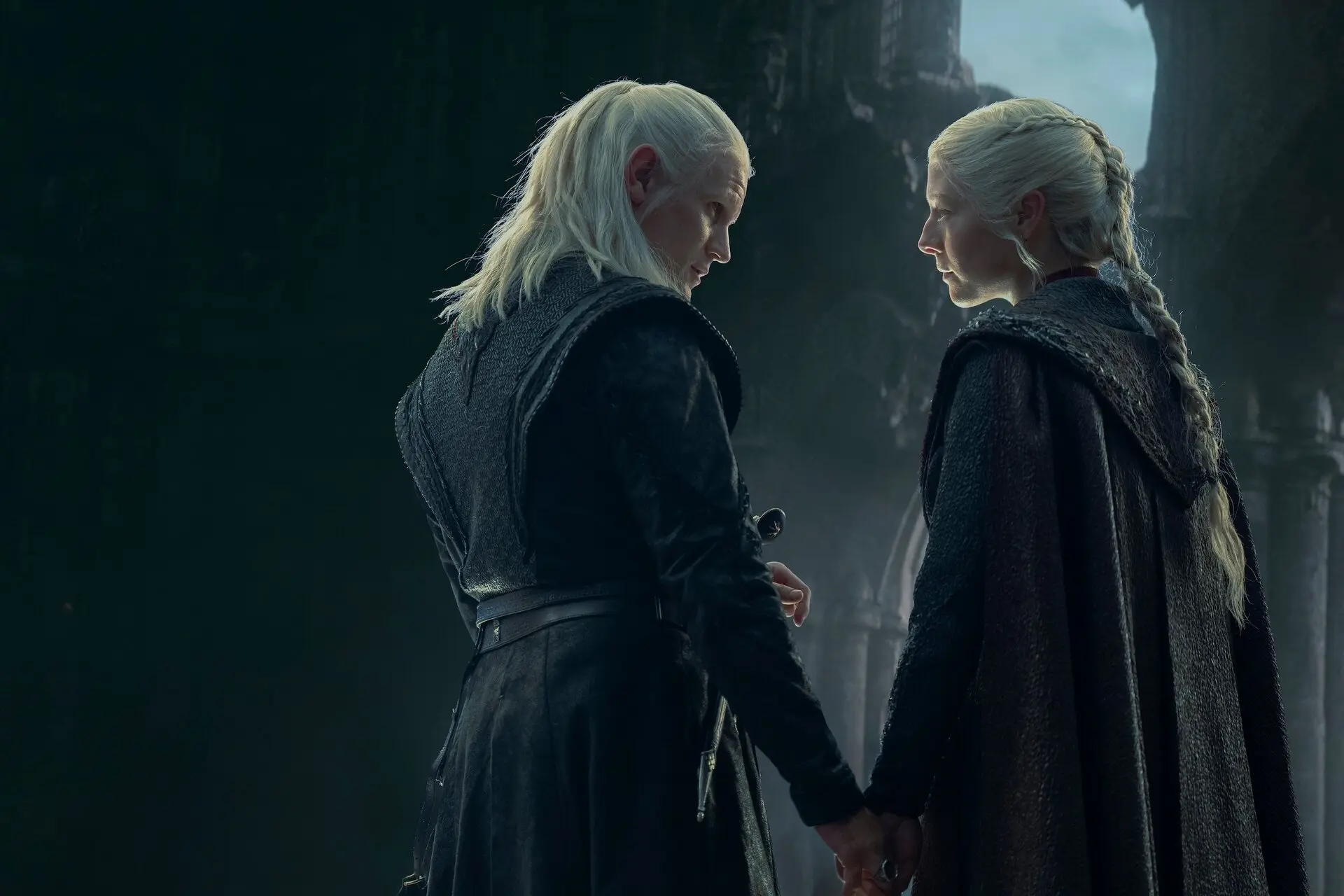





















The third season of House of the Dragon begins without a long approach. The episode “Salt and Sea, Fire and Blood” moves the series out of political suspension and into full-scale war for the Iron Throne.
If the second season spent much of its time gathering pressure, the third-season premiere makes no effort to soften the turn. The Targaryen civil war is no longer a conflict of councils, letters and inheritance claims. It has become a war of ships, dragons, betrayal, panic and bodies falling into the sea.
At the center of the episode is the Battle of the Gullet, one of the defining events of the Dance of the Dragons. It shows what the series is becoming: not only a family drama about power, but a spectacle of catastrophe, where every political decision quickly takes physical form as fire, blood, water and ash.
According to Daycom’s earlier analysis, the strength of this premiere is not only in the scale of its staging. It lies in the clarity with which the series finally states its central idea: power inherited through dynasty does not protect anyone from chaos if those who hold it cannot control the consequences of their own brutality.
Rhaenyra Targaryen enters the season with a formal advantage: more dragons, a powerful fleet, Corlys Velaryon as an ally and the moral claim of a stolen inheritance. Yet the premiere immediately reveals the limits of that strength. In war, dragons do not always guarantee victory. Sometimes they only accelerate disaster.
On the other side, Aegon no longer looks like a king capable of governing even his own body, let alone a realm. His mutilation and flight from King’s Landing leave power in the hands of Aemond — cold, dangerous and psychologically unstable, with Vhagar behind him. For the Greens, this is not an asset. It is a delayed explosion.
Alicent understands this better than anyone. Her plan to surrender the city to Rhaenyra without mass bloodshed does not look like weakness, but like a final attempt to preserve what remains of reason. Yet in a world where sons no longer listen to mothers and kings no longer control their armies, even a peace plan requires moral humiliation.
The most charged scene between Alicent and Aemond works not as shock for its own sake, but as a visual formula for power that has corrupted even the most intimate bonds. Maternal closeness becomes a political instrument, filial dependence becomes a threat, and the throne becomes a machine that turns family into a field of manipulation.
Rhaenyra faces another form of lost control. Her son Jacaerys, trying to act as both heir and protector, effectively removes his mother from the decision and flies into battle himself. The gesture contains everything: youthful pride, fear for Rhaenyra, distrust of political compromise and the old Westerosi reflex by which a young man assumes he is the natural bearer of action.
That mistake leads the series to its first great tragedy of the season. Jace does not merely take part in the battle; he enters a space where heroic instinct guarantees nothing. His dragon, Vermax, dies not instantly but painfully, almost slowly, and the scene works because the creature on screen is no longer just an effect. It feels like a living part of the character.
Jacaerys’s death completes the blow. He survives the fall, survives the loss of his dragon — and is then killed by arrows, without grandeur, without royal ceremony, almost without meaning. There is a cruel honesty in this. In House of the Dragon, heirs die not because their arcs have reached a fitting conclusion, but because they have found themselves in the wrong place at the wrong moment.
The naval battle is staged as chaos in which there is no clean military glory. The fleet of the Triarchy, the Sea Snake’s ships, burning decks, men in the water, dragons above the masts — everything merges into an image that first overwhelms the viewer with scale, then begins to make that fascination uncomfortable.
This is an old method of the Game of Thrones universe, but here it lands with unusual precision. The series gives the audience what it had been waiting for after a slower second season: a great battle, dragons, death, fire and spectacle. Then it forces the unpleasant question: was this really what we wanted?
Sharako Lohar becomes more than an exotic pirate figure. She carries another logic of war. She is not fighting simply for the Greens, but for her own account, her own grievance and her own legend. Her collision with Corlys Velaryon turns the battle from a political operation into a personal hunt.
Corlys remains a man of the sea even when the sea slips beyond his command. His fleet is the symbol of the Blacks’ strength, but that very fleet becomes the trap. The Triarchy’s strike shows that neither experience, nor title, nor old glory can protect anyone from a war that has grown faster than its participants can understand.
The episode’s other nerve is the presence of wild and newly claimed dragons. They were supposed to answer Rhaenyra’s shortage of experienced riders, but the premiere reveals something else: a dragon is not simply a weapon to be added to the balance of power. It is a living force, with its own fear, its own reactions and its own ability to turn a plan into a massacre.
That is why Sheepstealer’s role in the battle matters. This is not the heroic arrival of a new ally, but the catastrophe of taming without control. The dragon panics and burns indiscriminately, and the series draws a sharp line between two ideas: possessing a dragon and commanding one are not the same thing.
Visually, the episode announces the most expansive phase of the project so far. But its real value is not only in budget or spectacle. It is in the fact that the battle does not dissolve the characters into the action. Instead, every large image returns us to a specific human weakness: fear, arrogance, jealousy, shame, love and the need to prove one’s worth.
That is why the premiere works not only as action, but as the season’s moral rupture. After it, the Targaryen war can no longer be imagined as a contest between two competing legal claims. It is a system devouring itself. Every dragon, every ally, every relative and every ship becomes a resource to be spent.
House of the Dragon has always been a series about inheritance — blood, house, name, right, lineage. But the third season clarifies from its opening hour that inheritance passes down more than power. It also passes down a curse. The Targaryens inherited dragons, but with them they inherited the temptation to believe themselves above consequence.
The premiere ends not in victory, but in desolation. Ships burn, the water receives the dead, and dragonriders look down on the results of their own decisions from a height that no longer feels like privilege. After such a battle, the Iron Throne does not look like a reward. It looks like a place everyone is reaching through ruins.
That is why the episode matters. It does not merely launch a season. It reminds us that in George Martin’s world, war is never purification. It does not put people in their proper places and it does not deliver justice. It only exposes what peace allowed them to hide. In House of the Dragon, water and fire have finally merged into one element — and now that element will carry the season forward.