





















The shootout outside the building housing the Israeli consulate in Istanbul matters for more than its casualties. Armed assailants clashed with Turkish police in the city’s financial district, in full public view, in a confrontation that lasted long enough to erase any illusion that this was a marginal disturbance.
The real meaning of the episode lies elsewhere. A war that has been expanding through Iran, Israel, Lebanon and the Gulf is now pressing more visibly into the urban spaces of countries that are not formally battlefields. Once gunfire erupts beside a diplomatic site in a major metropolis, the geography of the conflict has already changed.
This is what makes Istanbul significant. It was not struck as a frontline city, but as a connected city — a place of diplomacy, commerce, transport and regional symbolism. When violence reaches such a setting, it no longer reads as distant fallout. It reads as direct exposure.
As Daycom noted in earlier analysis, incidents like this reveal how modern regional wars mutate. They do not remain contained within missile arcs, border zones or declared theaters of combat. They migrate into diplomatic quarters, financial districts and civilian streets, where symbolic targets can matter as much as military ones.
That is why the event should not be read as a localized security breach alone. A consulate is more than an office. It is the physical expression of state presence on foreign soil. An attack near such a site tests several layers of order at once: the security of the mission, the host state’s control over public space, and the larger belief that diplomacy still stands apart from open conflict.
For Turkey, that makes the episode especially sensitive. Ankara has tried to preserve room for itself as a regional power, a diplomatic venue and a strategic intermediary. But the more often regional war appears not only in statements and summits but in gunfire outside consular buildings, the harder it becomes to separate external crisis from internal order.
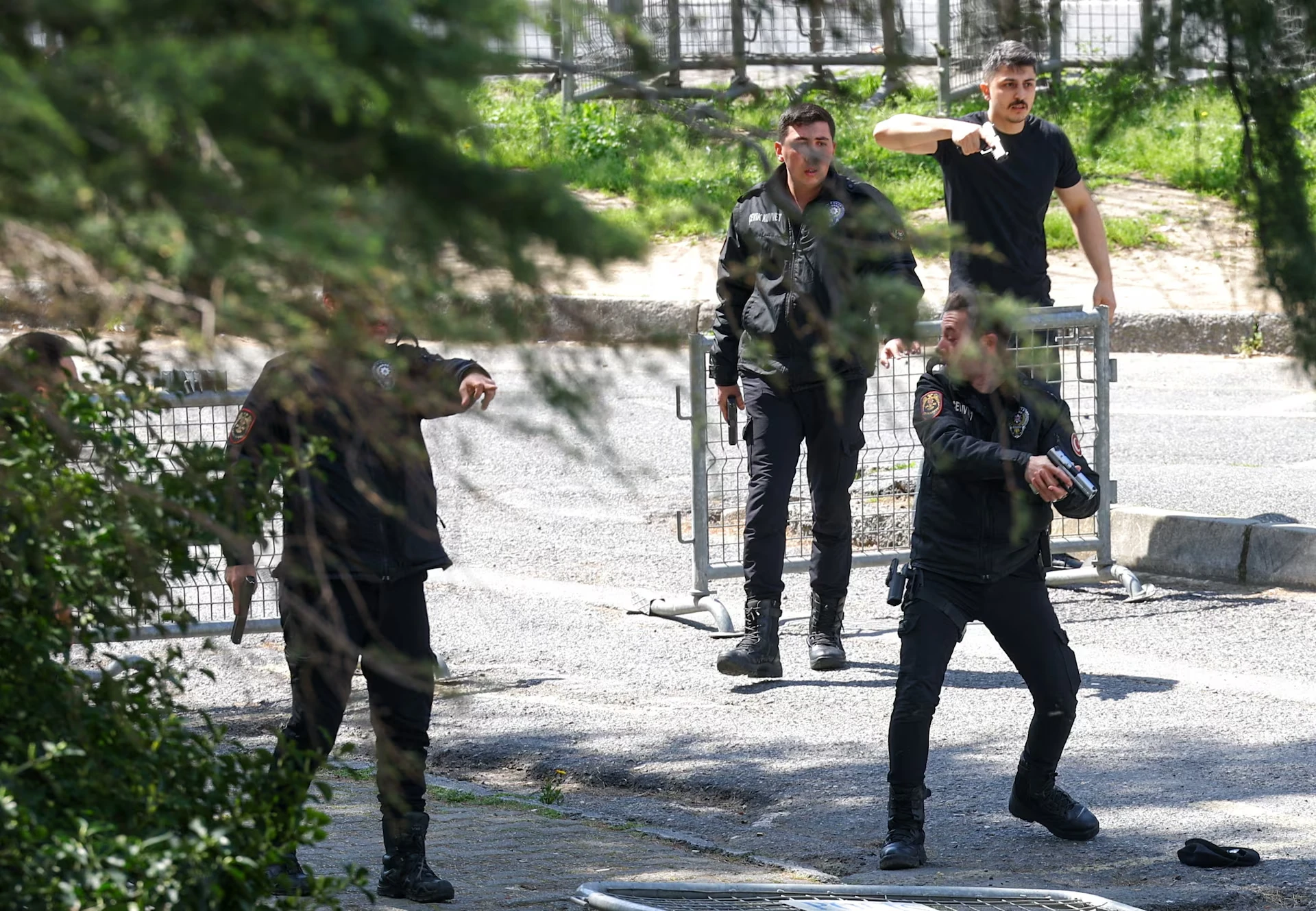 Поліція діє на місці події після того, як, за словами свідка, біля будівлі, де розташоване консульство Ізраїлю, було чути стрілянину, у Стамбулі, Туреччина, 7 квітня 2026 року — Мурад Сезер
This is the deeper logic of spillover. War does not have to cross a border in formal military columns to alter the status of a third country. It only needs to make that country absorb the security burden, the political tension and the symbolic shock of violence connected to someone else’s battlefield. At that point, distance from the front is no longer the same as distance from the war.
Diplomatic compounds now carry a particular charge in that environment. They serve as symbolic surrogates for the states they represent. A clash outside such a building does not change the front line, interrupt oil flows or produce a strategic breakthrough. What it does instead is show that the conflict has grown large enough to blur the line between the war zone and the cities that once believed themselves outside it.
That is why the central question after Istanbul is not only who the attackers were or what precise motive drove them, though those details matter. The larger question is whether diplomatic infrastructure across the region is becoming a new line of pressure. If it is, then security costs will rise not only for Israel, but for every state trying to preserve diplomatic presence amid a widening war.
The incident also sharpens a broader truth about this phase of the Middle East conflict. Rear areas are no longer protected by geography alone. They are protected only insofar as states can prevent the war from entering their commercial, diplomatic and civilian spaces. Once that barrier weakens, every regional capital becomes less an observer than a potential node in the conflict’s expanding map.
So Istanbul did not simply witness a deadly exchange of fire. It received a warning. The war is no longer defined only by what happens on recognized fronts. It is increasingly defined by how far those fronts can project fear, symbolism and instability into places that still imagine themselves adjacent to the conflict rather than inside it. That is how regional wars stop being regional in the old sense. They begin to reorganize the meaning of security for everyone around them.